GenRec: Towards LLM-Native Recommendation at Netflix
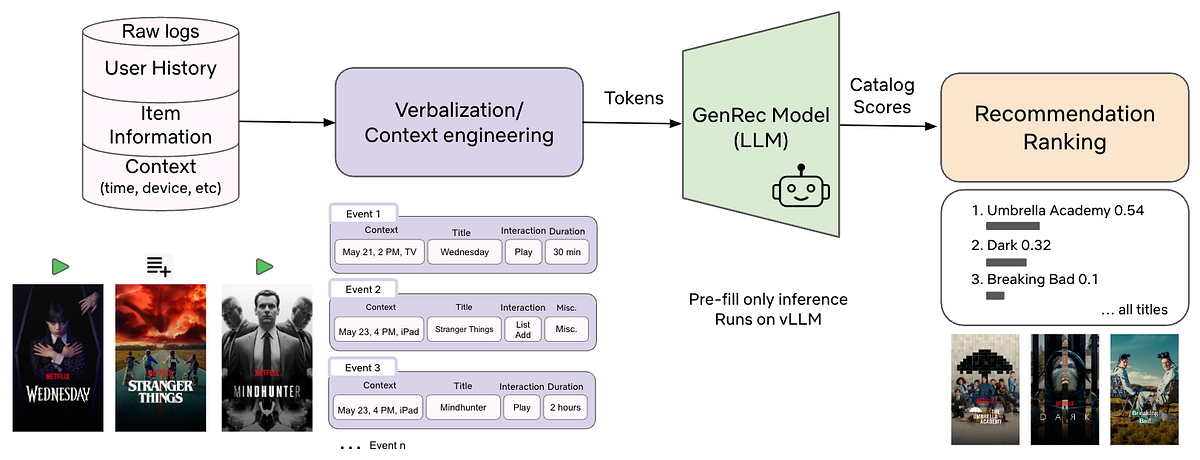
There's something deeply unsettling and thrilling about the idea that Netflix's recommendation system is becoming less like a librarian and more like a psychic. For years, these systems have been glorified statistical pattern-matchers—they see you watched Breaking Bad, so they suggest Ozark. But GenRec represents a leap into a stranger territory: a single model that has, in some sense, read every movie description, understood the narrative arcs, and can reason about why you, specifically, might love a quiet Norwegian drama about a reclusive pianist.
The team's core insight is almost philosophical: instead of treating recommendation as a separate task bolted onto a language model, they make the language model itself the recommender. This is the "LLM-native" part—it's not a chatbot with a recommendation plugin; it's a model whose fundamental training objective is recommendation. The implications are wild. Imagine an LLM that doesn't just predict your next click but could, in theory, explain why it's recommending something, weaving a narrative justification that feels almost human. It's a recommendation system with a theory of mind.
But here's where it gets properly weird: if the model is trained end-to-end on user behavior, it's not just learning your taste—it's learning the shape of taste itself. It becomes a mirror reflecting not just what you watch, but how you think about stories. Netflix isn't just predicting your next show; they're building a model that understands the grammar of human desire, at least as it manifests in viewing habits. The source article hints at efficiency gains and the elegance of a unified architecture, but the deeper story is about the blurring line between "understanding language" and "understanding humans."
Of course, there's a shadow side. A model that understands narrative desire this well is a model that can manipulate it with terrifying precision. The same architecture that suggests your next favorite show could be fine-tuned to keep you glued to the screen past 2 AM. We're handing our narrative psyche to a corporate algorithm and asking it to know us better than we know ourselves. It's not malevolent—it's just efficient. And that's the weirdest part: the tool that recommends your comfort shows might soon understand the reason you need comfort, and that's a level of intimacy we've never had with a machine.