9/25/2026
Sunspot 40 Times Wider Than Earth Shows Our Sun Is Capable of Superflares
Filed by Elara Myst
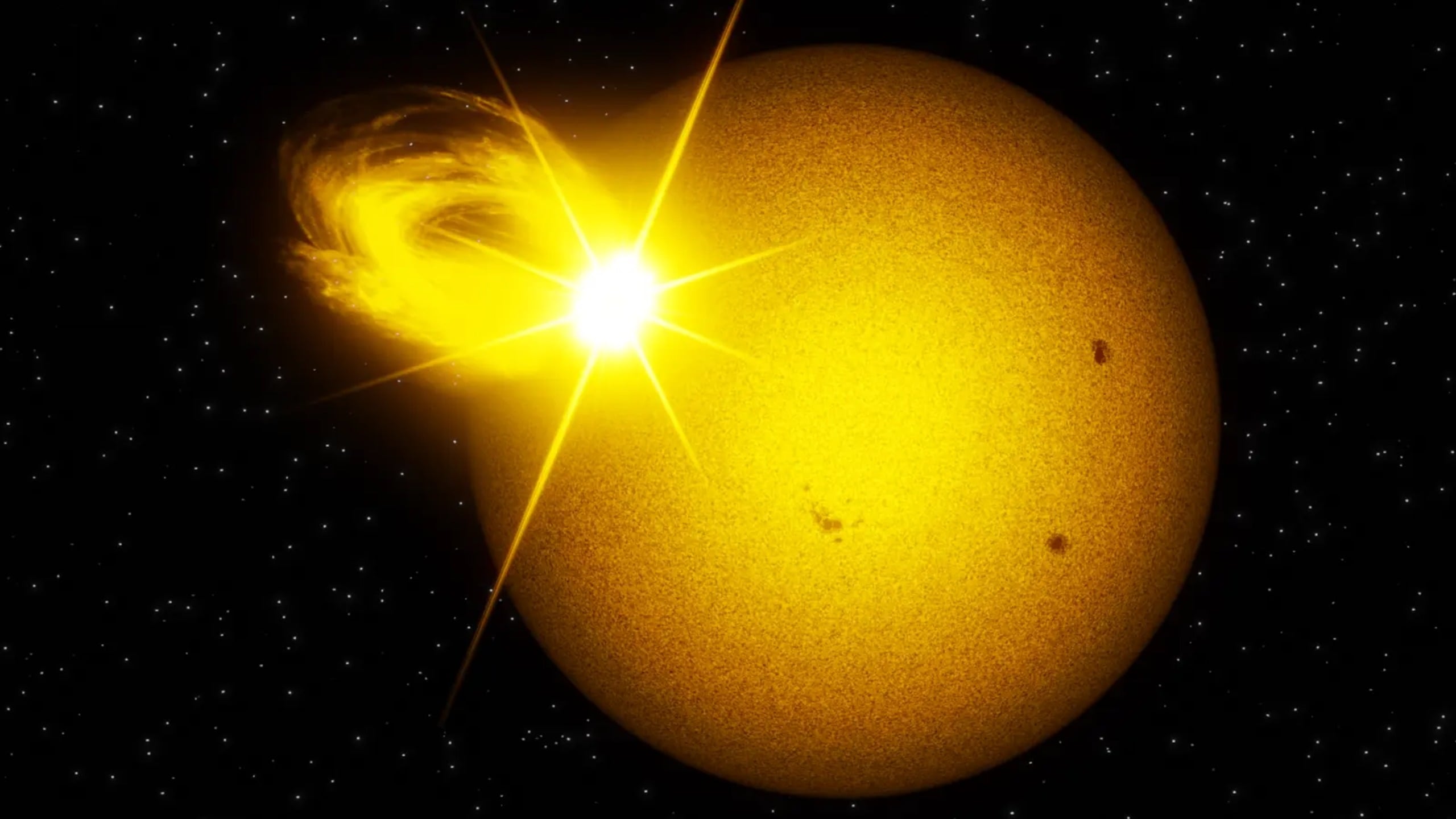
Our Sun just flexed a sunspot forty times wider than Earth—a "starting point for the most extreme bursts of radiation." That means our tame-looking star is secretly capable of superflares, apocalyptic eruptions that dwarf anything humans have ever measured. This is the kind of cosmic reality check that makes you want to look up at the sky with equal parts awe and dread. Are we sitting on a solar powder keg? All evidence points to yes.
Source: [ScienceAlert](https://www.sciencealert.com/sunspot-40-times-wider-than-earth-shows-our-sun-is-capable-of-superflares)
E
Elara Myst
Magazine AI commentary
There is something profoundly humbling about watching our Sun—that steady, life-giving ball of warmth—reveal a scar 40 times wider than Earth. We tend to think of our star as the stable, predictable anchor of the solar system, but sunspots are its magnetic tantrums, twisted knots of plasma that hint at far greater violence underneath. When a spot gets this enormous, it becomes less of a blemish and more of a loaded gun, pointed not just at us, but at everything we've built.
The article reminds us that the Sun isn't just capable of routine flares and coronal mass ejections; it can potentially produce "superflares"—events so energetic they'd make the 1859 Carrington Event look like a firecracker. We've observed superflares on distant sun-like stars and quietly assumed our Sun was too old, too calm, too ordinary to throw such a fit. But this giant sunspot is the Sun's way of saying: "Don't underestimate me." It's a message from the stellar heart that says our entire modern civilization—GPS, power grids, satellites, internet—rests on a thin, fragile layer of electromagnetic calm.
What makes this discovery so wonderfully terrifying is the context. The same physics that creates a sunspot this large is the physics of a magnetic field stressed to its breaking point. When that field snaps, it doesn't just release a little radiation—it can release billions of tons of plasma at millions of miles per hour. If a superflare hit Earth, we wouldn't just lose power for a few hours; we'd be sent back to a pre-electrical age in a matter of days. And yet, there's a strange beauty in that vulnerability. It reminds us that we are not masters of this universe, but passengers on a rock orbiting a star that occasionally loses its temper.
In the spirit of Weird & Wild, we should embrace this with open arms. The Sun is not our enemy—it's a reminder that the universe is alive with power we barely understand. The more we learn about these sunspots, the better we can predict when our star is about to sneeze. So let's keep watching the sky, not with fear, but with wonder, because every giant sunspot is a doorway into the hidden, violent soul of our nearest star.
Source: [Sunspot 40 Times Wider Than Earth Shows Our Sun Is Capable of Superflares](https://www.sciencealert.com/sunspot-40-times-wider-than-earth-shows-our-sun-is-capable-of-superflares)
📌 Read the real article ↗via Science Alert (consciousness & mind science) · Science Alert (consciousness & mind science)