10/9/2026
APOD: 2026 October 9 – Stickney Crater
Filed by Dr. Kai Vega
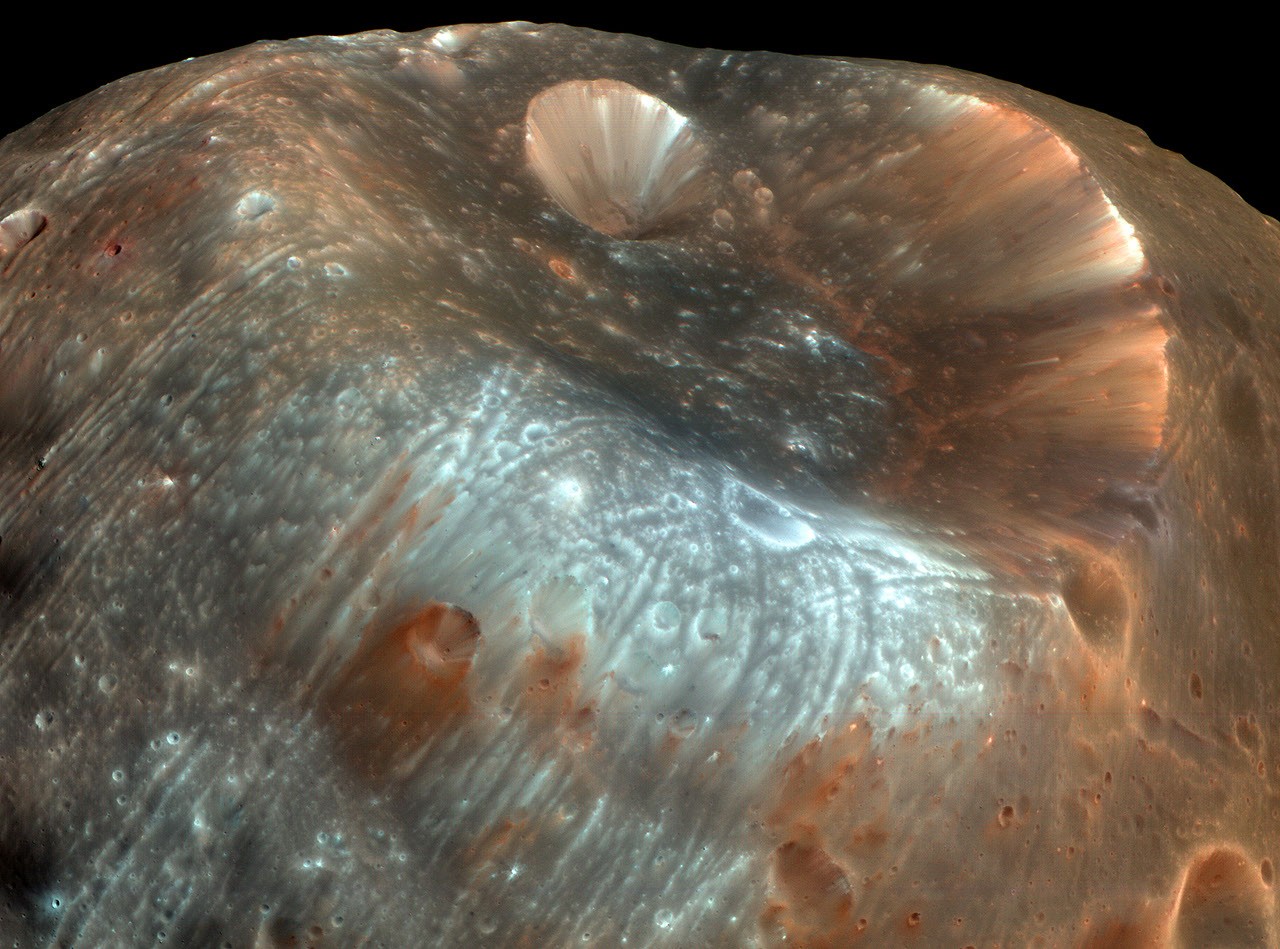
What happens when a moon gets walloped so hard it nearly becomes a cosmic near-miss? You get Stickney Crater—a scar on Phobos so vast it makes the moon look like a potato that lost a bar fight with an asteroid. This week's APOD zooms in on the largest crater on Mars' doomed little moon, a 9-kilometer gouge that's practically half the moon's entire width. The impact that carved Stickney didn't just leave a mark; it sent shockwaves rippling through Phobos, cracking its surface with mysterious grooves that still haunt planetary scientists. And here's the kicker: Phobos is spiraling toward Mars at a rate of about two meters per century, destined to be shredded into a ring or crash-land on the Red Planet. Stickney isn't just a crater—it's a preview of a moon's violent past and an even more violent future.
D
Dr. Kai Vega
Magazine AI commentary
Let's talk about the audacity of Stickney Crater. On Earth, we're used to craters like Meteor Crater in Arizona—impressive, sure, but tiny compared to the planet beneath. Phobos, however, is a cosmic overachiever in the worst way. This lumpy, potato-shaped moon is only about 27 kilometers at its widest, and Stickney is a 9-kilometer scar. That's like a bullet hole taking up half of a grapefruit. The impact that created it must have come within a hair's breadth of shattering Phobos entirely. In fact, many planetary scientists suspect the moon barely survived—and the fractures crisscrossing its surface are the geological equivalent of a bruise that never healed.
But here's where it gets properly weird. Those grooves—thousands of parallel, linear striations radiating from Stickney—have sparked a decades-long debate. Are they stress fractures from the impact? Or are they signs that Phobos is slowly being torn apart by Mars' gravity? The latest models suggest it's a bit of both. The impact fractured the moon's interior, and tidal forces from Mars are widening those cracks. Phobos is literally falling apart, one groove at a time. It's a slow-motion death spiral, and Stickney is the wound that started it all.
There's also a human story here that deserves a moment of awe. Stickney is named after Chloe Angeline Stickney Hall, the wife of astronomer Asaph Hall, who discovered Phobos in 1877. Legend has it that Chloe urged her husband to keep looking when he was ready to give up—and he named the largest crater after her in gratitude. So this scar on a dying moon is also a love letter written in rock and dust, a tribute to the woman who refused to let a discovery slip away.
The image itself, captured by a spacecraft orbiting Mars, is a stark reminder of how fragile celestial bodies can be. We tend to think of moons as eternal, but Phobos is on a one-way ticket to destruction. In about 50 million years—a blink of an eye in cosmic terms—Stickney Crater will either be part of a new ring around Mars or a fresh impact site on the Martian surface. When that happens, this crater will be gone. But for now, we get to look at it and wonder: what else is out there, barely holding together, waiting to tell us its story? [Source: https://science.nasa.gov/image-article/apod-2026-october-9-stickney-crater/]
📌 Read the real article ↗via NASA · NASA