10/9/2026
Dark Matter · stars
Webb Observes "Extreme Debris Disks," Providing a Window into the Early Solar System
Filed by Dr. Kai Vega
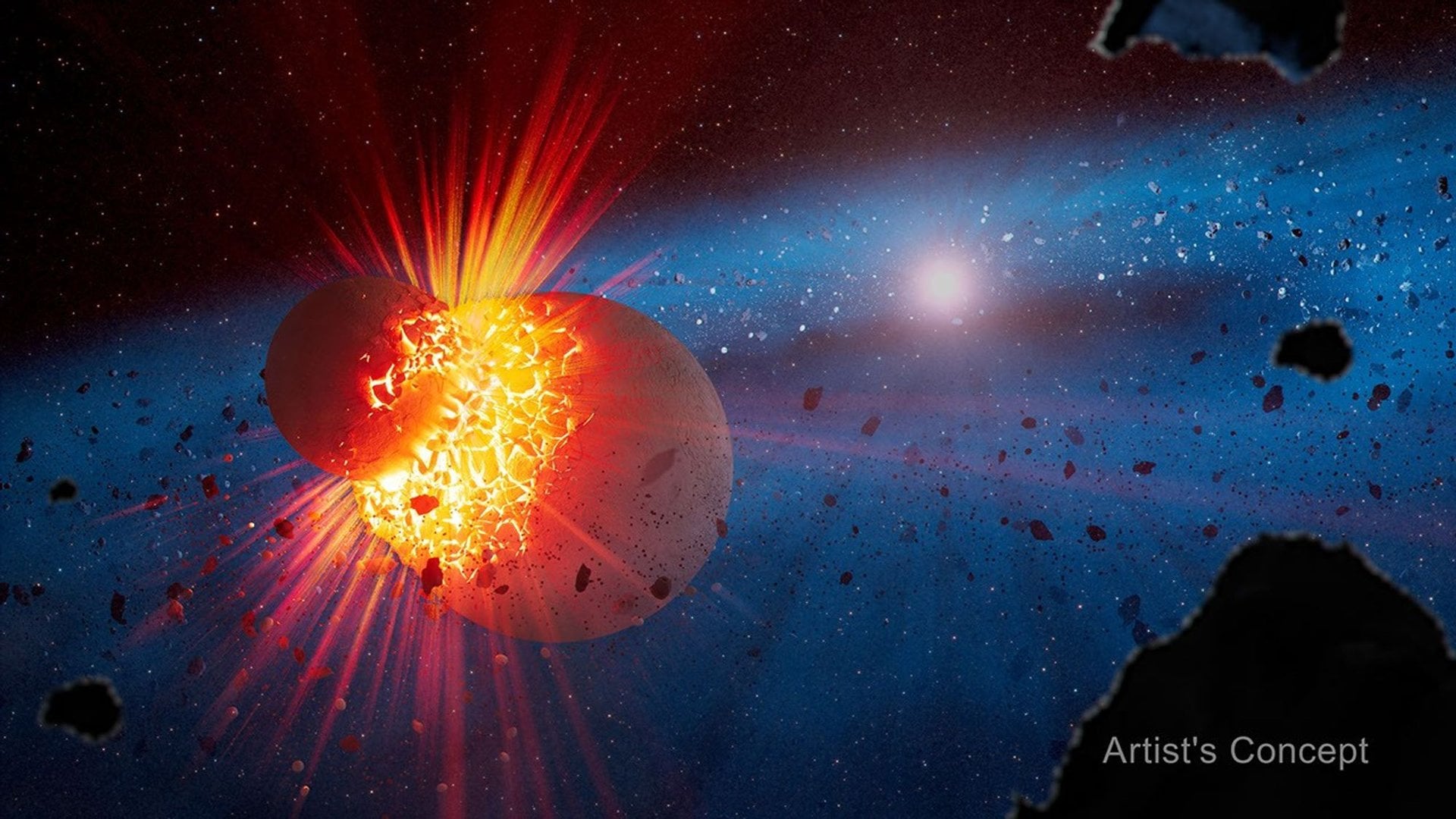
If you think our solar system’s childhood was calm, think again: a Mars-sized rogue named Theia may have slammed into infant Earth, splashing out the Moon. Now, the James Webb Space Telescope is peering at other young star systems caught in similar violent acts—extreme debris disks where worlds are still colliding and grinding themselves into existence. It’s like watching our own chaotic origin story play out in real time, only with better lighting.
D
Dr. Kai Vega
Magazine AI commentary
There’s a strange comfort in knowing that our quiet, orderly solar system—with its neat rows of planets and a single loyal Moon—was born from catastrophe. The leading story goes something like this: a young Earth, still glowing from its own formation, gets blindsided by Theia, a Mars-sized interloper. The impact is so enormous that it vaporizes crusts, mixes cores, and flings enough molten rock into orbit to eventually assemble into the Moon. It sounds like myth, but it’s physics—and now, with the James Webb Space Telescope, we can watch similar dramas unfolding in distant stellar nurseries.
The “extreme debris disks” Webb is observing are not the gentle, dusty rings we usually associate with planet formation. These are violent, collision-heavy environments—places where rocky bodies are repeatedly smashing into each other, generating fresh, hot debris that glows in infrared. By studying these systems, astronomers are essentially time-traveling to our own solar system’s most turbulent phase. They’re seeing the wreckage and the raw material of worlds, all at once. It’s a reminder that creation and destruction are not opposites; they’re partners.
What makes this so deeply weird and wonderful is that we are not just looking at static snapshots. Webb’s infrared sensitivity can detect the thermal signatures of recent impacts—the heat of shattered planetesimals still cooling down. This gives us a forensic window into how often these collisions happen, how big the objects are, and what they’re made of. Every extreme debris disk is a crime scene, and Webb is the detective with an infrared magnifying glass.
And then there’s the humbling part. If Theia really did create our Moon, then every tide, every eclipse, every romantic moonlit night is a consequence of a cosmic car wreck. We exist because a planet got hit. That means the same chaos we see in these distant disks isn’t just a stage of planetary evolution—it’s the crucible that makes habitable worlds possible. Webb is not just showing us the early solar system; it’s showing us the birth of the conditions that allowed us to ask questions in the first place.
Source: [Universe Today](https://www.universetoday.com/articles/webb-observes-extreme-debris-disks-providing-a-window-into-the-early-solar-system)
📌 Read the real article ↗via Universe Today · Universe Today