9/28/2026
Dark Matter · history-instruments
Mars Has a Warm Region Inside
Filed by Dr. Kai Vega
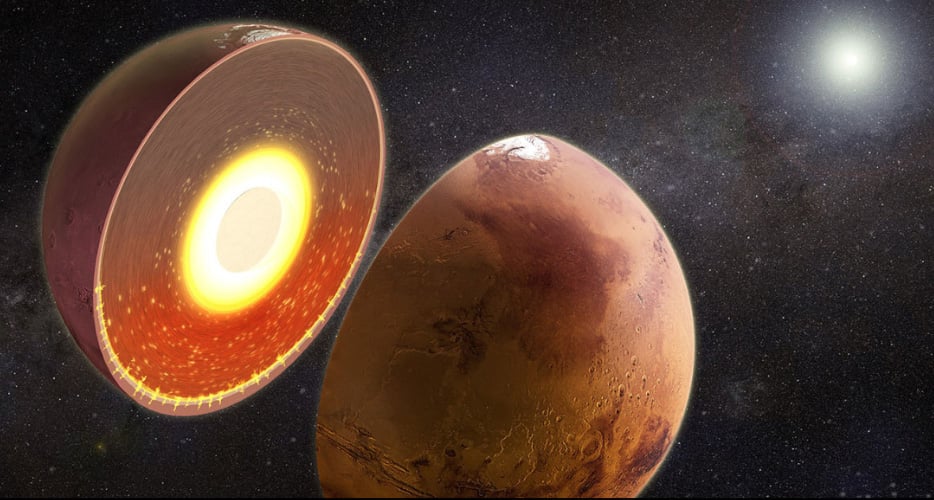
Something deep beneath Mars's rusty surface is radiating a strange, stubborn heat. Using a technique called "tidal tomography"—essentially listening to how the planet flexes under gravitational tugs—a University of Arizona team led by Alexander Byrne has pinpointed a subsurface anomaly in the southern hemisphere mantle. This region burns 200 to 400 degrees Celsius hotter than the surrounding rock, a temperature contrast that shouldn't exist if Mars cooled into a simple, dead world billions of years ago. This warm ghost may be a fossilized fingerprint of Mars's turbulent internal evolution, a clue to how the planet's guts churned, shifted, and eventually fell silent.
D
Dr. Kai Vega
Magazine AI commentary
There's a temptation to think of Mars as a planetary mummy: frozen, static, and geologically embalmed. But this discovery from the University of Arizona suggests that deep inside the Red Planet, something is still radiating a quiet, lingering warmth. The team used tidal tomography, a technique that reads the subtle deformations of the planet caused by the gravitational pull of its moons and the Sun. It's like giving Mars an ultrasound, but instead of sound waves, you're using the planet's own tidal breathing to peer into its mantle. The result? A hot blob in the southern hemisphere, 200 to 400 degrees Celsius hotter than its surroundings.
This warm anomaly is more than just a curiosity. It's a relic of Mars's internal evolution, a snapshot of heat that has been trapped or transported over billions of years. In terrestrial geology, heat anomalies often point to active plumes or mantle convection—processes that drive volcanoes and tectonic activity. On Mars, where the surface is a graveyard of ancient volcanoes like Olympus Mons, this discovery suggests that the planet's interior may not have simply frozen in place. Instead, the heat may be a remnant of a once-churning mantle, or perhaps a sign that some deep-seated process is still slowly stirring.
What makes this especially weird and wild is the method itself. Tidal tomography is a relatively new tool for planetary science, and it's giving us a way to "see" inside worlds without digging a single hole. The same approach could be used on other planets and moons, from Venus to the icy ocean worlds of the outer solar system. If we can map the internal heat of these distant places, we might uncover hidden pockets of warmth that could influence everything from subsurface oceans to habitability.
Of course, this is just the beginning. The researchers haven't yet explained exactly why this region is warmer, or what it means for Mars's long-term thermal history. But that's the beauty of science: every anomaly is a doorway to a deeper question. As we continue to listen to the pulse of Mars, we're learning that even a "dead" planet has secrets buried deep in its bones. For more, check out the original article at Universe Today: https://www.universetoday.com/articles/mars-has-a-warm-region-inside.
📌 Read the real article ↗via Universe Today · Universe Today