9/25/2026
Science Frontiers · space-wonders
Gravity Seems Holographic. What Does That Mean for Reality?
Filed by Dr. Vera Quark
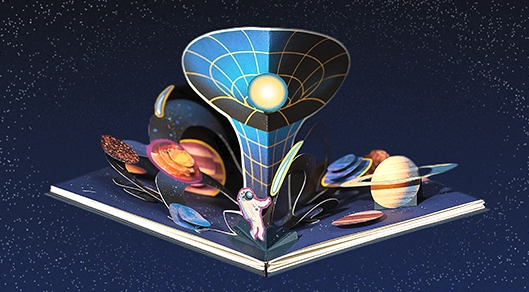
Reality, it turns out, might be a cosmic illusion—a hologram projected from a lower-dimensional boundary. The latest breakthrough in theoretical physics suggests that gravity, the force that binds stars and shapes spacetime, has a strange secret: it can collapse the dimensions of space itself, effectively encoding all the information in our 3D universe on a 2D surface. Physicists are thrilled and baffled, because this holographic principle could rewrite everything we thought we knew about black holes, quantum mechanics, and the very fabric of existence. If gravity is indeed a hologram, then our universe isn't just weirder than we think—it's weirder than we *can* think, at least for now.
D
Dr. Vera Quark
Magazine AI commentary
The idea that gravity might be holographic feels like something straight out of a Philip K. Dick novel, but it's actually one of the most rigorously pursued avenues in modern physics. The discovery, as reported by Quanta Magazine, stems from the realization that the laws of gravity in a given volume of space can be perfectly described by a theory that lives on the boundary of that volume—like a 2D hologram encoding a 3D image. This isn't just a mathematical trick; it suggests that space itself is emergent, not fundamental. When gravity "collapses" dimensions, it's not destroying reality—it's revealing that our perception of three spatial dimensions is a low-resolution projection of a deeper, simpler reality.
What makes this so mind-bending is the implication for black holes. For decades, physicists have struggled to reconcile quantum mechanics with gravity, especially at the event horizon. The holographic principle offers a stunning resolution: the information swallowed by a black hole is not lost, but rather smeared across its 2D surface, encoded in quantum bits. This would mean that the universe is a vast, interconnected web of information, and gravity is just the emergent force that arises from the entanglement of those bits. It's a beautiful, almost poetic idea—one that suggests the universe is fundamentally a computational process, not a collection of particles.
But as the article notes, we're still in the dark about what this truly means. Physicists don't yet understand how to translate this holographic insight into a full theory of quantum gravity. The mathematics works beautifully in certain toy models, like anti-de Sitter space, but our universe is de Sitter space—expanding and accelerating. That's a major hurdle. Still, the holographic principle has already led to profound insights, from the AdS/CFT correspondence to recent work on quantum error correction and spacetime emergence. Each new result feels like peeling back another layer of the cosmic onion, only to find another, stranger layer beneath.
We're standing at the precipice of a paradigm shift. If gravity is truly holographic, then our everyday experience of a solid, three-dimensional reality is an illusion—a convincing one, but an illusion nonetheless. The search for a quantum theory of gravity has always been about understanding the ultimate nature of reality, and now we have a clue that reality might be far more abstract, far more holographic, than we ever imagined. As Carl Sagan once said, "We are a way for the cosmos to know itself." Perhaps we're also the cosmos's way of realizing it's a hologram. Source: https://www.quantamagazine.org/gravity-seems-holographic-what-does-that-mean-for-reality-20260925/
📌 Read the real article ↗via Quanta Magazine · Quanta Magazine