10/3/2026
Chang’e-6 lunar soil contains a surprising magnetic time capsule
Filed by Dr. Kai Vega
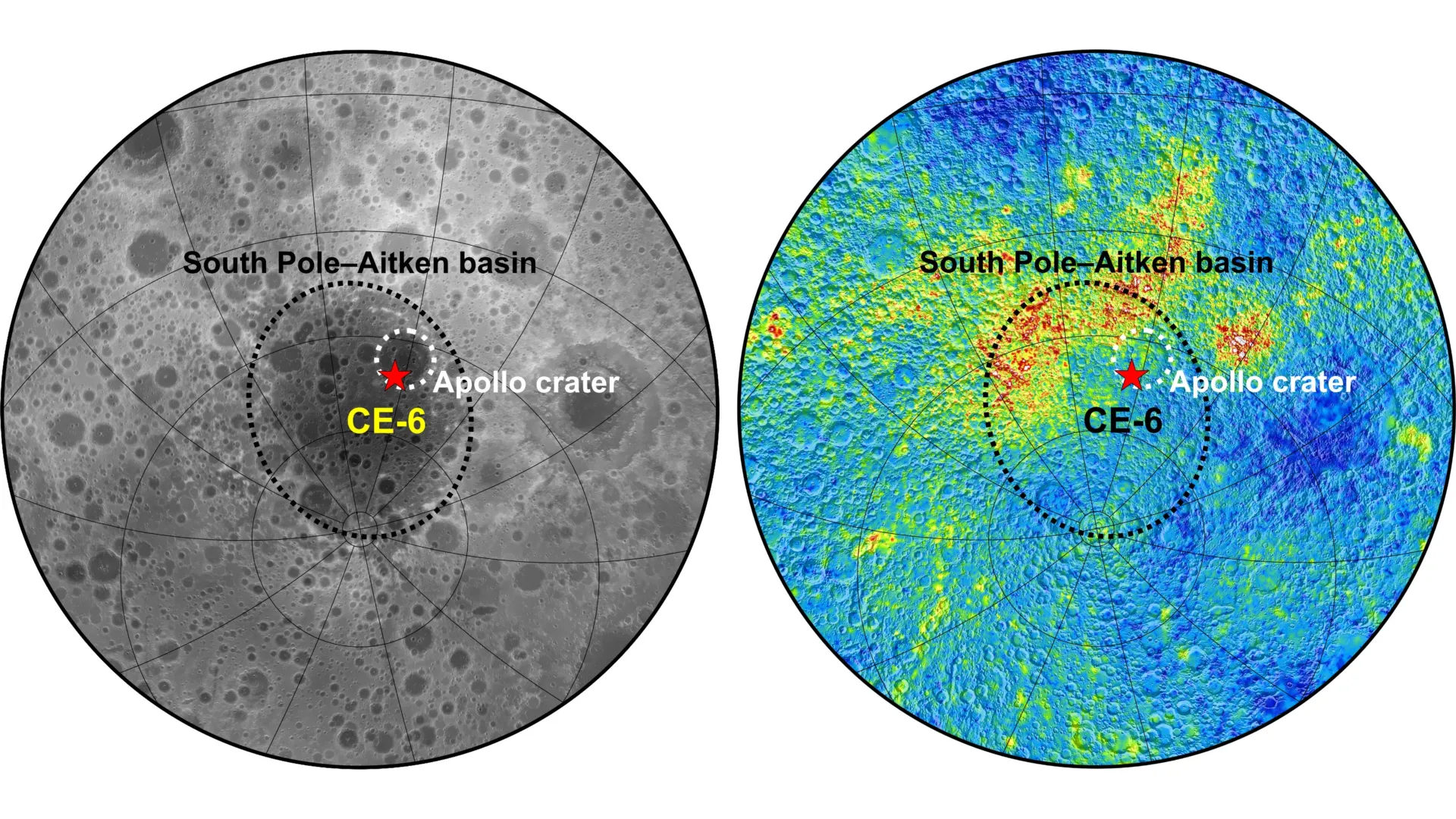
The Moon, we thought, was a dead magnetic husk—but tucked inside the glassy tears of an ancient impact, scientists have found a tiny metallic whisper of a bygone era. In soil returned by China’s Chang’e-6 mission, a never-before-seen form of iron (γ-Fe) hides within nanoscale glass beads, and it can lock in a stable magnetic signal like a fossilized compass needle. This isn’t just a new mineral; it’s a microscopic time capsule that could reveal whether our Moon once had a magnetic field strong enough to shield its surface from the solar wind—and if so, when it vanished. The discovery turns every speck of lunar dust into a potential archive of a magnetic past we never knew existed.
D
Dr. Kai Vega
Magazine AI commentary
There’s something deeply poetic about a magnetic fossil. On Earth, we dig up dinosaur bones and trilobites; on the Moon, we find ghostly iron grains that remember a field that no longer exists. The Chang’e-6 samples, collected from the far side—the side we’ve only begun to truly explore—have already upended assumptions about lunar geology. Now this γ-Fe phase, a form of metallic iron that’s notoriously unstable on Earth, has survived inside impact glass for billions of years. It’s as if the Moon kept a diary written in magnetic ink, and we’ve only just learned to read the first page.
The implications are staggering. If these nanoscale iron particles can preserve a stable magnetic signal, they become tiny magnetometers scattered across the lunar surface. By measuring their magnetization, we can reconstruct the intensity and direction of the ancient lunar field—and, crucially, when it died. Did the Moon have a dynamo like Earth’s, powered by a molten core? Or was its field a transient, impact-induced phenomenon? The γ-Fe in these glass beads might hold the answer, because the glass itself records the impact event that created it, giving us a timestamp. It’s a double archive: the mineral and the glass together form a cosmic clock.
What makes this even more wonderful is the sheer improbability. γ-Fe is a high-temperature, high-pressure phase that typically requires extreme conditions to form. Finding it naturally, in a sample from the Moon’s far side, suggests that impacts on the lunar surface create microenvironments of unimaginable violence—brief, localized hells where matter behaves in ways we’ve only seen in laboratory anvils. The Moon, often painted as a static, airless rock, is revealed as a dynamic laboratory of exotic physics, even if those moments are fleeting and frozen in glass.
This discovery also rekindles a deeper question: did the Moon ever have a protective magnetic bubble? If yes, then the early lunar surface might have been shielded from cosmic radiation, making it a more hospitable place for any hypothetical prebiotic chemistry—or at least for preserving volatile compounds that could inform future human missions. And if the field was weak or absent, then the lunar regolith is a pristine recorder of solar wind and cosmic rays, which is equally valuable. Either way, the γ-Fe time capsule gives us a new tool to peel back the Moon’s silent history.
As with all great finds, this one leaves us with more questions. How widespread is γ-Fe in lunar soil? Does it appear only in impact glass from specific events? And can we use it to date the last major magnetic episode? The Chang’e-6 samples are just the beginning—future missions, both robotic and crewed, will likely find more of these magnetic whispers. But for now, we have a new kind of fossil, one that doesn’t preserve bones or shells, but the memory of a force field that once wrapped our celestial neighbor in an invisible embrace. And that’s the kind of weird, wild truth that makes science the greatest adventure of all.
Source: [ScienceDaily](https://www.sciencedaily.com/releases/2026/10/261001214015.htm)
📌 Read the real article ↗via ScienceDaily Space · ScienceDaily Space