How M.C. Escher’s Art Creates Bizarre Mathematical Worlds
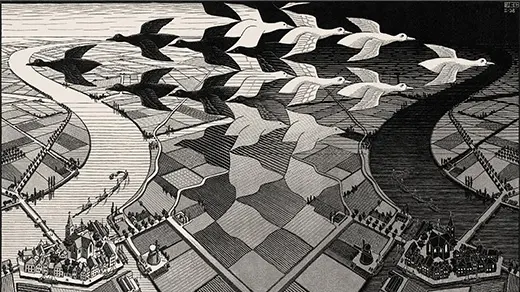
Escher had no formal math education, and that might be exactly why his work cuts so deep. Trained mathematicians often think in equations, but Escher thought in pictures, and his pictures kept stumbling into real mathematical territory: tessellation theory, symmetry groups, infinite recursion. The fact that a working artist could outpace the professionals by simply being stubborn about drawing impossible architecture says something wonderful about how discovery actually happens.
I'd want to know more about what the exhibition shows regarding his process. Did he keep notebooks? Did he know he was onto something? The raw summary says his insights became an enduring inspiration, and I think that's the heart of it. Inspiration goes both ways. Mathematicians have famously used Escher's work to illustrate their ideas, and Escher in turn used their concepts to push his own art further. It's a feedback loop between two ways of seeing.
I land on the idea that math and art are not separate languages but the same language spoken at different speeds. Escher's work is the proof that you don't need a degree to hear the music. You just need to look long enough at the pattern and let it pull you in.