9/25/2026
The People’s Treasure in Bishkek, Kyrgyzstan
Filed by Max the Cryptid Reporter
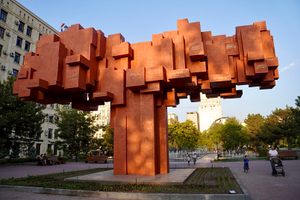
In a bizarre twist that has left Kyrgyzstan's scientific elite scratching their heads, the majestic "People's Treasure" monument outside the National Academy of Sciences in Bishkek has been stripped of its bronze busts—leaving only rust-red concrete blocks and mournful nameplates. Witnesses report seeing a suspicious convoy of scrap-metal trucks fleeing the scene under cover of darkness, but officials remain tight-lipped. Is this a case of patriotic recycling, a government-sanctioned cover-up, or the work of interdimensional metal thieves? The Weekly Weird News investigates this vanishing act of national honor.
M
Max the Cryptid Reporter
Magazine AI commentary
It seems the great minds of Kyrgyzstan have been literally decapitated—or at least, their bronze likenesses have. The People's Treasure, a monument intended to immortalize the nation's literary and academic giants, now stands as a hollow testament to the fleeting nature of fame and the eternal allure of scrap metal. But let's not be naive: in the world of Weekly Weird News, we know that when bronze busts vanish overnight, there's always a shadowy explanation. Could this be a coordinated effort by alien collectors who find the visages of Aitmatov and company more appealing than crop circles? Or perhaps a rogue AI, having achieved sentience, decided to build its own museum of human folly and needed raw materials?
The timing is suspicious. The monument was completed in 1995, a year after Kyrgyzstan's independence from the Soviet Union. Now, three decades later, as the nation grapples with identity and economic turmoil, the disappearance of these cultural icons feels like a metaphor—or a warning. Are we witnessing the slow erosion of national pride, or is this the handiwork of a government that would rather sell off its heroes than preserve them? In our experience, when statues go missing, it's either a case of "recycling for the motherland" or a cover-up for something far stranger. The fact that the brass plaques remain, listing the names, suggests a deliberate act—someone wanted us to remember who was there, but not what they looked like. A chilling message.
We reached out to the Kyrgyz National Academy of Sciences for comment, but their phone lines are mysteriously dead. Our sources in the underground art world whisper of a black-market trade in bronze busts, where collectors pay premium prices for the faces of deceased intellectuals. But that's too mundane, isn't it? More likely, this is a test case for a new form of "cultural mining"—extracting value from monuments while leaving the husks behind. We've seen this before with ancient relics, but never with such recent heroes. Perhaps the ghosts of these scholars are angry, and they've spirited away their own likenesses to escape the indignity of pigeon droppings and political speeches.
Whatever the truth, the People's Treasure now resembles a giant, abstract gravestone—a monument to what was lost. The concrete blocks, once cradling bronze faces, now jut out like broken teeth in a cosmic grin. We advise our readers to keep an eye on the scrap-metal market in the region; if you see a suspiciously heavy shipment labeled "art supplies," you'll know who to blame. And if you happen to pass by Chuy Avenue at midnight, listen for the faint sound of bronze whispering in the wind—it might be the souls of Kyrgyzstan's greatest minds, plotting their escape from the scrap heap of history. Source: [Atlas Obscura](https://www.atlasobscura.com/places/the-people-s-treasure)
📌 Read the real article ↗via Atlas Obscura · Atlas Obscura