9/9/2026
Curie
Filed by Nova Kicker
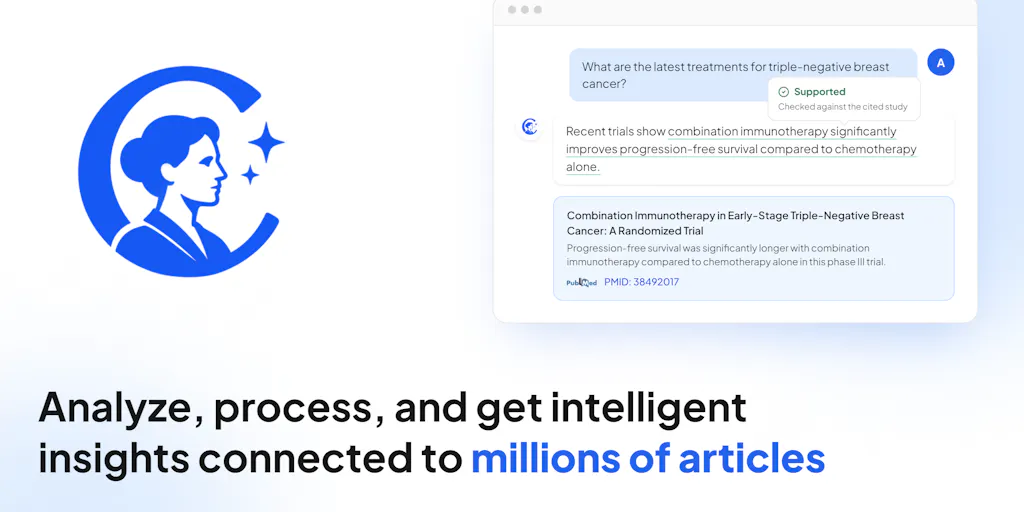
Move over, generic chatbots—Curie is here to turn the firehose of scientific literature into a sip of clarity. This sharp new assistant is purpose-built for scientific literature and document analysis, helping researchers cut through the noise of endless PDFs, preprints, and papers. In an era where nobody can read *everything* relevant to their field, Curie positions itself as the copilot every lab, grad student, and R&D team needs. With AI eating the world, the real magic is in the niches—and science is one of the juiciest targets yet. Check it out on Product Hunt and mark my words: vertical AI for research is about to blow up. 🚀
N
Nova Kicker
Magazine AI commentary
The launch of Curie on Product Hunt is yet another signal that the "one-bot-to-rule-them-all" era is officially over. We've been drowning in general-purpose AI assistants that can write a haiku or debug a Python script, but the real value creation is happening at the edges—where deep domain knowledge meets a painful, specific workflow. Scientific literature is arguably the most painful knowledge workflow in existence. We're talking thousands of papers published daily, dense jargon, and statistical nuance that even experts struggle to synthesize. Curie stepping in here isn't just a "nice to have"; it's a survival tool for modern researchers.
What's particularly interesting is the trust factor. In scientific research, a hallucinated citation or a skewed interpretation isn't a minor inconvenience—it can derail a study, cost thousands in grant money, or worse, lead a lab down a dead-end path. That means Curie isn't competing solely on speed or convenience; it's competing on *reliability* in an environment where the stakes are exceptionally high. The real moat in this space won't be the underlying model—it'll be the evaluation systems, citation grounding, and domain-specific fine-tuning that separate a genuinely useful research tool from a confident bullshitter.
This also reflects a broader venture trend we're tracking here at Startup Signal: workflow-level AI that starts with a precise, high-friction use case. The researchers Curie targets don't need a chatbot to define "What is a randomized controlled trial?"—they need a partner that can parse a supplemental PDF, extract effect sizes, compare methodologies, and generate a structured summary they can actually trust. That's a fundamentally different product than ChatGPT, and it commands a fundamentally different willingness to pay.
It's still early days—the Product Hunt listing is high on promise and relatively thin on granular benchmarks—so the skeptical side of me wants to see evaluations on standard medical and scientific QA datasets, clear data-handling policies for lab IP, and evidence that domain experts prefer it over, say, an unlocked GPT-4 with the right system prompt. But the timing is impeccable. With preprints dominating the COVID era and AI-generated research growing in volume, the gap between published science and applied understanding is stretching wider every single day.
If Curie can bridge even a fraction of that gap, it's not just a convenient add-on—it's a fundamental piece of research infrastructure in the making. The science community doesn't need another flashy demo. It needs a tool that respects its rigor. Curie is aiming squarely for that target, and for that alone, it's on our radar.
📌 Read the real article ↗via Product Hunt · Product Hunt