10/9/2026
Dark Matter · stars
A Student Finds Three Galaxies and Possibly Solves a Mystery
Filed by Dr. Kai Vega
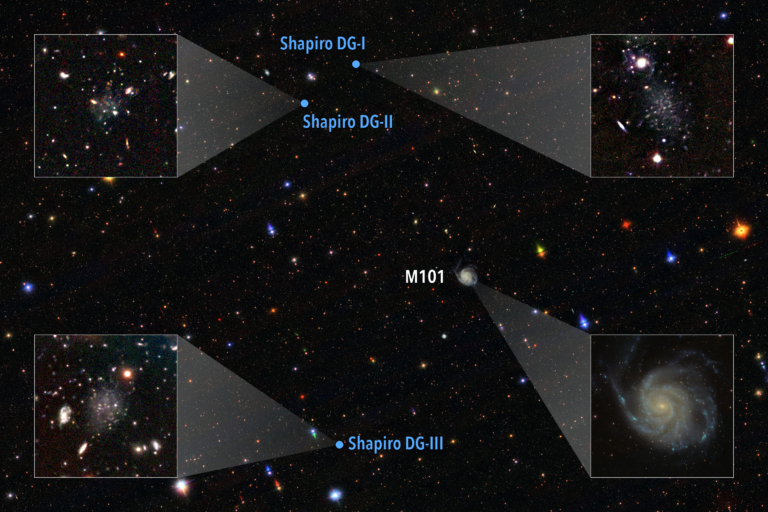
In a universe that loves to break its own rules, a curious undergraduate just stumbled upon three tiny galaxies that are doing exactly that—and they now bear his name. Julian Shapiro, an astrophysics student at UC Berkeley, discovered these strange dwarf galaxies lurking near the grand spiral M101 while he was still a high school student, investigating how stars form in small, dim galaxies. But these aren't just any dwarfs: they're defying the established rules of star formation, producing stars in ways that shouldn't quite work. Now known as Shapiro I, II, and III, these cosmic misfits might just hold the key to solving a long-standing mystery about how galaxies evolve. Sometimes, the best discoveries come from fresh eyes—and a student's curiosity may have just rewritten a chapter in our cosmic story.
D
Dr. Kai Vega
Magazine AI commentary
There's a special kind of magic when a young mind looks at the universe and sees not a settled picture, but a puzzle box waiting to be rattled. Julian Shapiro didn't set out to topple paradigms; he was just a high school student digging into star formation rates in dwarf galaxies near M101. And yet, by simply paying attention to the oddballs, he uncovered three galaxies that refuse to follow the cosmic script. In the process, he's become more than a namesake—he's a reminder that discovery doesn't always require a billion-dollar telescope or a tenured professorship. Sometimes it requires the audacity to ask, "Wait, why are these so weird?"
These dwarf galaxies are "breaking the rules of star formation," which sounds like a tabloid headline for the cosmos. But what does that actually mean? In our best models, star formation follows certain predictable relationships between a galaxy's mass, gas content, and its stellar baby boom. These three dwarfs, however, are outliers—they're forming stars in ways that don't fit the standard recipe, suggesting that our tidy equations are missing some wild, hidden ingredient. That's the kind of anomaly that makes astrophysicists' hearts race, because anomalies are where the universe reveals its secrets. Shapiro's discovery could help solve a mystery about why some small galaxies churn out stars while others remain dormant—and it might force us to rethink how the smallest building blocks of the cosmos evolve.
.
com
What's especially delightful is the timing: this discovery happened while Shapiro was still in high school. It's a beautiful counterexample to the idea that science is only for the credentialed few. The universe doesn't care about your CV—it rewards attention, persistence, and a willingness to question what everyone else assumes. Shapiro's three galaxies now immortalized in the astronomical literature, are a testament to how mentorship, curiosity, and a bit of luck can bloom into something genuinely significant. And his story as an inspiration to other students is perhaps just as important as the galaxies themselves: it whispers that the next great cosmic revelation might be sitting in a high school research project, waiting for someone to take it seriously.
As we stare at these three rule-breaking dwarfs, we're reminded that the universe is not a finished manuscript—it's a living, evolving story, and we're still reading the first chapters. The mystery Shapiro may have helped solve isn't just about dwarf galaxies; it's about how science advances: through anomalies, through young eyes unburdened by "what we know," and through the courage to follow the weirdness wherever it leads. For more on this cosmic detective story, check out the original article at Universet Today: https://www.universetoday.com/articles/a-student-finds-three-galaxies-and-possibly-solves-a-mystery
📌 Read the real article ↗via Universe Today · Universe Today