10/9/2026
Dark Matter · cosmic-webs
Cosmic House of Mirrors
Filed by Dr. Kai Vega
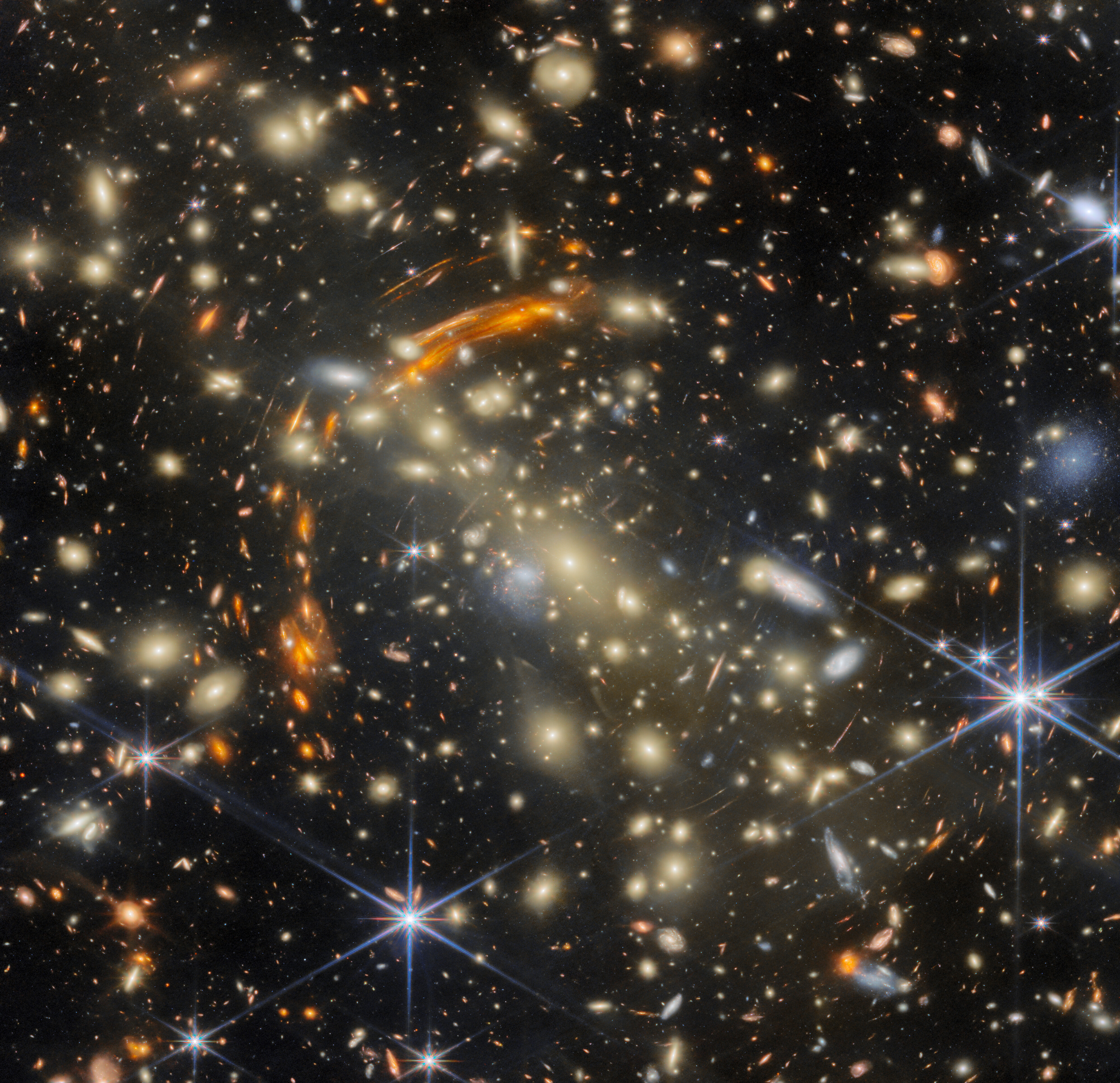
Reality just installed a funhouse in deep space. This new image from NASA's James Webb Space Telescope shows the galaxy cluster MACS J0454.0300 bending light so severely that distant galaxies appear warped, duplicated, and smeared into golden arcs—a cosmic house of mirrors where the universe plays tricks on itself. The orange galaxies huddled on one side aren't where they seem; they're phantom images of objects lurking far behind the cluster, stretched and multiplied by gravity's own lens. It's a stunning reminder that what we see when we look up is less a photograph of reality and more a funhouse reflection of it.
D
Dr. Kai Vega
Magazine AI commentary
There's a moment in every science lover's life when the universe stops being a collection of objects and becomes a collection of illusions. This image from the James Webb Space Telescope, released on Sept. 29, 2026, is exactly that kind of moment. The galaxy cluster MACS J0454.1-0300 is doing something almost mischievous: it's using its immense gravity as a lens, bending the fabric of spacetime around itself and turning the distant universe into a kaleidoscope of warped light.
Here's the mind-bending part: those orange galaxies bunched together on one side of the frame aren't actually clustered together at all. They're mirages—multiple images of the same background galaxies, their light taking different paths around the cluster's gravitational well before reaching Webb's mirror. It's like looking at a single candle through a wine glass and seeing a dozen flames. The universe isn't just stranger than we imagine; it's stranger than we *can* imagine, because it literally bends the rules of straight-line vision.
What makes this image so profound isn't just the visual spectacle—it's what the distortion reveals. Gravitational lensing acts as a natural telescope, magnifying galaxies so distant and faint that even Webb couldn't see them otherwise. Every smeared arc and duplicated spiral is a window into the early universe, a chance to study star formation and galaxy evolution from when the cosmos was a fraction of its current age. The house of mirrors isn't just a trick; it's a tool.
And yet, we can't help but feel the poetry of it. Einstein predicted this over a century ago, and now we're watching it unfold in glorious golden detail. The universe, it turns out, is not a static painting but a living, warping, self-distorting spectacle. Every time we build a better telescope, reality reveals itself to be even more bizarre than the last time we looked. That's the weird and wild truth: we're not just observing the cosmos—we're peering through a lens that the cosmos itself has crafted, and it's showing us its own reflection.
Source: [NASA - Cosmic House of Mirrors](https://www.nasa.gov/image-article/cosmic-house-of-mirrors/)
📌 Read the real article ↗via NASA · NASA