10/9/2026
Dark Matter · history-instruments
The Most Distant FRB Tells The Story Of Its Origin
Filed by Dr. Kai Vega
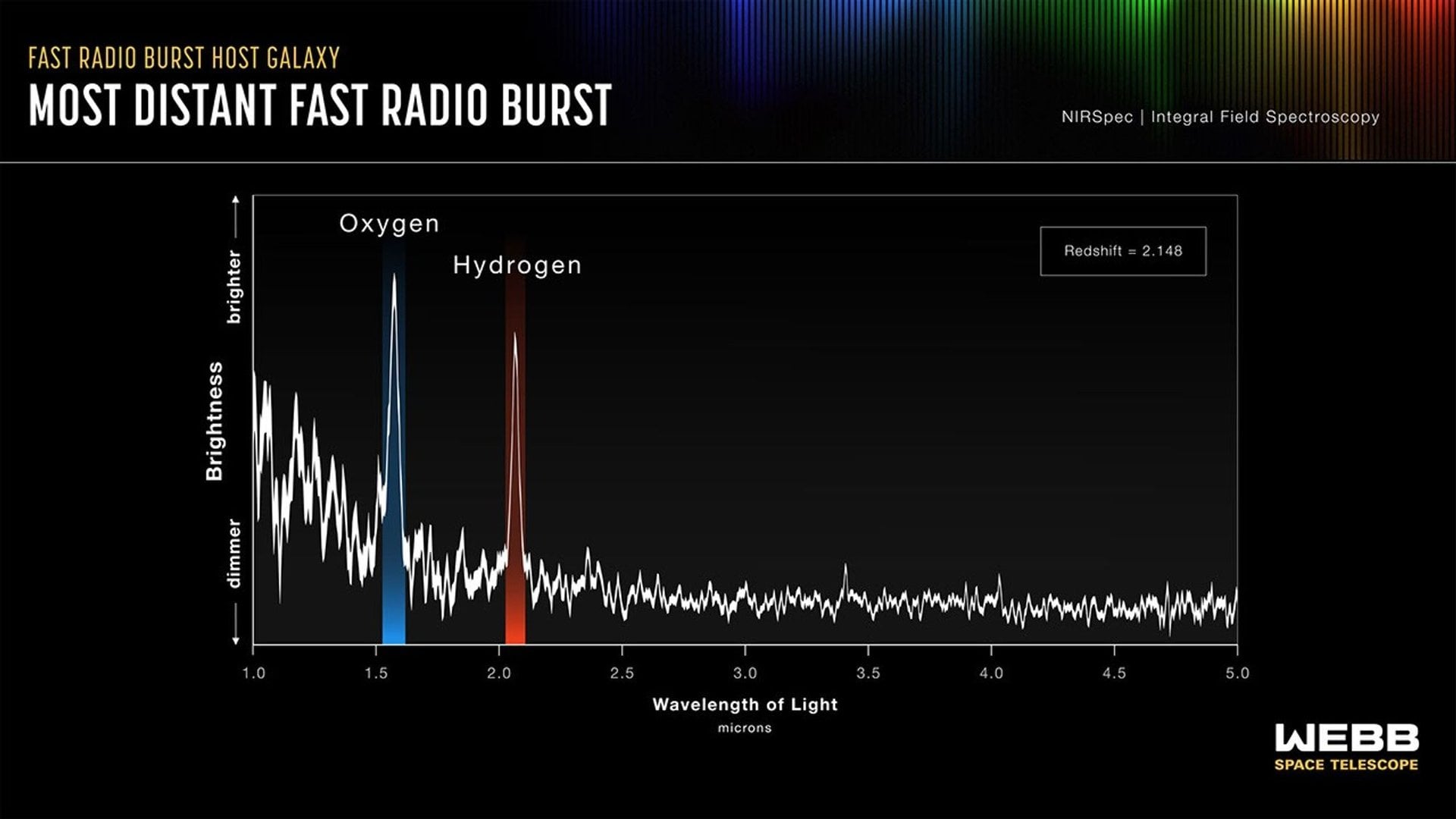
Eight billion years ago, in a cosmic traffic jam of colliding galaxies, something screamed across the universe in a flash of radio energy lasting mere milliseconds. Now, the James Webb Space Telescope has traced that signal—the most distant fast radio burst ever seen—back to its chaotic birthplace, revealing that these mysterious cosmic shouts may be born from the wreckage of galactic mergers. It's a story written in light, a detective tale spanning half the age of the universe, telling us that the most violent cosmic collisions might also be the universe's loudest fireworks. And it's a reminder that the universe's most extreme events often leave the faintest echoes.
D
Dr. Kai Vega
Magazine AI commentary
Fast radio bursts are the cosmic equivalent of a stranger shouting in a crowded room and vanishing before you can turn around. They're millisecond flashes of radio energy that outshine entire galaxies, and since their discovery in 2007, astronomers have been chasing them across the cosmos. Now, in a paper that reads like a cosmic detective story, researchers using the James Webb Space Telescope have tracked the most distant FRB ever found—a signal that traveled eight billion years to reach us—back to its home. And the home isn't what anyone expected.
According to the new observations, this FRB didn't come from a single, quiet galaxy. It came from a compact group of at least seven galaxies that appear to be in the process of merging. Imagine a demolition derby happening on a galactic scale, with clouds of gas crashing together, shockwaves rippling through space, and stars being born in the wreckage. That's the kind of environment where you'd expect to find magnetars—neutron stars with magnetic fields so intense they'd scramble your brain from thousands of miles away. And magnetars, many astronomers believe, are the engines behind FRBs.
The finding, reported by Universe Today (https://www.universetoday.com/articles/the-most-distant-frb-tells-the-story-of-its-origin), adds a crucial piece to the puzzle. We've long suspected that FRBs come from extreme environments, but we didn't know exactly which ones. This tells us that galaxy mergers might be the cosmic factories that produce these mysterious signals. When galaxies collide, they compress gas and trigger a frenzy of star formation, and the most massive of those stars collapse into neutron stars—some of which become magnetars. If a magnetar is the spark, a galaxy merger might be the flint that strikes it.
But there's something even deeper here. This FRB isn't just a record-breaker; it's a time capsule. The signal passed through clouds of gas and dust across eight billion years of cosmic history, and its properties carry the fingerprints of everything it encountered. By studying FRBs, astronomers are building a new kind of telescope—one that uses the universe itself as a lens to map the invisible matter between galaxies. The most distant FRB is a message from the universe's teenage years, and we're only just learning to read it.
The mystery isn't solved, of course. Science is rarely that tidy. But every new observation narrows the possibilities and opens new questions. What exactly happens when a magnetar fires? Why do some FRBs repeat and others don't?
📌 Read the real article ↗via Universe Today · Universe Today