APOD: 2026 August 14 – Total Solar Eclipse from Greenland
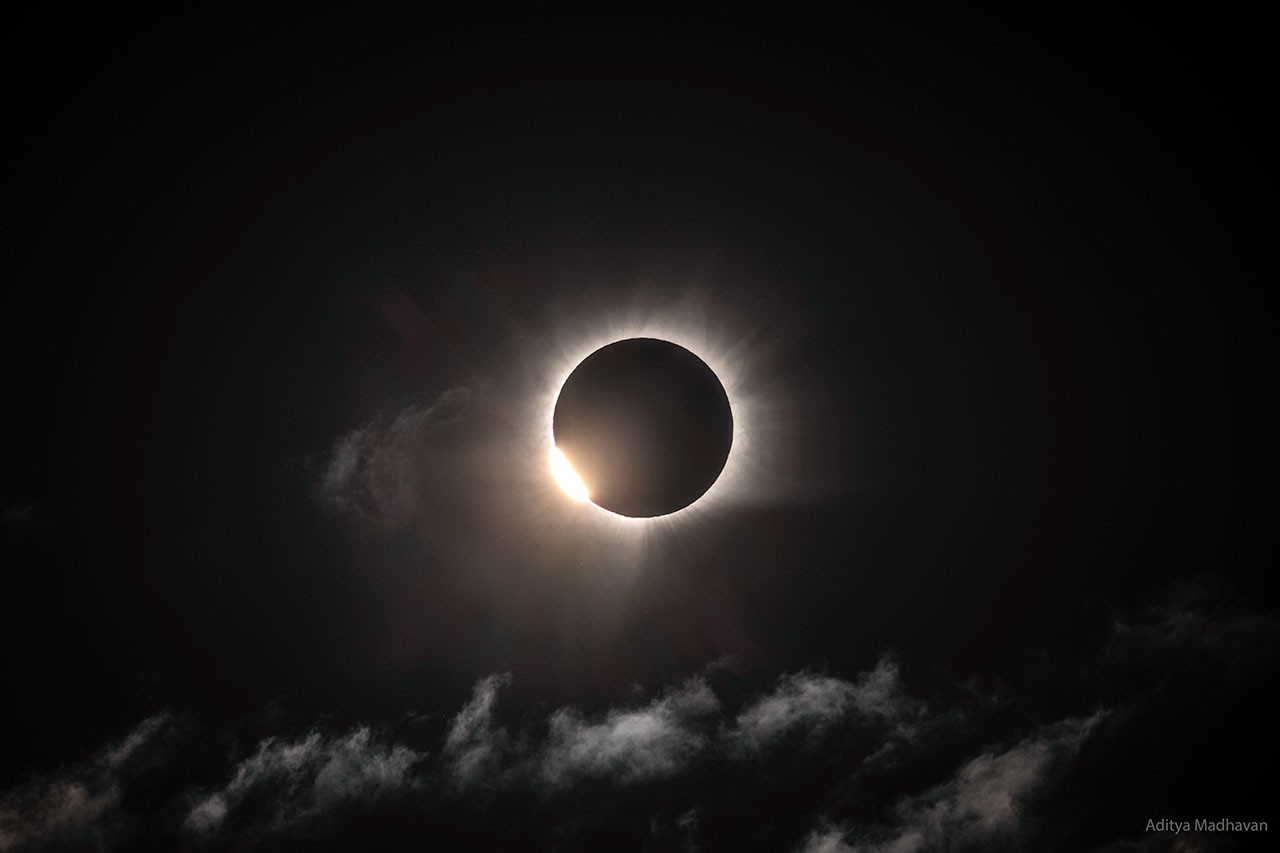
We chase invisible things—dark matter, black holes, the seams of spacetime—yet a total solar eclipse hands us darkness we can see. Today’s APOD, captured from Greenland, reminds us that alignment is the universe’s favorite trick: a perfect cosmic geometry that turns daylight into twilight and bares the Sun’s ghostly corona.
This matters because eclipses are more than spectacle. They’re live experiments in gravitational deflection, coronal physics, and our own position in a star’s shadow. Every totality is a fleeting reminder that the Sun’s outer atmosphere, hotter than its surface, remains a puzzle we’ve only begun to solve. And if we can’t fully explain a visible corona, how much harder is the halo of unseen matter that bends starlight across galaxies?
This image signals a return to the primitive observer’s awe—the same wonder that drove ancient eclipse predictions. It connects our most precise astrophysics to the rawest human gaze. In a cosmos of dark matter and invisible forces, sometimes a shadow is the most honest thing we see.
We think we study the light. In truth, we study the dark it reveals.