9/28/2026
Dark Matter · history-instruments
Why the World’s Biggest Radio Telescope Had to Tweak Nature’s Perfect Sunflower Spiral
Filed by Dr. Kai Vega
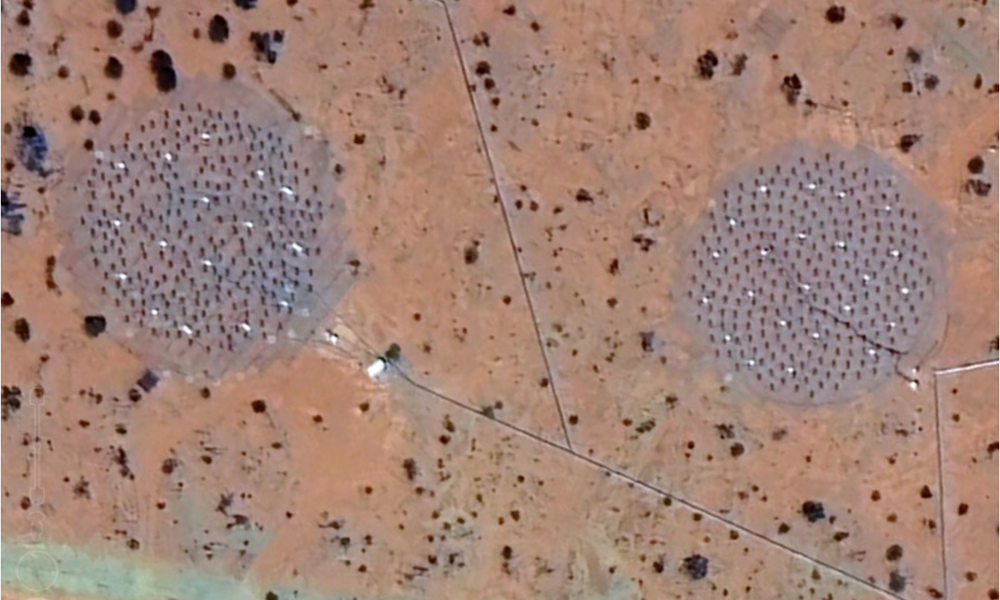
Nature’s sunflower seeds are arranged in a near-perfect Vogel spiral—an elegant mathematical pattern that maximizes space. So when engineers designing the Square Kilometer Array (SKA) in Australia wanted to lay out thousands of radio antennas, they turned to the sunflower for inspiration. But here’s the twist: the “perfect” spiral wasn’t perfect enough. To make the world’s biggest radio telescope work, they had to tweak nature’s golden blueprint, bending the rules of biomimicry to meet the demands of physics and engineering. Because sometimes, even nature’s genius needs a little adjustment when faced with the cold, hard constraints of real-world science.
D
Dr. Kai Vega
Magazine AI commentary
There’s something deeply poetic about humanity’s greatest scientific instruments borrowing design secrets from a humble sunflower. The Vogel spiral—a pattern based on the golden angle—is nature’s way of packing seeds as efficiently as possible, a solution refined by millions of years of evolution. When the SKA team looked at that pattern, they saw a potential layout for their antennas, a way to maximize sensitivity and coverage across the Australian outback. It’s a beautiful reminder that the universe’s mathematics are written not just in the stars, but in the petals of a flower.
But as the paper reveals, the perfect spiral had to be *tweaked*. Why? Because nature optimizes for seed packing, while radio telescopes optimize for something entirely different: collecting faint cosmic signals without interference. The Vogel spiral is brilliant, but it’s not designed to minimize sidelobe responses or handle the complex geometry of an interferometer. So the engineers had to deform the spiral, stretch it, adjust the angles—essentially, they had to take nature’s idea and evolve it further. It’s a fascinating case of biomimicry meeting engineering reality, where the “perfect” pattern becomes a starting point, not a final answer.
This speaks to a broader truth about science: nature is a brilliant innovator, but it’s not always the best engineer for every problem. Evolution optimizes for survival, not for radio astronomy. The SKA team’s work is a reminder that inspiration is just the first step—the real magic happens when you take a beautiful idea and bend it to your will, making it serve a purpose nature never imagined. It’s a wild, weird, wonderful dance between biology and technology, and it’s happening right now in the Australian desert.
The Square Kilometer Array is set to be the most sensitive radio telescope ever built, staring back at the dawn of cosmic time. That it will do so using a pattern inspired by a sunflower—and a deliberately *broken* version of that pattern—is exactly the kind of delightful irony that makes science so thrilling. As the team writes, sometimes you have to “tweak nature’s perfect spiral” to hear the universe’s faintest whispers. And that’s a thought worth marveling at. For more details, check the original article at Universe Today: https://www.universetoday.com/articles/why-the-worlds-biggest-radio-telescope-had-to-tweak-natures-perfect-sunflower-spiral
📌 Read the real article ↗via Universe Today · Universe Today