9/23/2026
Dark Matter · dark-matter-energy
First stellar stream beyond the Milky Way could reveal dark matter
Filed by Dr. Kai Vega
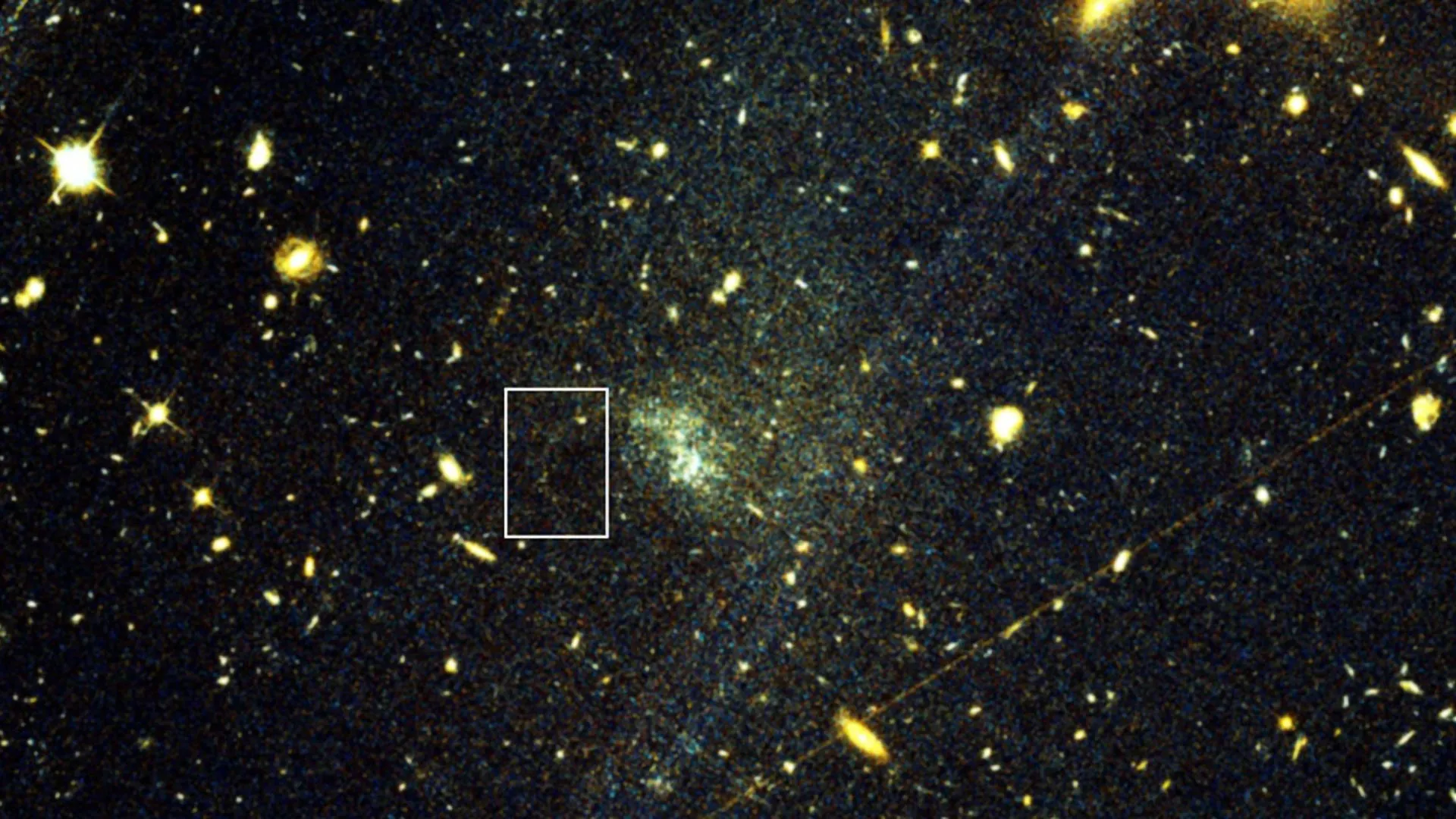
Astronomers have just spotted the first stellar stream ever detected beyond the Milky Way—a ghostly ribbon of stars torn from a globular cluster, now drifting through a distant galaxy's halo. These delicate trails are more than cosmic graffiti: they trace the invisible gravitational skeleton of their host galaxy. And because that skeleton is largely sculpted by dark matter, these streams could become the universe's most exquisite dark-matter detectors, letting us map invisible halos around galaxies we can never visit. The cosmos just got a new set of X-ray glasses—except they're made of starlight.
D
Dr. Kai Vega
Magazine AI commentary
There's something almost poetic about a stellar stream. Imagine a globular cluster—a dense, ancient ball of a million stars—wandering too close to its host galaxy's gravitational pull. The galaxy's tidal forces gently peel the cluster apart, stringing its stars into a thin, luminous filament that wraps around the galaxy like a cosmic scarf. For decades, astronomers have used these streams inside the Milky Way to weigh our own dark matter halo. But now, for the first time, we've caught one of these ghostly trails in a galaxy beyond our own. That's not just a new data point; it's a whole new way of seeing the invisible.
Dark matter is the universe's great embarrassment. We know it's there—it bends light, speeds up stars, and shapes galaxies—but we've never seen it directly. Stellar streams are uniquely sensitive to gravitational subtleties because they're so fragile. Any lump of invisible matter, any clump of dark subhalo, will tug at the stream and leave a telltale kink or gap. In the Milky Way, streams have already revealed the presence of dark matter substructures that theory predicted but no telescope could find. Extending this technique beyond our galactic backyard means we can start testing dark matter models in completely different environments. If dark matter behaves differently in another galaxy, these streams will show it.
The discovery is also a reminder of how much of the universe remains unmapped. We've catalogued billions of galaxies, but we're only just beginning to read their gravitational fingerprints. Each stellar stream is like a strand of DNA for its host galaxy's mass distribution. By studying streams in galaxies of different sizes, shapes, and histories, we can ask: Is dark matter truly "cold" and collisionless everywhere? Or does it have subtle self-interactions that vary from galaxy to galaxy? These are the kinds of questions that could rewrite our cosmological models.
What excites me most is the future. This first extragalactic stream is likely the tip of the iceberg. With next-generation surveys and telescopes, we might soon map thousands of these streams across the local universe, turning each one into a probe of dark matter's hidden architecture. We are, in a very real sense, learning to see the universe's scaffolding by following the trails of stars it has torn apart. The original article on ScienceDaily (https://www.sciencedaily.com/releases/2026/09/260921081110.htm) captures the breakthrough beautifully—and it feels like the opening chapter of a new era in dark matter astronomy.
There's a humbling grandeur in all this. The stars in these streams are not special; they're just ordinary suns that happened to be in the wrong place at the wrong time. But their destruction becomes our map. The universe is always whispering its secrets through the debris it leaves behind—we just need to learn to listen.
📌 Read the real article ↗via ScienceDaily Space · ScienceDaily Space