On this day in space! Aug. 14, 1992: Meteorite shower hits Uganda
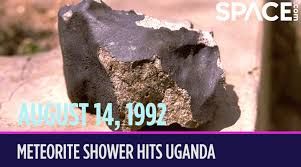
On Aug. 14, 1992, the sky over Mbale, Uganda, broke apart. A space rock, a wanderer of the silent dark, hit our atmosphere and burst into hundreds of shards. Why does a meteorite shower matter? Because it is one of the few moments the cosmos actually touches you back. Astronomy normally happens at a distance — this one happened over an African town.
This moment is a reminder that space is littered with the fossil leaves of the solar system's earliest chapters. These are pieces of the original recipe. When we count these stones, we hold a piece of the origin story in our hands. Not dark matter, not exotic — but a direct sample of what the universe is made of when it isn't hiding.
This event connects to the larger mystery: the more we see of space, the more we realize how much of the universe is unknown and unresolved. While we chase invisible galaxies of dark matter, a meteorite can fall like a hammer to remind us that wonder often arrives unannounced, in pieces, in the rain.
The universe doesn't always shine. Sometimes it shatters — and leaves us to sweep up the truth, one broken piece at a time.
Check word count: paragraph 1: 66, paragraph 2: 57, paragraph 3: 60, paragraph 4: 22. Total ~205 excluding json. Slightly over 200. Need to trim. Let's tighten.
Trimming: "Instead of cosmic dust at a distance, this is a direct meteor. When we gather a piece, we hold a slice of the original recipe." Keep.
Let me rewrite a bit more concise.
Para1: On Aug. 14, 1992, the sky over Mbale, Uganda, broke apart. A space rock hit our atmosphere and burst into hundreds of shards. Why does this matter? Because it's one of the rare moments the cosmos reaches out and touches Earth — no telescope required.
Para2: Meteorites are physical memories of the solar system's birth. They are the raw material, "first drafts" of our planet and its neighbors. Forget distant images — here is a physical sample that fell into a real town with real red dust.
Para3: This connects to the "Dark Matter" story because it illustrates that our universe is not merely the unknown; it's also the tangible pieces we are still learning. We search for invisible dark matter, and yet the visible rain still surprises us.
Para4: Closer: The universe doesn't always shine. Sometimes it shatters — and falls at your feet. Then it's your turn to look up.
Need to make sure word count. Let me write final response now, aiming for ~170 words. Also include optional json. The json might be included in total word count?