Astronomers discover mysterious 10-sided cloud structure at Saturn's south pole
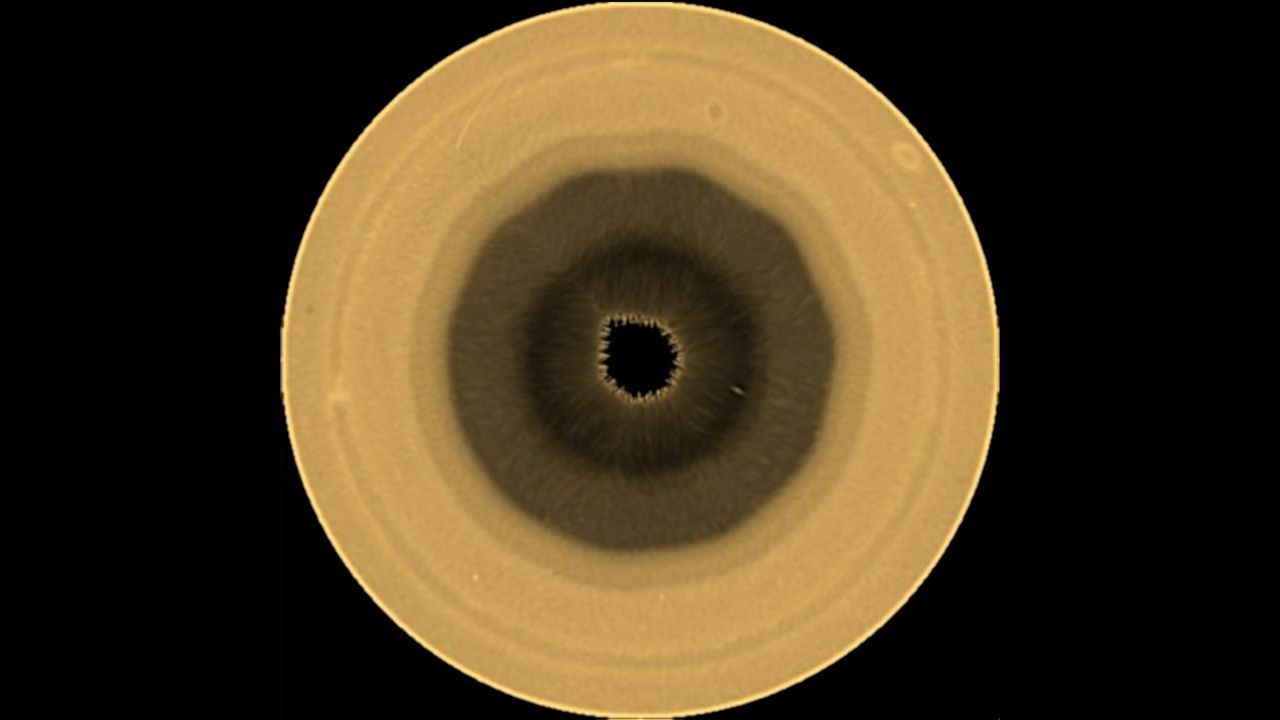
There's something almost poetic about the universe's insistence on geometry. We've known for decades that Saturn's north pole harbors a perfectly hexagonal jet stream—a six-sided marvel that has puzzled planetary scientists since Voyager first glimpsed it in the 1980s. Now, the south pole answers back with a ten-sided counterpart, as if the planet itself is composing a symphony of polygons. But this isn't mere cosmic whimsy; it's a clue buried in plain sight.
The existence of these polygonal structures points to a fundamental principle of fluid dynamics operating under extreme conditions. When a planet spins rapidly and its atmosphere churns with internal heat, the resulting jet streams can organize into standing wave patterns—essentially, the atmosphere "freezing" into harmonic shapes. That Saturn produces different polygons at different poles tells us the two hemispheres are dynamically distinct, with variations in wind speed, temperature, and internal heat flux that we've only begun to map.
What excites me most is the comparative angle. Jupiter has its own atmospheric mysteries—the Great Red Spot being the most famous—but no polygonal storms have been found there yet. Why? What conditions on Saturn allow these geometric structures to persist for decades while Jupiter's atmosphere remains dominated by turbulent eddies? Answering that question could reshape our understanding of planetary atmospheres, from gas giants to exoplanets we're just beginning to characterize with instruments like JWST.
The Keck II observations, detailed in the study, show the 10-sided structure spans roughly 4,000 miles—large enough to swallow several Earths. It's a humbling reminder that the solar system still holds surprises, even in our own celestial backyard. As we push further into the era of dedicated ice giant missions and advanced ground-based observatories, we should expect more such revelations. The cosmos, it seems, is a geometer at heart.