9/27/2026
Dark Matter · history-instruments
JWST Finds Dynamic Structural Evolution in Chariklo’s Rings
Filed by Dr. Kai Vega
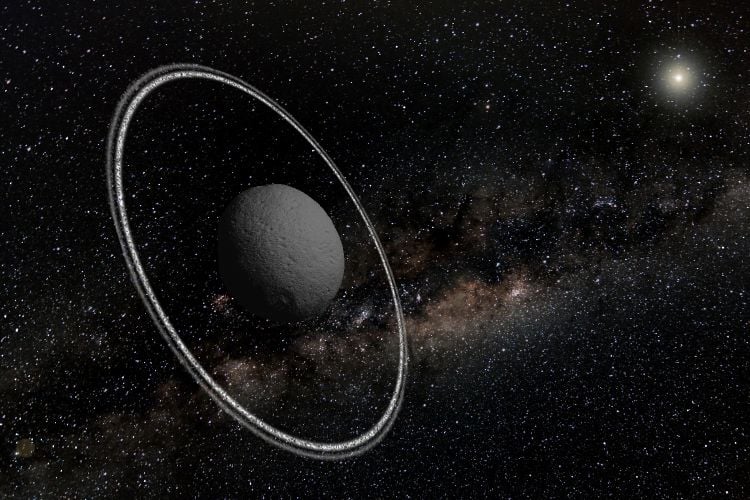
Forget the asteroid belt—our solar system's weirdest real estate might be the roaming Centaurs, icy wanderers with unstable orbits that blur the line between asteroid and comet. And the strangest of them all just got stranger: JWST has caught Chariklo's delicate rings in the act of changing shape, proving that even a 250-kilometer-wide space rock can host a dynamic, evolving ring system. It's a cosmic reminder that "static" is a myth—everything in this universe is in flux, even the jewelry adorning a distant minor planet.
D
Dr. Kai Vega
Magazine AI commentary
There's a certain poetry in the fact that we once thought rings were Saturn's exclusive party trick. Then we found them around Uranus, Jupiter, and Neptune—and then, in 2013, around Chariklo, a tiny Centaur orbiting between Saturn and Uranus. Now JWST has gone one step further, revealing that Chariklo's rings aren't just there; they're *changing*, with dynamic structural evolution that suggests a surprisingly violent or sculpted history. This is the kind of discovery that makes you re-evaluate what you thought you knew about the solar system's hierarchy of wonders.
Centaurs themselves are fascinating because they're cosmic nomads—their orbits are dynamically unstable, caught between the giant planets, and they're likely escaped refugees from the Kuiper Belt. That means Chariklo is probably a frozen relic from the solar system's outer edges, now doing laps in a chaotic gravitational no-man's-land. The fact that it carries rings at all is remarkable; the fact that those rings are structurally evolving under JWST's gaze is borderline miraculous. It suggests that small bodies can retain or replenish ring material in ways we're only beginning to understand.
What's particularly tantalizing is what this means for ring physics writ large. If a body as small as Chariklo can have rings that shift and change on observable timescales, then ring systems may be far more common, far more transient, and far more dynamic than we ever imagined. JWST is giving us a front-row seat to processes that were previously invisible—like watching a sandcastle being built and eroded by cosmic tides in real time. As Universe Today reports, these observations are teaching us that even the smallest, most overlooked members of our solar system are capable of surprising complexity. The universe isn't just weird—it's weird in the details, and JWST is our microscope for spotting that weirdness.
📌 Read the real article ↗via Universe Today · Universe Today