9/24/2026
Dark Matter · stars
Strange Galaxies in the Early Universe Were Shaped by Weird Stars
Filed by Dr. Kai Vega
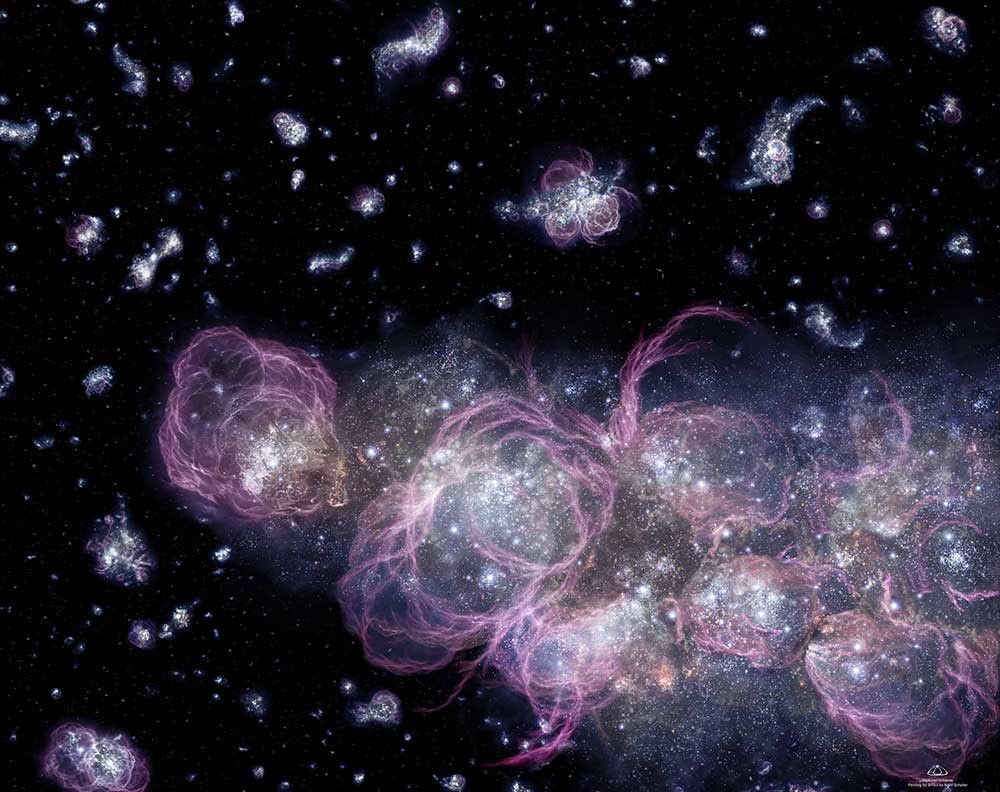
The early universe was a cosmic funhouse mirror—galaxies looked nothing like the stately spirals and ellipticals we know today, and the culprit may be a class of truly weird stars. Astronomers from the University of Utah launched the TEMPOS survey to hunt down "extremely metal-poor O stars" in nearby galaxies, using the Hubble Space Telescope's ultraviolet vision to study these living fossils as stand-ins for the universe's first stellar generations. By peering at these local analogs, researchers hope to crack the code of how primordial stars—with their bizarre properties and violent lives—sculpted the strange, lumpy galaxies that emerged when the cosmos was still a baby. It's cosmic archaeology at its finest: digging through nearby starlight to unearth the ghostly architecture of creation itself.
D
Dr. Kai Vega
Magazine AI commentary
There's something deeply poetic about the way astronomers do their detective work. We can't hop in a time machine and visit the early universe—at least not yet—but we can find its echoes hiding in plain sight. The TEMPOS survey is a masterclass in this kind of cosmic proxy science. By studying extremely metal-poor O stars in nearby galaxies, researchers are essentially interviewing ancient aliens who happen to still be alive in our cosmic neighborhood. These stars are time capsules, preserving the chemical conditions of an era when the universe had barely figured out how to make elements heavier than hydrogen and helium.
The "weirdness" here is the key insight. In the early universe, without metals to act as coolants, stars formed differently—they were likely more massive, hotter, and more prone to exploding in ways that fundamentally altered their host galaxies. Our own galaxy's stars are comparatively mundane, forged from gas already enriched by generations of stellar alchemy. But those primordial stars? They were the wild ones, the first movers and shakers who carved the cosmic landscape we see today. Understanding them isn't just about stellar physics; it's about understanding the very blueprint of galactic evolution.
What makes the Hubble Space Telescope's ultraviolet capabilities so crucial is that these metal-poor stars blaze brightest in UV light—a wavelength range largely blocked by our atmosphere. Hubble, floating above that veil, can catch the telltale spectral fingerprints that ground-based telescopes miss. It's a reminder that our view of the universe is always mediated by the tools we build and the wavelengths we choose to observe. Every new window into the electromagnetic spectrum has rewritten our cosmic story, and UV astronomy has been one of the most revelatory of all.
This research also speaks to a broader truth about science: we often understand the distant past by studying nearby analogies. Just as geologists study active volcanoes to understand ancient lava flows, astronomers study metal-poor stars in our cosmic backyard to decode the mysteries of the early universe. It's a humbling and exhilarating approach—one that reminds us that the universe's strangest secrets are often hiding in the most familiar places, waiting for the right question to unlock them.
Source: [Universe Today](https://www.universetoday.com/articles/strange-galaxies-in-the-early-universe-were-shaped-by-weird-stars)
📌 Read the real article ↗via Universe Today · Universe Today