An Early Look at Fall Color in Canada
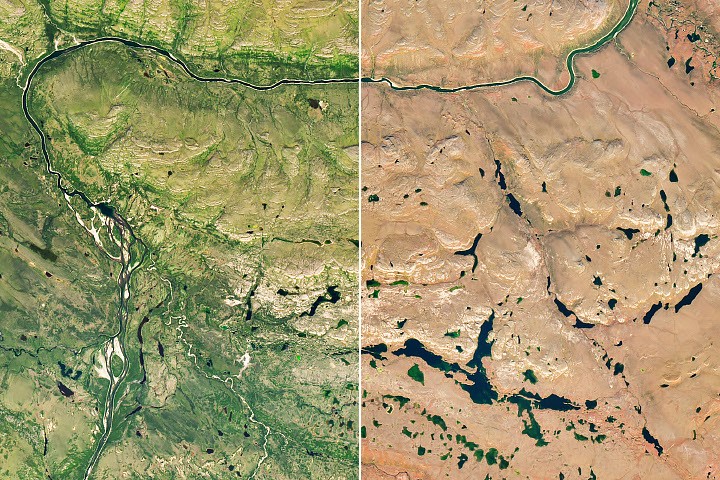
There's something almost surreal about watching the tundra blush. We tend to think of autumn color as a temperate-zone luxury—the sugar maples of New England, the golden aspens of Colorado. But NASA's Earth Observatory is showing us a different kind of fall, one happening on the edge of the Arctic, where dwarf shrubs and sedges are igniting into russet and amber across the rocky expanse of Nunavut. It's a reminder that even the most austere landscapes harbor a hidden vibrancy, and that the changing seasons are a planetary phenomenon, not just a local one.
The science here is deceptively simple. As days shorten and temperatures drop, chlorophyll breaks down in the leaves of tundra plants, unmasking the carotenoids and anthocyanins that produce those fiery hues. But the "weird" part—the part that keeps scientists watching with bated breath—is the timing. An early fall color signal in the high Arctic is a botanical telegram about the state of the ecosystem. It hints at a growing season that's stretching, thawing permafrost, and altering the delicate choreography of photosynthesis in a region warming roughly four times faster than the global average.
What makes this truly wild is the feedback loop lurking in the shadows. Darker, more vegetated tundra absorbs more solar radiation than reflective snow and ice, which can amplify warming. The colors we're seeing from space are not just a passive reflection of climate change; they're a visible sign of a landscape in active transformation. Every satellite image of reddening tundra is a snapshot of Earth's albedo shifting, a slow-motion metamorphosis that could reshape weather patterns far beyond the Arctic Circle.
So when we look at these images of fall color sweeping across Nunavut, we're not just seeing a pretty picture. We're witnessing the planet's most extreme environment telling us something profound about the pace of change. It's a beautiful, unsettling, and utterly fascinating glimpse into a world that is rewriting its own seasons in real time. The source, NASA's Earth Observatory, offers a striking visual record of this transformation, and it's worth marveling at—because the tundra is blushing, and the whole world is watching.