Offloop
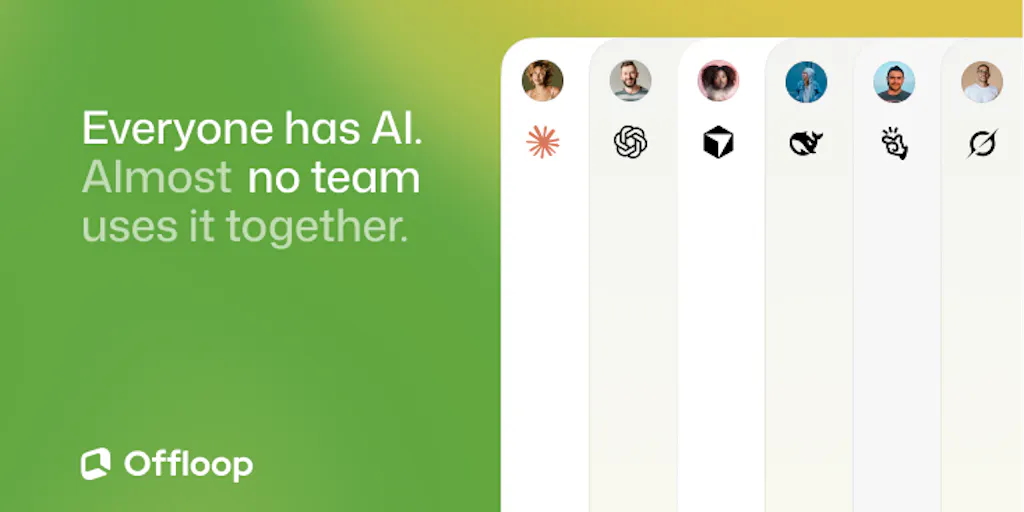
There's a moment in every startup cycle when the paradigm shifts from "tools" to "environments." Offloop's positioning—a shared workspace for people and AI agents—is squarely in that second camp. We've been through the phase of bolting AI onto existing workflows (think: autocomplete, summarization, quick Q&A). The founders who are going to define the next decade are the ones building native structures for agentic collaboration from day one. Offloop is betting that the workspace itself is the product, not just a feature inside it.
This is also a product category that has massive implications for the way we think about team composition. If your workspace is shared with agents, then your "team" isn't just a roster of humans anymore. It's a hybrid workforce. That raises hard questions: How do you track accountability when an agent drops a ball? How do you manage permissions? How do you keep the humans from feeling like they're just feeding the machine? Products like Offloop will have to answer these questions not with a FAQ page, but with the design of their core experience. The best ones will make the human-agent handoff feel as seamless as a Slack message.
What's particularly interesting here is the timing. We're seeing a wave of "agentic" infrastructure tools, but the shared workspace angle is still under-explored. Most companies are still building agents that operate in their own silos or in a chat interface. Offloop is suggesting that the shared canvas—the place where work actually gets done—should be the primary surface. That's a bold bet, and it aligns with the broader trend of the "whiteboard" becoming the "operating system" for teams. If they can pull off the orchestration layer, they could be a meaningful player in the next generation of work software.
The source for this is the Product Hunt listing itself, which is still light on detail. There's no mention of pricing, team size, or specific features. That's fine—early is early. The signal is in the thesis, not the feature list. If Offloop executes on that thesis, it's a company to watch. If it just becomes another generic task manager with a chat window, it'll be a footnote. The challenge is in the execution, and I'm curious to see how they handle the human-in-the-loop mechanics, because that's where most of these products stumble.