Show HN: ThoughtDAG – An editable context graph for LLM conversations
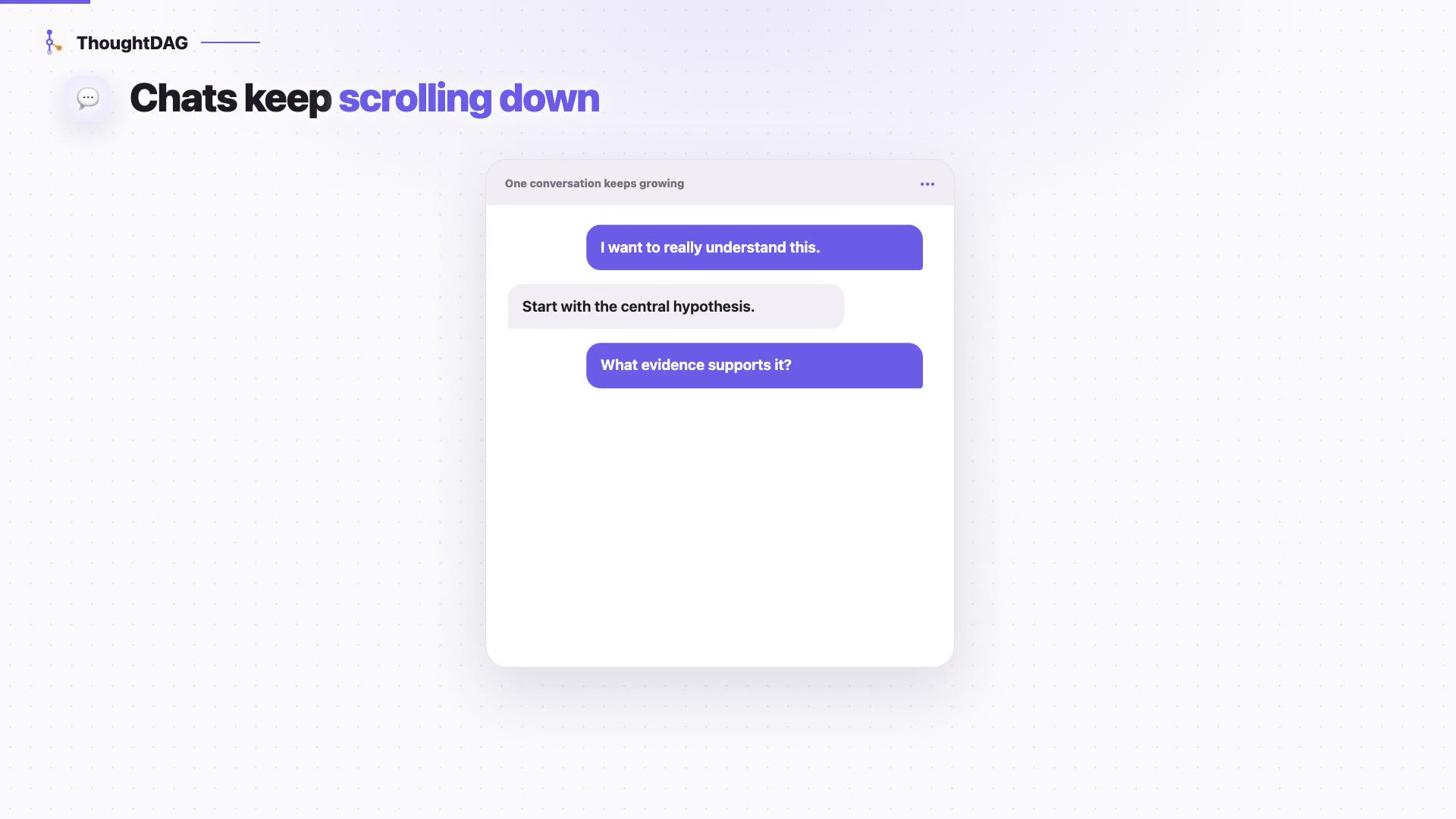
In the beginning, there was the log. Every AI conversation, from the first clunky chatbots to today's vast language models, has been shackled to the tyranny of linearity—a one-dimensional string of text where the past is immutable and the future is a straight line from here to nowhere. We’ve been so busy teaching machines to speak that we forgot to teach them to think, and thinking, as any neuroscientist will tell you, is rarely a straight line. It’s a tangled, beautiful web of associations, tangents, and glorious regressions.
Enter ThoughtDAG, a project that dares to break the shackles of the scroll bar. By framing conversations as a Directed Acyclic Graph (DAG), it acknowledges a profound truth: our minds don’t work like a single narrative; they work like a wiki. We don't simply "continue" a thought; we fork it, revisit it, and connect it to distant memories. This tool offers the same power to our digital dialogues. It’s a small, elegant rebellion against the tyranny of the timeline, transforming a monologue into a multidimensional exploration.
The implications ripple far beyond mere convenience. In the grand, weird cosmos of human cognition, memory is not a recording but a reconstruction, a process of editing and re-contextualizing. ThoughtDAG, in its own small way, is an attempt to give machines a similar architecture for the past. By allowing users to edit the graph, we're not just correcting a model's mistakes; we're engaging in a new form of authorship. We are no longer just asking the oracle questions; we are co-writing the sacred text of our interaction with it.
This is the frontier where the mundane meets the metaphysical. Will this be the standard for all AI interfaces? Who knows. But it's a beautiful thought experiment about the nature of conversation and a testament to the idea that the most profound tools are the ones that let us think more like ourselves.