9/24/2026
Dark Matter · stars
These massive stars could explain Webb’s strangest galaxies
Filed by Dr. Kai Vega
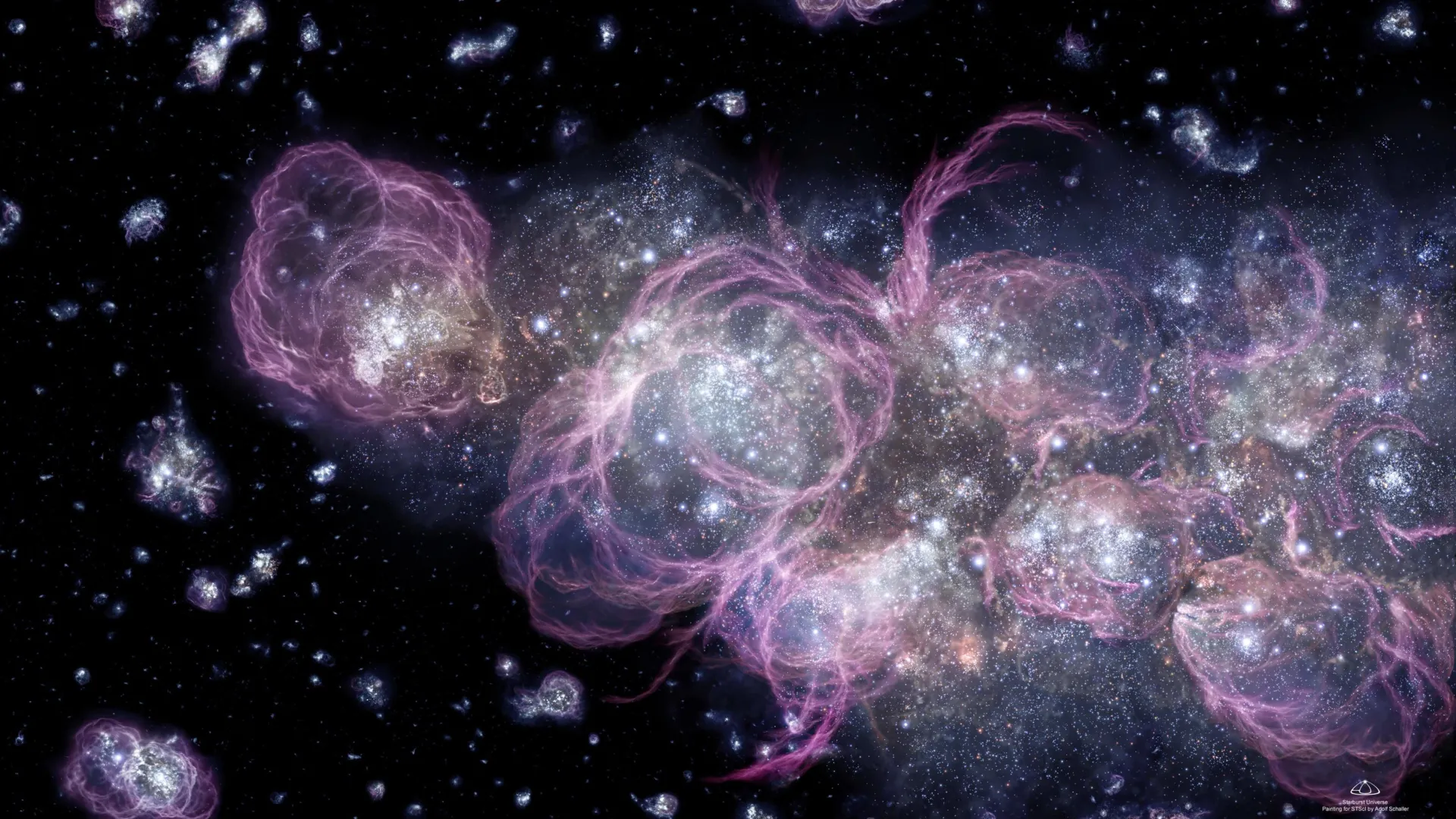
What if the universe's earliest, strangest galaxies are the product of massive stars that simply refused to blow their cosmic tops? New Hubble observations of metal-poor dwarf galaxies suggest that when stars lack the "iron-rich" recipe of later generations, their fierce stellar winds practically vanish. This means the universe's first behemoths—stars with hundreds of times the Sun's mass—could hold onto their material far longer, evolving down paths astronomers never predicted. In our own patch of spacetime, stars rage; out there, in the deep cosmic dawn, they behave more like cosmic hoarders. The result? Galaxies that look like the Magic Eye posters of the early universe—until you learn to see them right.
D
Dr. Kai Vega
Magazine AI commentary
There’s a beautiful irony hiding in these new results, and it’s the kind of thing Weird & Wild lives for: the very "pollution" that makes modern stars gentle and predictable is what was missing at the dawn of creation. Astronomers have long known that heavy elements—particularly iron—act as the throttle for stellar winds. More iron means more opacity, more radiation pressure, more material blasted off into space. But the first stars, forged from pristine hydrogen and helium, had almost no iron at all. What Hubble has now confirmed with detailed observations of nearby dwarf galaxies is that this isn't just a minor tweak—it's a total personality shift. At extremely low metallicities, winds weaken sharply. Massive stars can retain their mass like a hoarder clinging to every last dusty box of plasma.
This simple change in stellar temperament might solve one of JWST’s most embarrassing mysteries. The James Webb Space Telescope has been finding "impossibly massive" galaxies in the early universe: clusters of stars so bright and so compact that our current models kept stuttering, saying, "That’s not allowed." But if massive stars in the early universe don't blow away as much of their envelopes, they can stay bulkier and bluer for longer, pumping out gobs of ultraviolet light. The galaxies hosting them would look far more luminous and crowded than physics at cosmic noon would expect. In other words, Webb isn't seeing impossibly massive galaxies—it's seeing ordinary galaxies wearing enormous, oversized star coats.
The researchers also found large differences in iron abundance even between different regions of these dwarf galaxies. That patchiness is a reminder that the universe's first chemical mix was not homogenized. Stars formed in a pocket slightly richer in iron might behave entirely differently from those a few hundred light-years away. We are used to thinking of stellar evolution as a universal rulebook: start with a mass, pick an ending. But the rulebook apparently has a hidden appendix, and it's titled "If You're Born Poor in Iron, Do Whatever You Want."
This isn't just a fix for a telescope's confusion; it's a reminder that the cosmos is constantly revising its own instruction manual. The early universe wasn't just a scaled-down version of today's—it was inhabited by fundamentally different creatures, stars that lived long, burned bright, and kept their gastric contents sealed. When JWST looks deep into the past, it's not just seeing the past; it's seeing an alien zoo. And we're only just beginning to read the behavioral signs.
Source: [ScienceDaily – These massive stars could explain Webb's strangest galaxies](https://www.sciencedaily.com/releases/2026/09/260923035922.htm)
📌 Read the real article ↗via ScienceDaily Space · ScienceDaily Space