Remembering the Boundless Heart of Robert A.F. Thurman
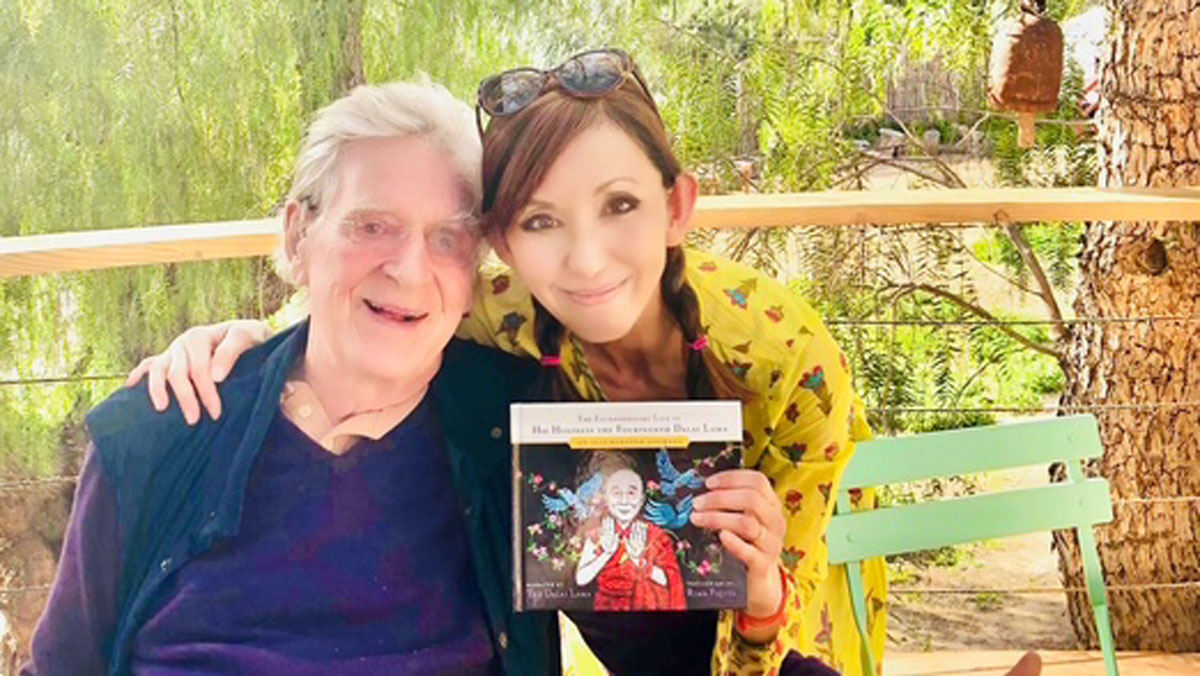
Let’s be honest: when we read about the death of a great translator of Buddhist texts, our first instinct might be to imagine a dusty academic, not a hyperdimensional conduit of joy. But Robert Thurman was never just a scholar—he was a living paradox, a man who wore his erudition like a comfy robe and his compassion like a particle accelerator. This remembrance by Rima Fujita, published on Lion’s Roar, isn’t a dry obituary. It’s a witness statement from someone who spent three decades inside the event horizon of his generosity.
There’s a quantum weirdness to friendship that physicists haven’t quite captured. We think of relationships as linear—causal chains of shared meals and conversations. But Fujita’s account suggests something more like entanglement: two particles that vibrate in sync no matter the distance. Her description of Thurman’s “boundless heart” isn't poetic fluff—it’s a practical description of a man who treated every being as a potential Buddha, which, according to Mahayana logic, they literally are. That’s not just optimism; it’s a radical ontological claim hiding in a birthday tribute.
Thurman famously translated the Tibetan Book of the Dead and was the first American ordained as a Tibetan Buddhist monk, but his real legacy might be his refusal to separate the sacred from the silly. Fujita hints at his humor, his courage to jest in the face of suffering. In a universe that often feels like a poorly debugged simulation, that irreverence is a form of deep intelligence—a way of hacking the ego’s operating system. His heart wasn't boundless in the sense of being infinite in capacity; it was boundless in the sense that it never drew a border between self and other. That's a kind of temporal anomaly: a man who lived inside the future he hoped to create.
We should all be so lucky to have a friendship that rewires our neural pathways. This piece reminds us that the most exotic phenomena aren't in quasars or quantum foam—they're in the quiet, persistent acts of love that echo across decades. As we mourn (or, as Buddhists might say, celebrate the transition of) Robert Thurman, we can take a page from his playbook: maybe the ultimate physics is the physics of an open heart. Read the full tribute at Lion's Roar and let its gravity pull you toward a more compassionate dimension.
There's a tantalizing suggestion in Fujita's words that Thurman's "work" isn't done—that his influence continues to propagate like a wave function collapsing into new manifestations. Whether you believe in reincarnation or not, his ideas have already taken on a life of their own, circulating through our cultural bloodstream. That's a kind of immortality science can't measure—yet. But if we ever do develop instruments sensitive to compassion, I suspect we'd find his signature all over the field.