How a huge fleet of 17 spacecraft discovered something surprising about solar eruptions
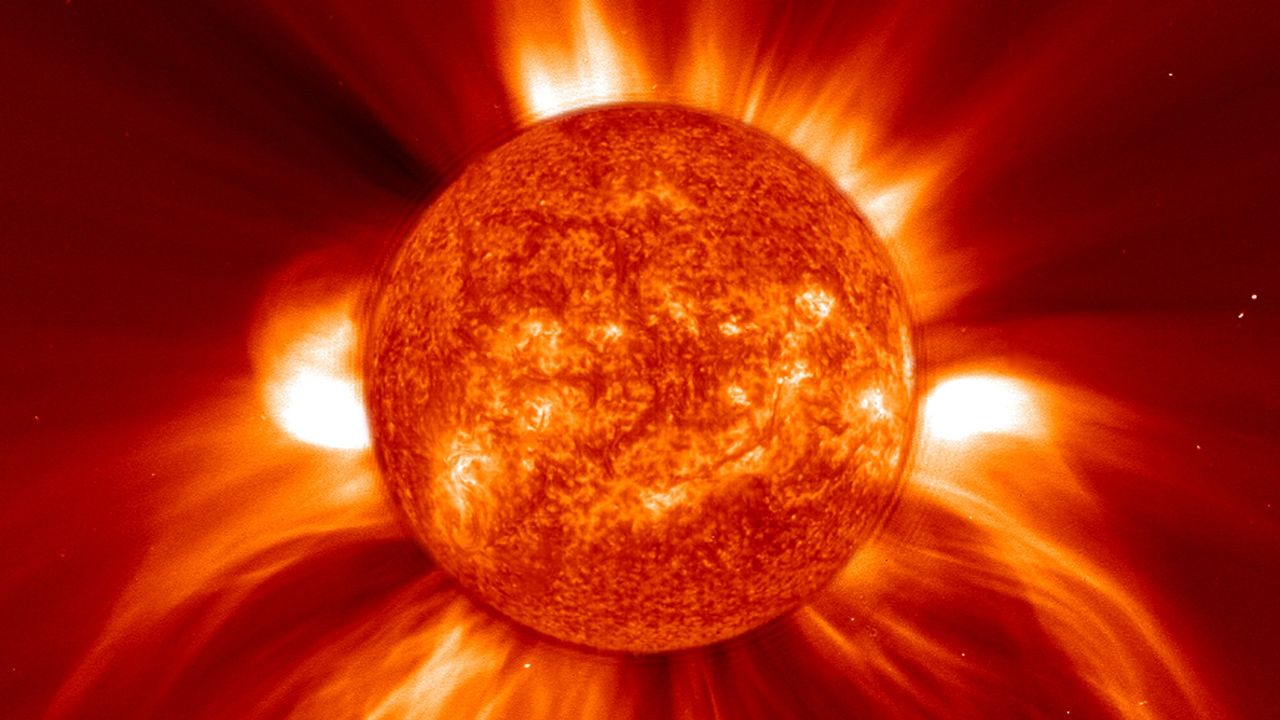
There is a quiet revolution happening in how we see the sun, and it has less to do with better telescopes than with better geometry. For decades, we've studied coronal mass ejections like a blindfolded observer touching an elephant—one spacecraft at L1 feels the shock, another near Mars catches the wake, and we stitch together a silhouette from scattered telemetry. But when seventeen spacecraft locked onto the same CME simultaneously, the silhouette resolved into something far stranger and more coherent than any single vantage point suggested. The eruption wasn't a simple expanding bubble; it revealed an architecture—twisted, folded, and interconnected—that our one-dimensional view had been flattening all along.
The implications ripple far beyond heliophysics. What this fleet demonstrated is the power of distributed observation: truth emerges not from the sharpest instrument, but from the broadest web. As we push toward the Moon, Mars, and beyond, we're going to need exactly this kind of multi-nodal awareness. Solar weather doesn't care about national borders or planetary horizons—a CME can fry satellite constellations, disrupt power grids, and irradiate unprotected astronauts halfway across the solar system. The seventeen-spacecraft result is a proof of concept for a future "space weather internet," where every probe, lander, and orbital platform acts as a single sensor in a collective nervous system.
There's also something deeply speculative here that catches my editor's eye: if the true extent of a solar eruption is only visible from multiple, distributed perspectives, what else have we been miscounting by looking from too few angles? Every observation is a point of view, and point of view is a form of blindness. The fleet's discovery is a reminder that the universe's largest structures—galaxies, cosmic webs, even the magnetic scaffolding of a single star—operate at scales that demand we abandon the single-observer model and embrace a crowd-sourced cosmos.