The Tarantula That Lost Its Fire
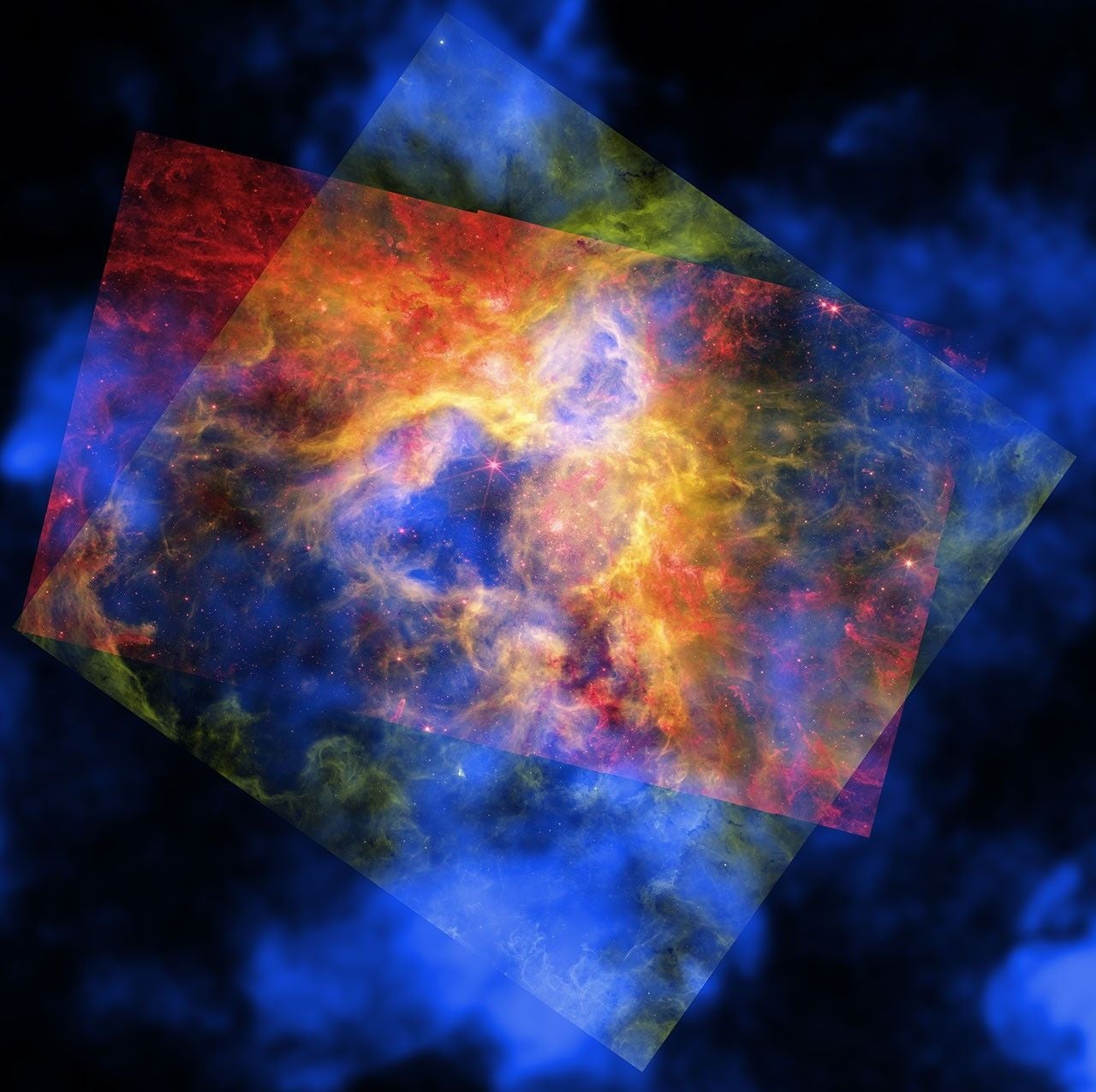
The Tarantula Nebula has always been a cosmic bonfire—a stellar nursery so violent it should scream in X-rays. Yet when we pointed our most sensitive instruments at it, the fire whispered. For years, that silence was a thorn in astrophysics. Now, by stitching together Chandra’s X-ray vision with Hubble, Webb, and Spitzer’s infrared eyes, we’ve finally seen the truth: the young, massive stars are not heating the gas as we assumed. The missing radiation isn’t a failure of physics—it’s a failure of our models.
This matters because it’s a reality check. We build grand theories of feedback, of how stars shape galaxies, based on idealized physics. But the universe is messier. The Tarantula is telling us that stellar winds and radiation can be channeled, diluted, or absorbed in ways we haven’t fully mapped. If we get this wrong here, 160,000 light-years away, we get it wrong everywhere—including in the early universe, where the first stars lit up the dark.
What connects here is the power of synthesis. No single telescope could crack this. It took four observatories, each seeing a different slice of the spectrum, to reveal that the fire isn’t lost—it’s just hidden. That’s the real lesson: the cosmos rarely yields to a single gaze.
So when you look at the Tarantula, remember: its fire still burns, but it’s teaching us that even the brightest stars can keep secrets. The universe’s deepest mysteries aren’t always loud. Sometimes, they’re the silences we finally learn to hear.