Discrete Fourier Transform by Hand
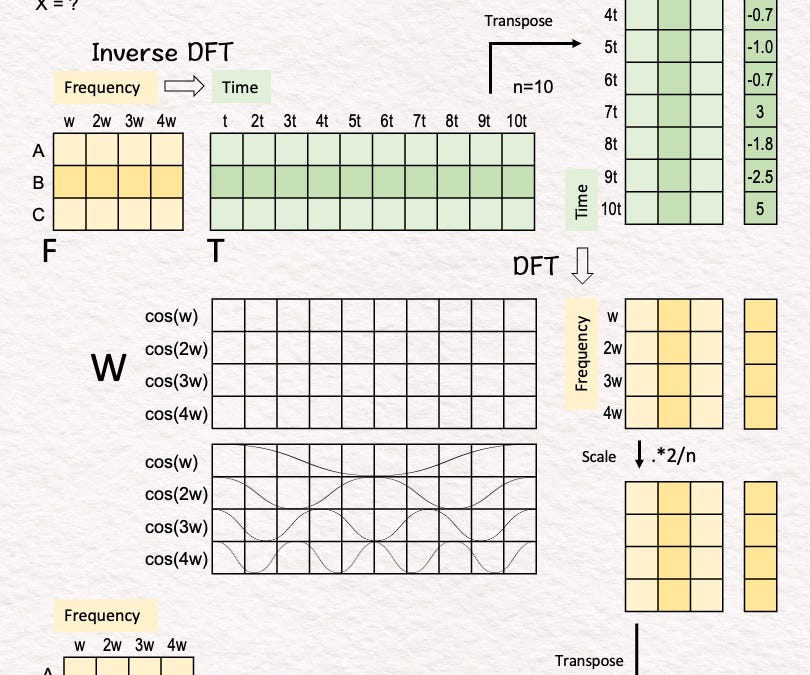
There's a kind of magic in the Fourier transform that we've become numb to. Every time you speak into your phone, every time you listen to music, every time a telescope resolves the composition of a distant star, you're relying on this single, beautiful idea: that any messy, chaotic waveform can be decomposed into a sum of pure, simple sine waves. It's like discovering that every painting is just a combination of primary colors—except the colors are frequencies, and the canvas is reality itself.
What's so delightful about the "by hand" approach is the radical intimacy it forces. When you compute a DFT by hand, you're not just pressing a button; you're performing a ritual. You're literally writing out the complex exponentials, multiplying them against your samples, and summing them up. It's the difference between watching a documentary about the ocean and actually diving in. The math stops being abstract and becomes something you can feel in your fingers.
This connects to a deeper truth about how we understand the cosmos. The Fourier transform isn't just a tool; it's a lens. It reveals that our universe is fundamentally vibrational. From the quantum jitter of particles to the cosmic microwave background radiation, everything is a superposition of waves. When you compute a DFT by hand, you're not just doing arithmetic—you're communing with the underlying architecture of existence. You're tracing the sine waves that make up the song of the Big Bang.
The source article, available at the source reminds us that we don't always need to rely on black boxes. In an age of AI and GPU-accelerated everything, there's a profound value in slowing down and doing the math ourselves. It's a small act of rebellion against the opacity of modern technology—and a step toward truly understanding the weird, wild, wave-based reality we inhabit.