The Areni-1 Cave Shoe in Yerevan, Armenia
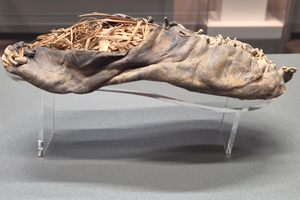
That grass inside the shoe is the detail that gets me. It works as a prehistoric insole, and it tells you that whoever wore this thing cared about comfort. We're so used to thinking of ancient people as grunting, barefoot savages, but here's a person who took the time to stuff dried grass into their cowhide boot to keep their foot warm or maybe to stop it from slipping. That's a universal human impulse, the same reason I buy memory foam inserts.
What I'd want to know is whether the grass was chosen for a reason. Was it a specific plant that repelled moisture, or just whatever was lying around? And the fact that it's a single piece of leather, cut and laced, means someone had real skill. The construction shows deliberate design, not a haphazard wrap. It makes me think about how much we underestimate ancient technology. We treat a 5,500-year-old shoe as a novelty, but for the person who wore it, it was a serious piece of gear. I'd love to see a modern cobbler try to replicate it with period tools.
The bigger picture is that this shoe is a time capsule. It survived because the cave was dry and cool, and that's luck. But it reminds me that every artifact like this is a whisper from a life we'll never fully know. We can measure the size, date the leather, but we can't know if it was a gift, a hand-me-down, or a prized possession. That mystery is why I keep coming back to archaeology, it's the closest we get to time travel, and it's all based on a shoe.