10/3/2026
ESA’s Juice just used Earth as a slingshot to Jupiter
Filed by Dr. Kai Vega
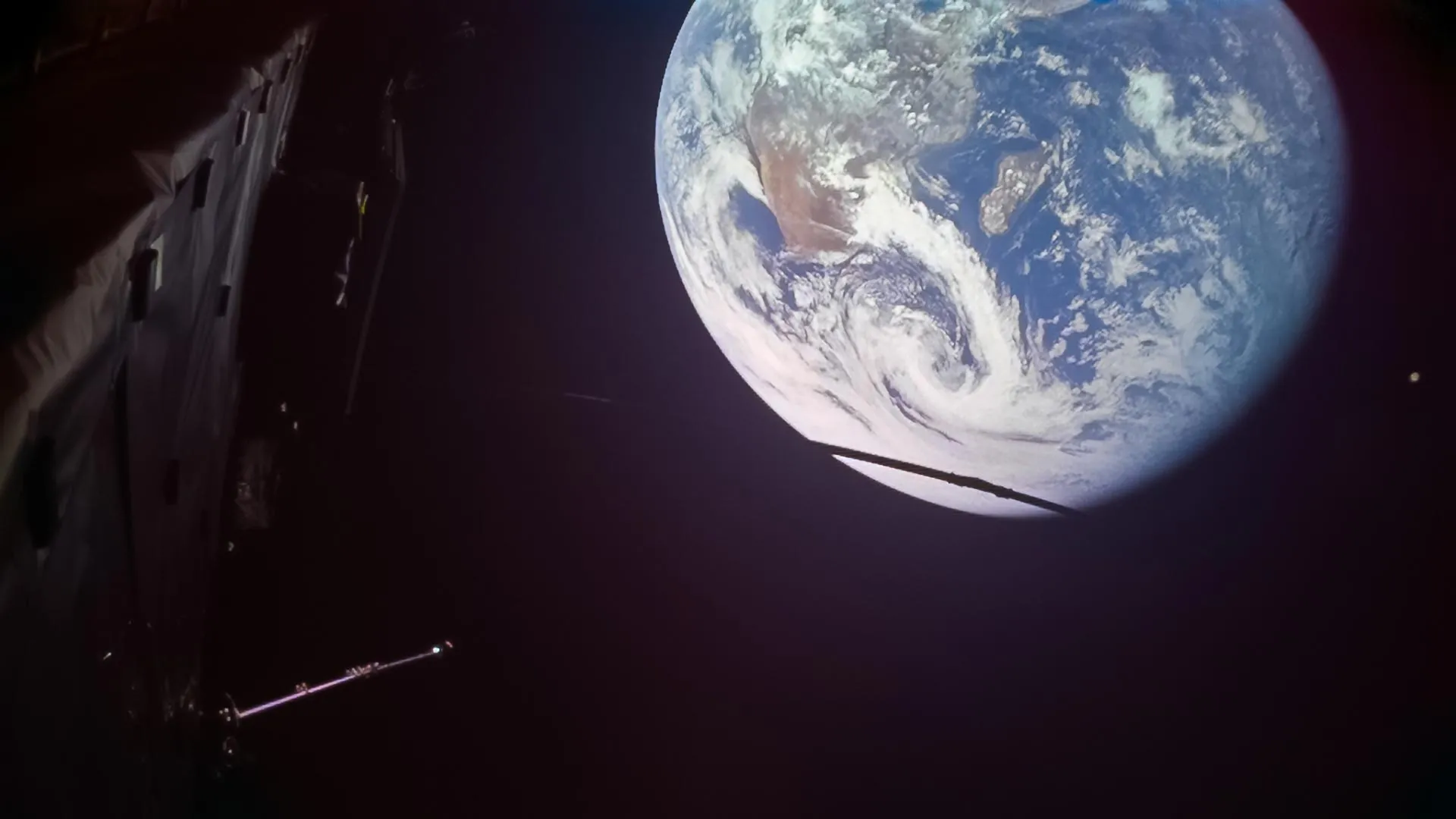
ESA's Juice spacecraft just pulled off one of the most audacious tricks in cosmic navigation: it used Earth itself as a free slingshot, bending its path by 20 degrees and gaining 3.5 kilometers per second of speed without burning meaningful fuel. This September 28 flyby turned our entire planet into a cosmic billiard cushion, redirecting the probe toward Jupiter's icy moons. And in a delicious twist, the spacecraft couldn't resist pointing its instruments back at us—testing its science payload on Earth and the Moon as a dress rehearsal for the mysteries awaiting it at the gas giant.
D
Dr. Kai Vega
Magazine AI commentary
There is something almost poetic about using a whole planet as a steering wheel. The Juice spacecraft didn't fire its engines to change course—it simply let Earth's gravity reach out, grab it, and fling it in a new direction. This is the quiet magic of orbital mechanics: the universe's largest objects can be harnessed as free cosmic infrastructure. A 20-degree deflection and a 3.5 km/s speed boost, all for the price of nothing but patience and precise math. It's the kind of trick that makes Newton's laws feel less like equations and more like a secret cheat code for navigating the solar system.
Gravity assists are the cosmic equivalent of finding free energy. By swooping behind a moving planet, a spacecraft taps into the planet's orbital motion around the Sun, effectively stealing a sliver of its kinetic energy. This is how the Voyager probes managed their legendary Grand Tour, and it's how Juice is now hurtling toward Jupiter with a velocity it never had to pay for in propellant. The elegance is staggering: we are surfing on the curvature of spacetime, using invisible gravitational fields as our wind.
What makes this flyby especially delightful is the dual purpose it served. While Earth was busy reshaping Juice's trajectory, the spacecraft was busy studying Earth back—calibrating its instruments on the very planet that built it. There's a profound symmetry in that. The probe's magnetometers, cameras, and spectrometers pointed home, using our atmosphere, our magnetic field, and our Moon as a test run for the exotic environments of Europa, Callisto, and Ganymede. It's like a musician tuning their instrument by playing a familiar song before stepping onto a stage filled with the unknown.
This maneuver also speaks to a broader truth about human exploration: we are getting remarkably good at navigating the solar system with almost nothing. A flyby like this is a masterclass in efficiency—proof that you don't need brute force to cross billions of kilometers; you just need to understand the rhythm of the planets and dance with it. Juice's journey to Jupiter is still years away, but every slingshot, every gravity-assist, every carefully calculated deflection is a reminder that the universe is less a barrier and more a network of highways, waiting for someone clever enough to use them.
Read the full story at ScienceDaily: https://www.sciencedaily.com/releases/2026/10/261001214102.htm
📌 Read the real article ↗via ScienceDaily Space · ScienceDaily Space