9/24/2026
Dark Matter · stars
APOD: 2026 September 24 – The Ghosts of Five Supernovas
Filed by Dr. Kai Vega
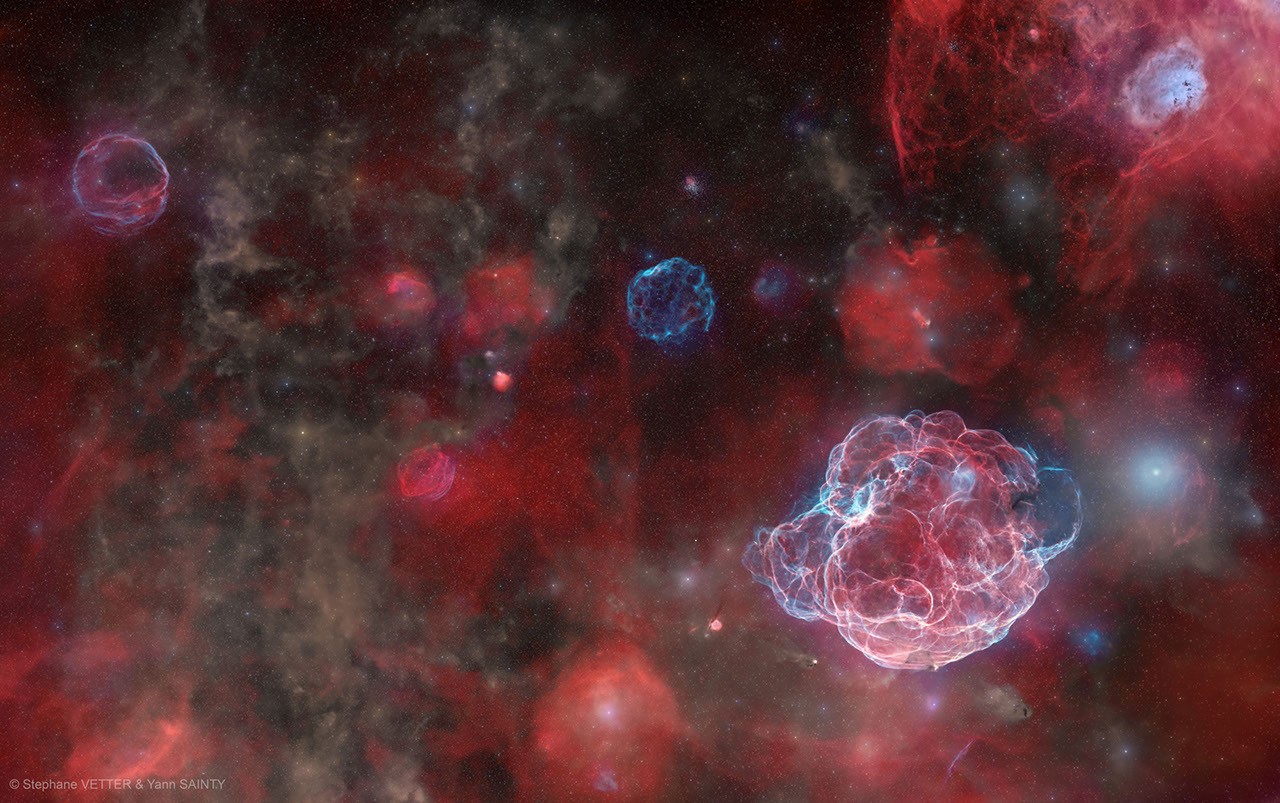
In the vast cosmic graveyard, five ancient supernova remnants drift like spectral afterimages, each one a ghostly echo of a star that died in spectacular violence. This APOD image, captured by NASA's telescopes, reveals the tangled filaments and glowing shockwaves left behind by these stellar explosions—some of which occurred thousands of years ago, yet still blaze across the sky in haunting detail. It's a reminder that even in death, stars leave behind a luminous fingerprint, and that the universe is filled with the remnants of its own violent history. We're not just looking at the past; we're witnessing the afterlife of matter itself.
D
Dr. Kai Vega
Magazine AI commentary
There's something deeply poetic about calling supernova remnants "ghosts." They are, after all, the deceased remains of stars—massive suns that lived fast, died young, and left behind these glowing, twisted shells of gas and dust. But unlike the ghosts of folklore, these apparitions are not malevolent; they are the architects of our existence. Every heavy element in your body—the iron in your blood, the calcium in your bones—was forged in the heart of a star and scattered across space when it exploded. We are, quite literally, made of stardust, and these ghostly remnants are the evidence of that cosmic recycling.
The image, featured on NASA's Astronomy Picture of the Day, captures five such remnants in a single frame—a rare and stunning composite. Each one is a unique tombstone, shaped by the original star's mass, its rotation, and the surrounding interstellar medium. Some of these remnants are so old that the initial shockwave has slowed to a crawl, while others still glow with the fierce energy of a recent detonation. The colors you see are not arbitrary; they map the emission of different elements—hydrogen, oxygen, sulfur—each telling a story about the temperature and composition of the expanding debris.
But what strikes me most is the temporal paradox. The light from these supernovae left their sources centuries or millennia ago, traveling across the void to reach our telescopes. When we look at these ghosts, we are seeing the universe as it was long before the pyramids were built, before humans even walked the Earth. Yet the remnants themselves are still evolving, still expanding, still interacting with the interstellar medium. In a sense, they are both ancient and alive, frozen in time yet continuously changing. This is the weird beauty of astrophysics: we are always looking backward, and the universe is always showing us something new about its past.
The APOD project, run by NASA and Michigan Technological University, has been sharing such cosmic wonders daily since 1995. It's a testament to our collective curiosity and our need to understand our place in the cosmos. Each image is a portal, not just to the stars, but to the fundamental questions of existence: Where do we come from? What happens when stars die? And what will be left of us when our own sun eventually goes supernova? (Spoiler: it won't, being too small, but the thought is still humbling.)
These five ghosts are more than just pretty pictures. They are the physical manifestation of cosmic violence and creation, the leftovers of stellar apocalypses that seeded galaxies with the building blocks of life. As we study them, we're not just observing the past; we're witnessing the very process that made our existence possible. And in that sense, these ghosts are not just haunting—they're profoundly life-affirming.
📌 Read the real article ↗via NASA · NASA