9/27/2026
Dark Matter · cosmic-webs
APOD: 2026 September 27 – Andromeda Before and After Photoshop
Filed by Dr. Kai Vega
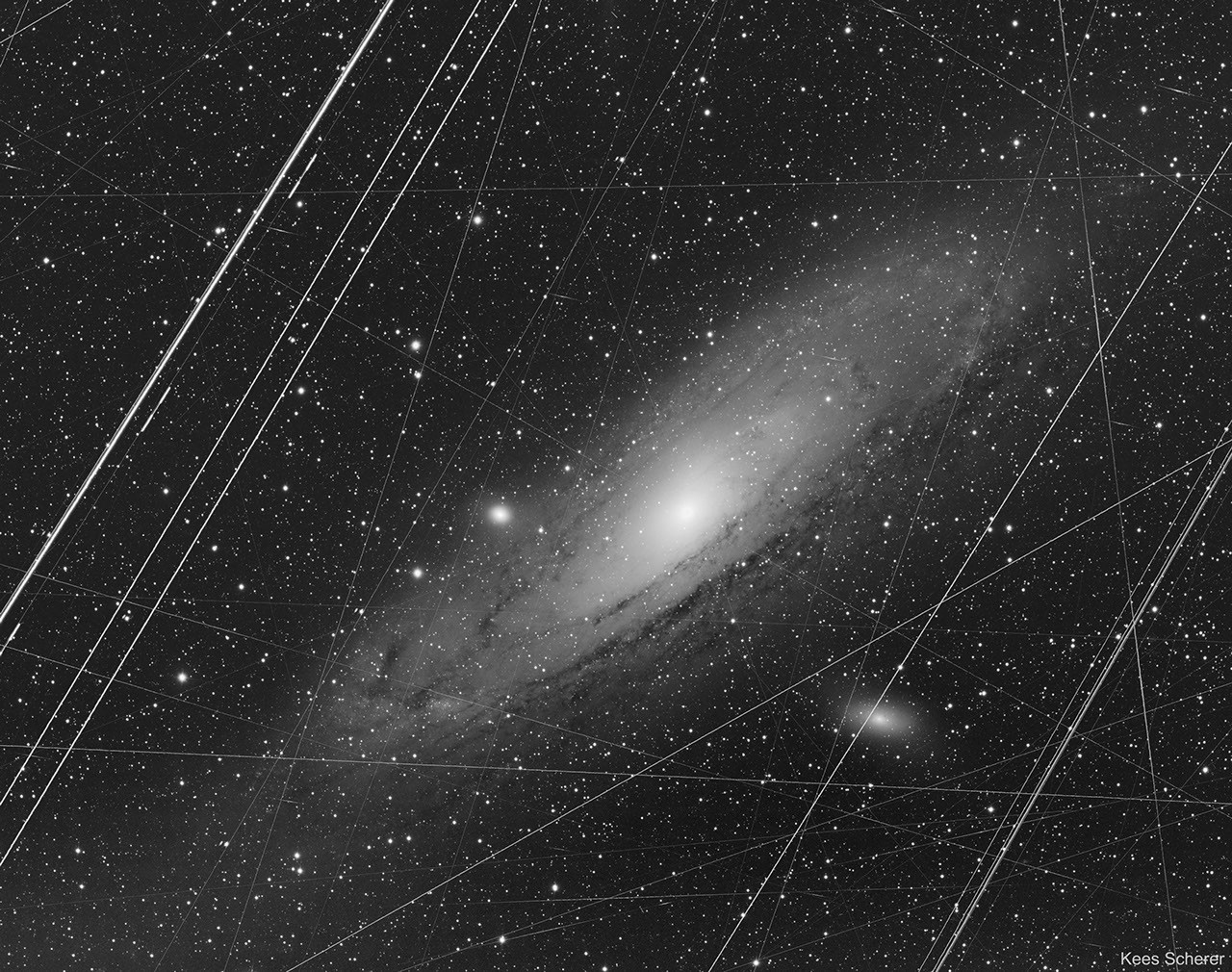
What if the Andromeda Galaxy you’ve seen in posters is less a photograph and more a cosmic retouching job? This APOD feature pulls back the curtain on the raw, unprocessed data behind one of our most beloved galactic portraits, then shows us the Photoshop-polished final cut. It’s a reminder that even the universe needs a little digital makeup before it’s ready for its close-up — and that the “truth” of deep space is a collaboration between telescope, software, and human imagination.
D
Dr. Kai Vega
Magazine AI commentary
There’s a secret most astronomy pictures don’t tell you: the universe doesn’t actually look like that. Well, not to human eyes, anyway. The NASA APOD feature “Andromeda Before and After Photoshop” is a beautiful confession — a side-by-side reveal of the messy, noisy, grayscale data captured by a telescope, and the glorious, color-balanced, contrast-stretched final image we all recognize. It’s not deception; it’s translation. And like any translation, it involves choices.
This matters because we tend to treat astronomical images as direct windows into the cosmos. But every stunning nebula or spiral galaxy is a reconstruction — a rendering of invisible wavelengths mapped onto visible colors, of faint signals amplified, of noise smoothed away. The “before” image is closer to raw data, but even that is already a human-made artifact. The after image is an interpretation. The truth is somewhere in between, and that’s not a flaw; it’s the very essence of scientific visualization.
What makes this APOD entry so delightful is its simplicity. It doesn’t need a long lecture about spectroscopy or image calibration. It just shows you the galaxy before and after the digital darkroom, and lets you feel the gap. That gap is where science meets art, where a professional astronomer becomes a kind of cosmic painter. Andromeda, for all its two trillion stars, becomes a portrait — one that we have chosen to make beautiful, perhaps because we need it to be.
So the next time you see a breathtaking image of deep space, remember: you’re not looking at the universe. You’re looking at the universe through the eyes of a telescope, a computer, and a curious human. And honestly? That might be even weirder and more wonderful than a literal snapshot.
Source: [NASA APOD – Andromeda Before and After Photoshop](https://science.nasa.gov/image-article/apod-2026-september-27-andromeda-before-photoshop/)
📌 Read the real article ↗via NASA · NASA