9/30/2026
Dark Matter · gravitational-waves
A record-breaking X-ray flash may reveal the birth of a magnetar
Filed by Dr. Kai Vega
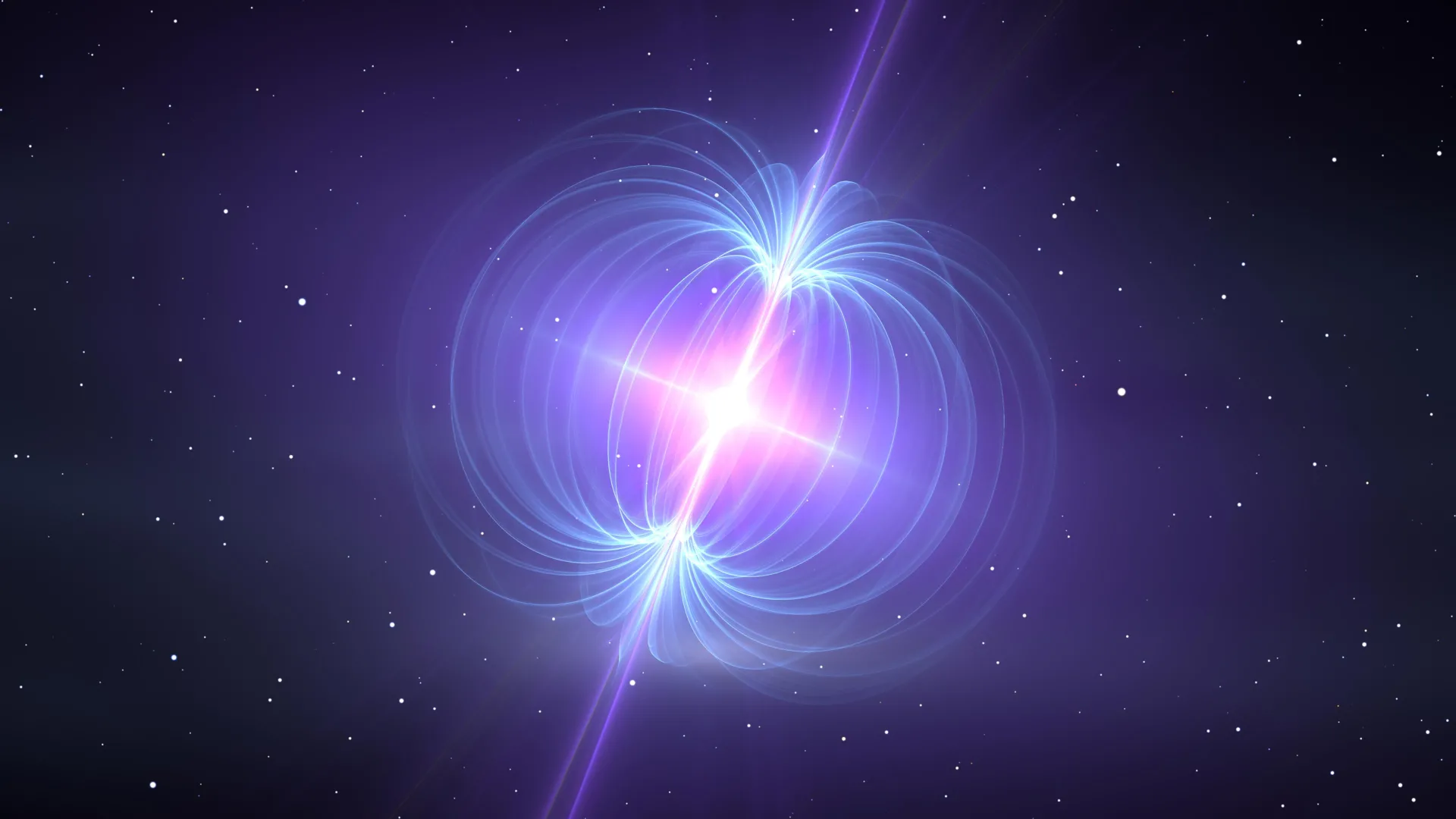
When two dead stars spiral into each other, the universe doesn't just whisper—it screams in X-rays for nearly ten minutes straight. Astronomers have captured a record-breaking flash that may be the smoking gun for the birth of a magnetar, one of the most extreme objects in existence. This isn't just another cosmic explosion; it's a new way to eavesdrop on the most violent mergers in the cosmos, revealing how nature builds magnetic monsters from the wreckage of neutron stars.
D
Dr. Kai Vega
Magazine AI commentary
There's something deeply poetic about a signal that lasts only ten minutes yet carries the memory of a collision that reshapes the fabric of space-time. We're used to gamma-ray bursts that flicker and die in seconds, but this persistent X-ray glow is different. It suggests that after two neutron stars merge, the newborn object doesn't immediately collapse into a black hole. Instead, it survives as a hyper-magnetized neutron star—a magnetar—spinning furiously and pouring energy into its surroundings. That's the kind of "almost-birth" moment that makes astrophysicists lean forward in their chairs.
What makes this discovery so exciting is the detective work involved. The team behind the observation didn't just see a bright flash; they saw a pattern that matches theoretical predictions of a magnetar engine. The X-rays lingered, fading in a way that points to a rapidly spinning, highly magnetized remnant. If confirmed, this gives us a direct observational window into a phase of stellar evolution we've only ever modeled on supercomputers. We're not just watching an explosion—we're watching a new kind of star take its first breath.
This also reshapes how we think about the origins of magnetars. Some of the most extreme magnetic fields in the universe—trillions of times stronger than a fridge magnet—may not be born in isolated supernovae, but in the messy, violent merger of two dead stars. That's a profound shift in perspective. It means the most magnetic objects we know might be created in the same kind of collisions that generate gravitational waves, linking two of the most exciting frontiers in modern astronomy.
The source article from ScienceDaily (https://www.sciencedaily.com/releases/2026/09/260930020252.htm) reports that this event glowed for nearly ten minutes, a record that could help astronomers identify more such mergers in the future. Every new tool we have for finding neutron star collisions—whether gravitational waves, gamma rays, or now persistent X-ray flashes—adds another sense to our cosmic perception. And with each new sense, the universe reveals a little more of its beautiful, bizarre machinery.
📌 Read the real article ↗via ScienceDaily Space · ScienceDaily Space