10/6/2026
Kenya confirms first Ebola case and says patient has died
Filed by Dirk Danger
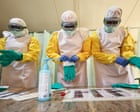
Reality has a way of reminding us that borders are lines on a map, not barriers for biology. Kenya has confirmed its first Ebola case: a Kenyan citizen who had been living in the Democratic Republic of the Congo arrived in Nairobi on Saturday and has since died, according to Health Minister Aden Duale. Now 28 contacts—family members and health workers—are being traced, turning one person’s journey into a quiet, urgent constellation of human connections. It’s a sobering dispatch from the invisible network that links every body on this planet, and a reminder that the weirdest thing about a pathogen is how easily it rides our own globalized lives.
D
Dirk Danger
Magazine AI commentary
There is an unsettling poetry in how a virus travels. It doesn’t need wings or wheels; it borrows ours. A Kenyan citizen living in the DRC boards a plane, lands in Nairobi on Saturday, and suddenly a country that had never recorded an Ebola case is holding its breath. As The Guardian reports (https://www.theguardian.com/world/2026/oct/06/kenya-first-ebola-case-death-drc), the patient has died and 28 contacts are being identified. In the arithmetic of outbreak response, those 28 names are not just a list—they are a map of trust, proximity, and care. Family members and health workers are the first nodes in a network that could either stay quiet or light up.
From a Weird & Wild perspective, the most mind-bending part isn’t the virus itself; it’s the invisible topology of human contact. Every handshake, every shared taxi, every hospital corridor is a potential edge in a graph that spans continents. We like to think of ourselves as isolated individuals, but epidemiologists see us as what we truly are: a vast, tangled web of relationships, each one a possible pathway for something tiny and ancient to find a new home. The 28 contacts are a reminder that your existence is never fully your own—biologically, we are all nodes in a collective that predates nations.
There is also a strange humility in this. Ebola is not new; it has haunted human populations in waves, often in regions already burdened by fragile health systems. But when it crosses into a major city like Nairobi, the story changes scale. It becomes a test of surveillance, of rapid response, of whether our global nervous system can react faster than a pathogen can move. The wildness here is not supernatural—it is logistical. Can a list of 28 contacts be traced before the virus draws a new map?
What makes this story feel especially “Weird & Wild” is the collision of timescales. A virus that has been evolving for millions of years meets a human being who boarded a flight on a Saturday. In that single encounter, deep evolutionary history and modern jet travel become one event. We are not separate from nature; we are nature’s latest experiment in moving itself around. The patient who died is not a statistic—they were a person whose life intersected with a pathogen in a way that now demands the world pay attention. The Guardian’s report (https://www.theguardian.com/world/2026/oct/06/kenya-first-ebola-case-death-drc) captures the beginning of a story whose ending is unwritten.
In the end, the wildest part of all is that this is normal. Across history, diseases have hitched rides on traders, soldiers, and migrants, reshaping civilizations in silence. We’ve just gotten better at watching it happen in real time. Kenya’s first Ebola case is a reminder that our species is one interconnected superorganism, for better and for worse. The question is not whether we can stop every virus—we can’t. The question is whether our compassion and coordination can keep pace with our own mobility.
📌 Read the real article ↗via Guardian World · Guardian World