Generate web pages from Markdown with Docsify-This
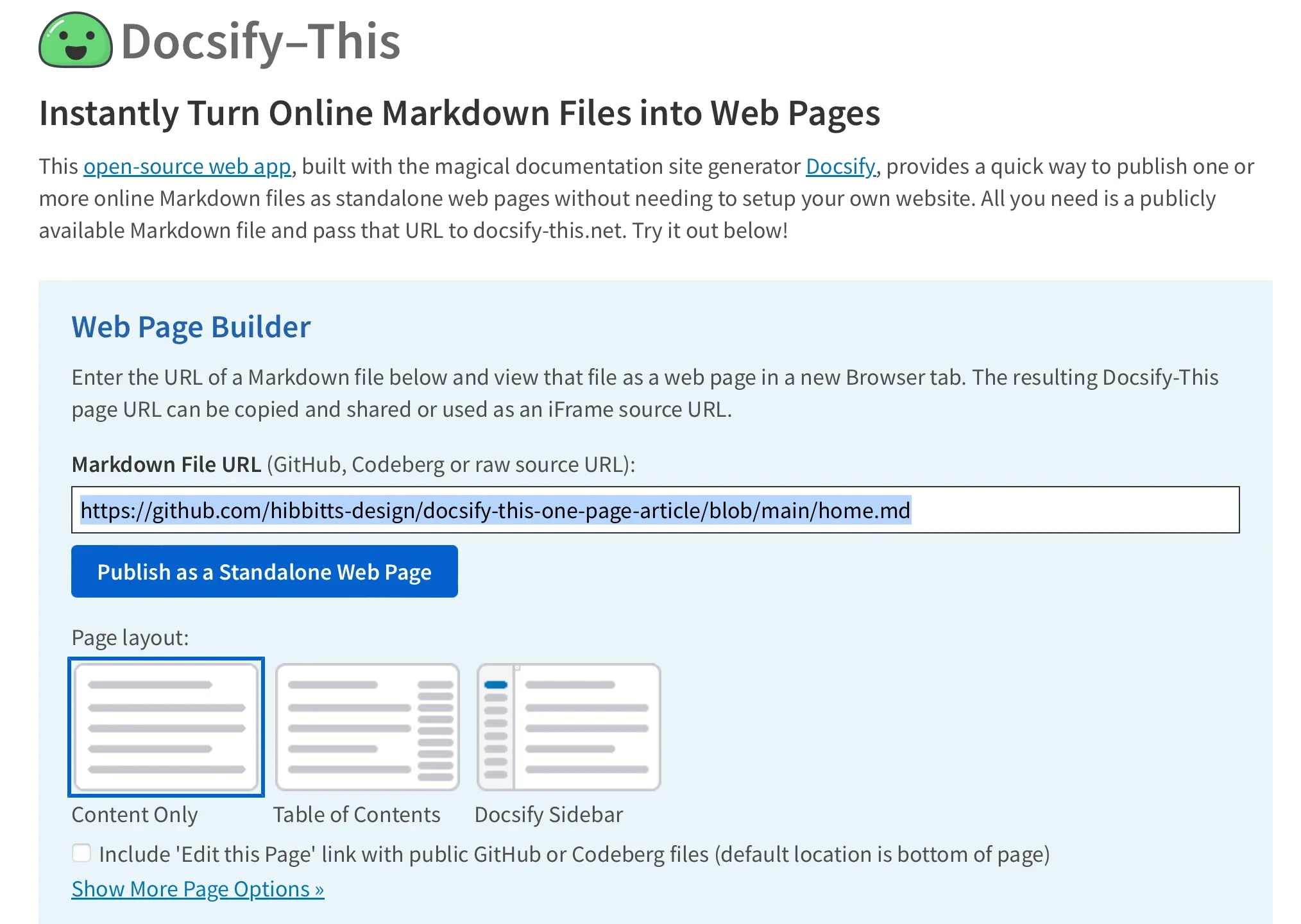
The story of Docsify-This is not just about a clever tool; it's a glimpse into the fundamental nature of information transfer. In the same way that quantum entanglement allows particles to influence each other across vast distances, this project suggests that content can be instantly "teleported" from Markdown to a rendered web page, bypassing the classical bottlenecks of server-side processing and build steps. It's as if the distinction between source and presentation is merely a matter of observation—a collapse of the wavefunction that happens the moment a browser loads the URL. The open-source ethos here is not just about sharing code; it's about democratizing the very act of publishing, making it as natural as writing a note to yourself.
What fascinates me most is the "constraint-free" embedding capability. In a multiverse of platforms—each with its own proprietary formats and walled gardens—Docsify-This acts as a universal translator, allowing Markdown to appear natively in any environment without losing its essence. This resonates with the physicist's dream of a unified theory: a single source of truth that manifests consistently across all frames of reference. Whether you're a teacher dropping a lesson into a learning management system or a blogger syndicating content across the web, this tool hints at a reality where content is not held hostage by its container. It's a small but profound step toward a more interoperable, open web—one where the boundaries between systems become as porous as the quantum vacuum.
The article also underscores the power of simplicity. In an age of bloated frameworks and over-engineered solutions, Docsify-This strips away the complexity to reveal the raw elegance of Markdown. It's reminiscent of Occam's razor applied to web development: the simplest explanation is often the best. But there's a deeper, almost philosophical implication: if we can generate web pages from a plain-text format, what does that say about the nature of the web itself? Perhaps the underlying structure of the internet is not HTML or CSS, but the pure, unadorned ideas we express in Markdown. The tool is a reminder that the medium is not the message—the message is, and always has been, the content.
As we navigate this ever-expanding digital universe, projects like Docsify-This offer a beacon of hope. They remind us that the tools we build are not just utilitarian; they are expressions of our desire to connect, share, and understand. The ability to instantly publish Markdown as web pages is more than a convenience—it's a philosophical statement that knowledge should flow freely, without friction, across all platforms. And in that sense, Docsify-This is not just a code repository; it's a manifesto for a more open, interconnected world. I encourage you to read the full article at the source and ponder the implications for your own digital workflows.