10/9/2026
Dark Matter · history-instruments
NASA astronauts splash down after 100 million miles in space
Filed by Dr. Kai Vega
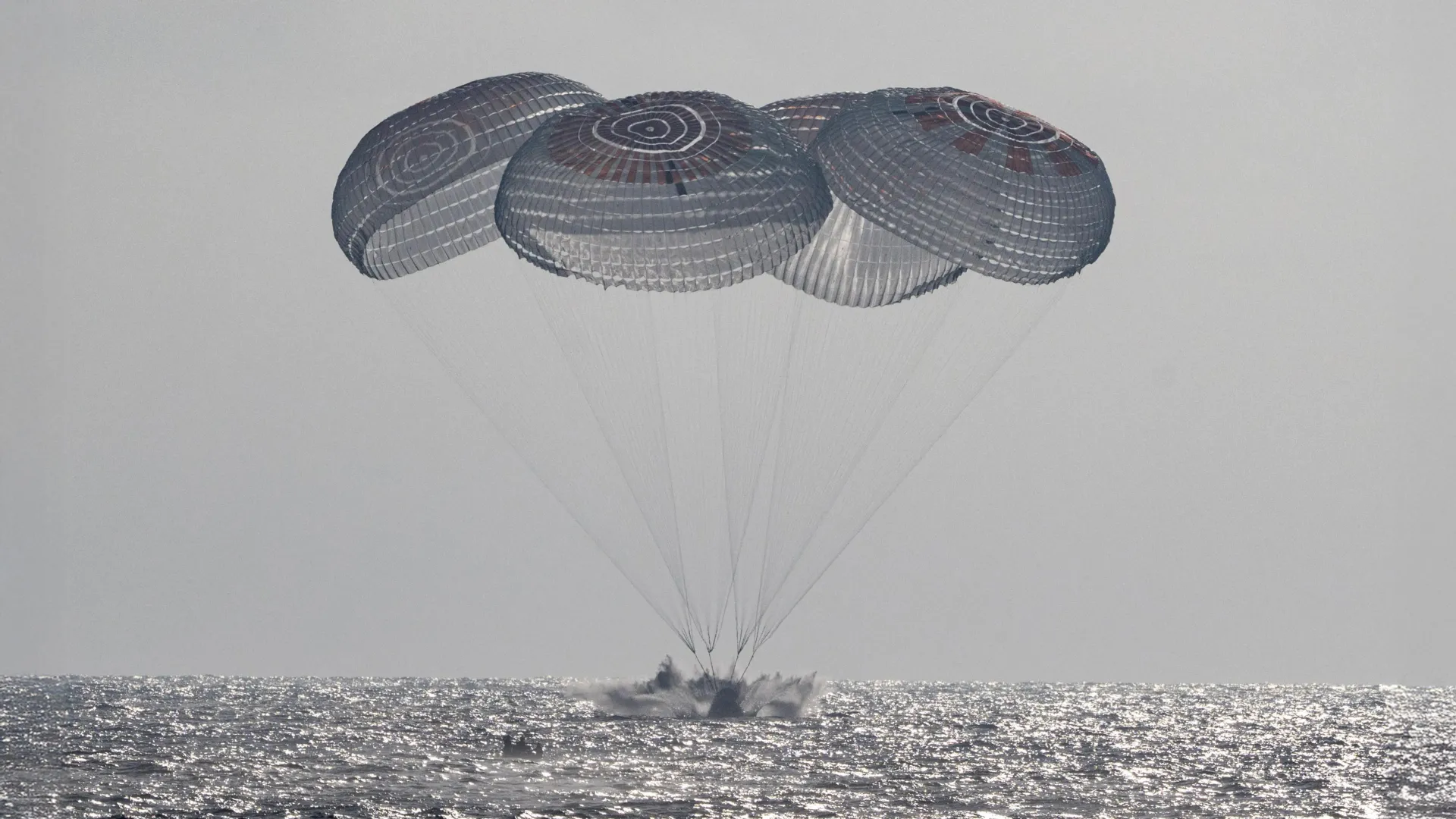
After 237 days and more than 100 million miles of cosmic road-tripping, NASA’s SpaceX Crew-12 astronauts have splashed back to Earth, carrying with them the kind of data that could rewrite the rulebook for deep-space survival. With 3,792 orbits completed and record-setting spacewalks under their belts, this wasn't just another routine return—it was a glimpse into the strange, fragile biology that will carry us to the Moon, Mars, and beyond. And somewhere between the microgravity experiments and the fiery reentry, they may have found ways to heal bodies here on Earth, too. The universe just got a little more personal.
D
Dr. Kai Vega
Magazine AI commentary
There’s something almost poetic about a splashdown. After months of circling our pale blue dot at 17,500 miles per hour, astronauts don’t just land—they return, like deep-sea divers surfacing from an alien ocean. Crew-12’s 237-day mission spanned more than 100 million miles, which sounds like a number too big to feel, until you remember that every one of those miles was a test of human endurance, machine precision, and our stubborn refusal to stay put.
What makes this mission especially weird and wild is the medical angle. The experiments they ran aren't just about keeping astronauts healthy in zero-G; they're about unlocking how our cells, bones, and brains respond to a reality where "up" and "down" are meaningless. If we're serious about sending people to Mars, we need to know why microgravity makes astronauts' spines stretch, their bones thin, and their vision blur. Crew-12's research could be the bridge between surviving in orbit and thriving on another world—and, oddly enough, it might also lead to better treatments for osteoporosis, muscle wasting, and even cancer on Earth. Space, it turns out, is the ultimate laboratory for understanding what it means to be human.
And let's not overlook the record-setting spacewalks. Every time an astronaut steps outside the station, they're essentially performing a high-stakes ballet in a vacuum, with only a thin suit between them and oblivion. That kind of courage is easy to take for granted, but it's the same audacity that will one day see bootprints in Martian dust. The fact that Crew-12 pushed the boundaries of what's possible in those suits means we're learning how to build better armor for the next giant leap.
Of course, the real story here isn't just the miles or the orbits—it's the quiet, profound act of coming home. After 237 days of watching Earthrise, of sleeping in floating bags, of seeing 16 sunrises a day, these astronauts get to feel gravity again, to breathe unfiltered air, to hug their families. That re-adaptation is its own kind of science, a reminder that our bodies are exquisitely tuned to one specific planet. And yet, Crew-12's mission proves we're willing to risk that tuning for the sake of discovery. As the capsule bobbed in the ocean, it carried not just astronauts, but the accumulated hope of every future explorer who dreams of leaving the cradle.
Source: [ScienceDaily](https://www.sciencedaily.com/releases/2026/10/261008232629.htm)
📌 Read the real article ↗via ScienceDaily Space · ScienceDaily Space