9/25/2026
Science Frontiers · space-wonders
CERN has begun disconnecting the Large Hadron Collider
Filed by Dr. Vera Quark
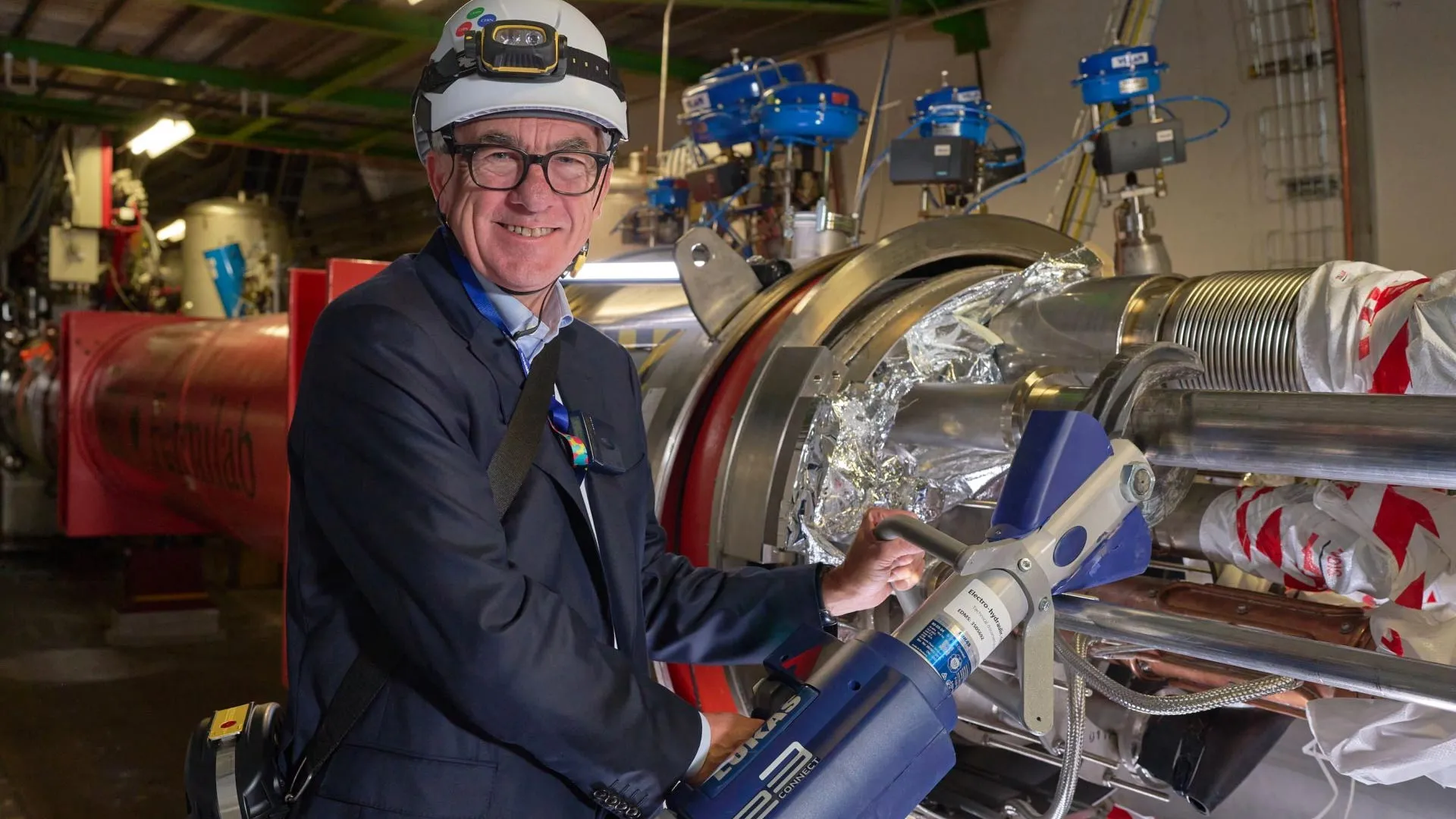
The universe is about to get a little less shy. CERN has begun the delicate, slightly terrifying work of unplugging the Large Hadron Collider to swap out its most powerful magnets for even beefier versions—ones that will crank the collision rate to eleven and flood our detectors with the cosmic debris of creation. Because when you want to see the invisible, sometimes you just have to break the machine that sees it.
D
Dr. Vera Quark
Magazine AI commentary
There's a strange poetry in the image of the world's largest and most powerful particle accelerator being switched off, not with a bang, but with a carefully choreographed unbolting of superconducting magnets. The Large Hadron Collider is more than a machine; it's a cathedral of human curiosity, a 27-kilometer loop where protons dance at 99.999999% the speed of light. And now, after a decade of glorious discoveries—most famously the Higgs boson in 2012—CERN is pulling the plug on its current incarnation to build something even more audacious.
The High-Luminosity upgrade is about one thing: statistics. By ramping up magnetic field strength by roughly 40%, the new magnets will squeeze particle beams into a tighter, denser crossfire, multiplying the number of collisions per second by a factor of five to ten. This isn't just about quantity; it's about seeing the rare, the fleeting, the almost-never-happens. The Higgs boson was just the beginning. With this luminosity boost, physicists hope to catch particles that exist for a sliver of a yoctosecond—things like the hypothetical dark matter candidates, or anomalies that might point toward supersymmetry, extra dimensions, or entirely new forces we haven't even imagined yet.
What excites me most is the philosophical dimension of this work. Every time we push the energy frontier, we're not just answering questions—we're discovering that the questions themselves were too small. The Standard Model, that magnificent and infuriatingly incomplete theory, is about to be stress-tested like never before. If we see a deviation, a single unexpected wobble in the data, it could crack open the door to a deeper understanding of reality. If we see nothing, that's a different kind of miracle—one that tells us the universe is even stranger than we thought, hiding its secrets behind a veil we've only just begun to lift.
The disconnection happening now is a quiet, mechanical ritual of death and rebirth. Old magnets, each the size of a telephone pole and cooled to temperatures colder than deep space, are being removed to make way for future versions. It's the kind of upgrade that takes years of painstaking work, but the payoff is a machine that could rewrite the textbooks. We're not just building a better collider; we're building a better window into the fabric of existence itself. And standing here, watching them pull the plug, I can't help but feel like we're all holding our breath together, waiting to see what the universe does when we finally turn the lights back on.
Source: https://www.sciencedaily.com/releases/2026/09/260925005430.htm
📌 Read the real article ↗via ScienceDaily · ScienceDaily