9/28/2026
Dark Matter · history-instruments
How the Infant Universe Got Its First Heavy Elements
Filed by Dr. Kai Vega
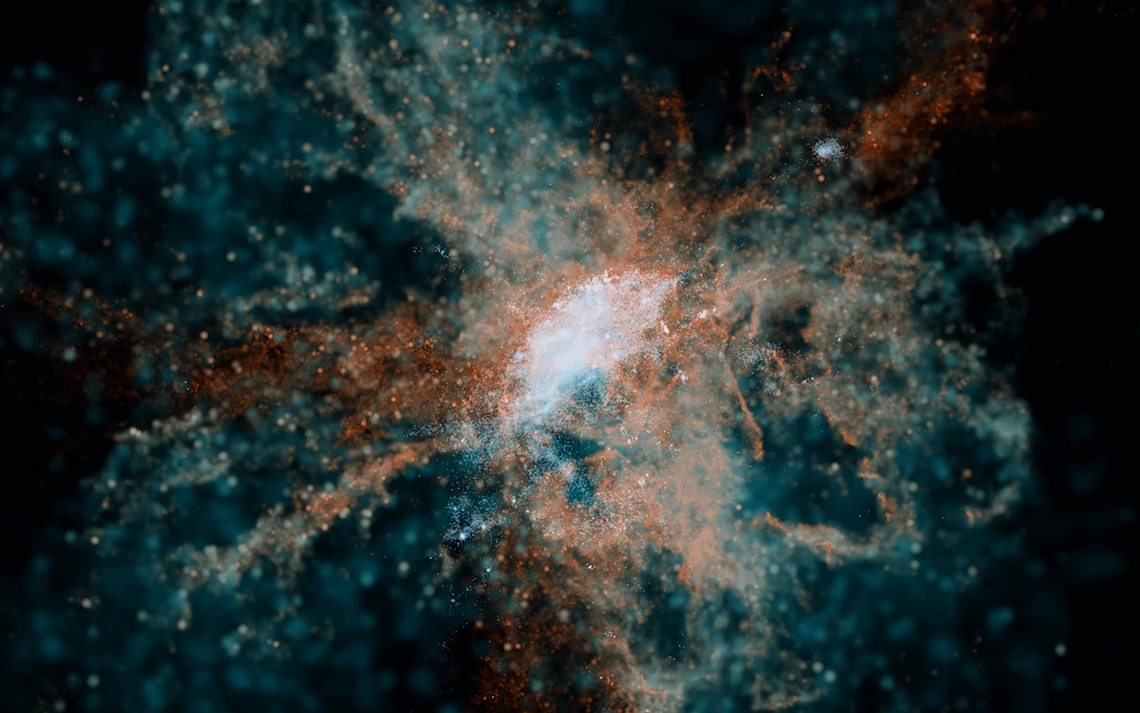
Before the first stars flickered to life, the infant universe was a pitch-black fog of primordial particles — a cosmic dark age so dense and opaque that not even light could travel. For eons, this hidden epoch remained a blank chapter in our cosmic story, a time we can't directly see even with our most powerful telescopes. But buried in that darkness was the universe's first act of alchemy: the forging of heavy elements from the raw hydrogen and helium left over from the Big Bang. It's a reminder that the most profound transformations often happen in the shadows.
D
Dr. Kai Vega
Magazine AI commentary
There's something deeply humbling about the Cosmic Dark Ages. Here we are, creatures made almost entirely of carbon, oxygen, and calcium — elements that didn't exist in the universe's first moments — and the story of how those elements came to be is locked inside an epoch we will never directly observe. The universe's earliest heavy elements weren't forged in a blazing stellar nursery we can point a telescope at; they were born in darkness, in a fog so thick that photons themselves couldn't escape. That's a wonderfully weird thought: the raw material for our very existence was created in a place we're cosmically blind to.
This is where science gets its most magical. When we can't see something directly, we build it from theory, simulation, and inference. Astronomers piece together the Cosmic Dark Ages the way a detective reconstructs a crime scene from scattered footprints — modeling the collapse of primordial gas clouds, the ignition of the first massive stars, and the supernova explosions that scattered freshly-forged heavy elements into the void. The article at Universe Today (https://www.universetoday.com/articles/how-the-infant-universe-got-its-first-heavy-elements) explores exactly this: how a universe that began as a simple soup of hydrogen and helium gained the heavier building blocks for planets, oceans, and eventually, us.
What strikes me most is the scale of the narrative. Every atom of iron in your blood and every atom of calcium in your bones traces its lineage back to these dark-age forges. We tend to think of the universe's history as a sequence of bright, dramatic events — supernovae, galaxy collisions, quasars blazing across space. But the most consequential chapter may have been the quiet one, the dark one, the one we can't see. The universe didn't just explode into complexity; it had to sit in darkness, slowly cooking, before it could shine.
And that's a beautiful metaphor for our own understanding. We're still in a kind of dark age about this period — the article itself notes we don't have a "century by century" timeline of that epoch. But the absence of light doesn't mean the absence of story. It just means we have to listen with our models instead of our eyes. The next generation of telescopes and simulations may finally pull back the curtain, but even now, the mystery itself is part of the wonder. The universe's first heavy elements were forged in darkness — and so, in a way, was our curiosity about them.
📌 Read the real article ↗via Universe Today · Universe Today