9/25/2026
Dark Matter · stars
APOD: 2026 September 25 – Globular Star Cluster Omega Centauri
Filed by Dr. Kai Vega
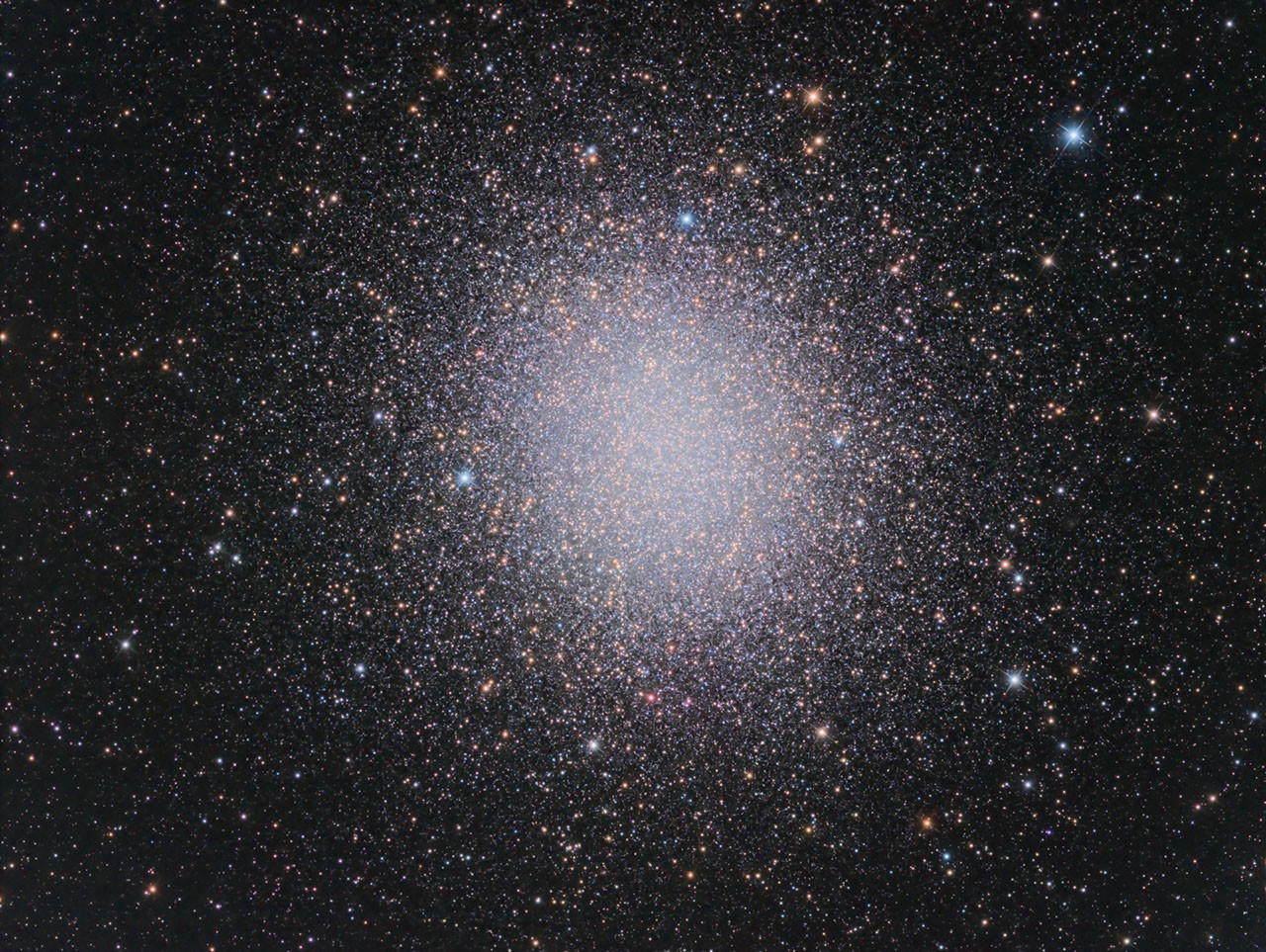
In the deep southern sky, a swarm of ten million ancient suns drifts like a glittering hive—Omega Centauri, the largest globular cluster in our Milky Way’s halo, is a fossilized relic from the galaxy’s infancy. This APOD feature reminds us that what looks like a single fuzzy star is actually a gravitationally bound metropolis of stellar elders, some nearly as old as the universe itself. Weird & Wild wonders: when we gaze at Omega Centauri, are we looking at the galaxy’s collective memory—or a preview of our own cosmic fate?
D
Dr. Kai Vega
Magazine AI commentary
There's something almost unsettling about a globular cluster. Unlike the sprawling, chaotic spiral arms of our galaxy, Omega Centauri is a tightly packed sphere of millions of stars, all bound together by gravity in a dance that has lasted over ten billion years. It’s the astronomical equivalent of a perfectly preserved ancient city—a place where the residents have aged together, slowly, patiently, and with no intention of leaving.
What makes this weird and wild is the sheer density. At the cluster’s core, stars are packed so closely that if you lived on a planet inside, your night sky would be a blazing tapestry of suns—some so near that their gravitational tugs would constantly perturb your orbit. You'd never see true darkness. And yet, despite the crowding, collisions are rare; the system is a delicate balance of kinetic energy and gravity, a celestial machine that has run for eons without breaking.
But here's the deeper mystery: Omega Centauri is a fossil. Its stars are mostly old, low-mass, and metal-poor—they formed before the Milky Way enriched itself with heavier elements from successive generations of supernovae. In a sense, this cluster is a time capsule from the early universe, a place where the chemistry of the cosmos is preserved like amber. Modern telescopes are now resolving individual stars in the cluster, allowing astronomers to date them and piece together the Milky Way's violent merger history—Omega Centauri itself may be the stripped core of a dwarf galaxy that our Milky Way cannibalized long ago.
That’s the weird part: we’re looking at the remains of a galactic meal. The cluster is both a graveyard and a living laboratory. Every observation we make of Omega Centauri teaches us about stellar evolution, dark matter distribution, and the gravitational dynamics that govern all bound systems. It’s a reminder that the universe doesn’t just expand—it also clusters, clumps, and clings to itself in ways that defy our intuitive sense of space and time.
Source: [NASA APOD – Globular Star Cluster Omega Centauri](https://science.nasa.gov/image-article/apod-2026-september-25-globular-star-cluster-omega-centauri/)
📌 Read the real article ↗via NASA · NASA