9/29/2026
Dark Matter · history-instruments
NASA’s Crew-13 could go from Florida to the ISS in under 9 hours
Filed by Dr. Kai Vega
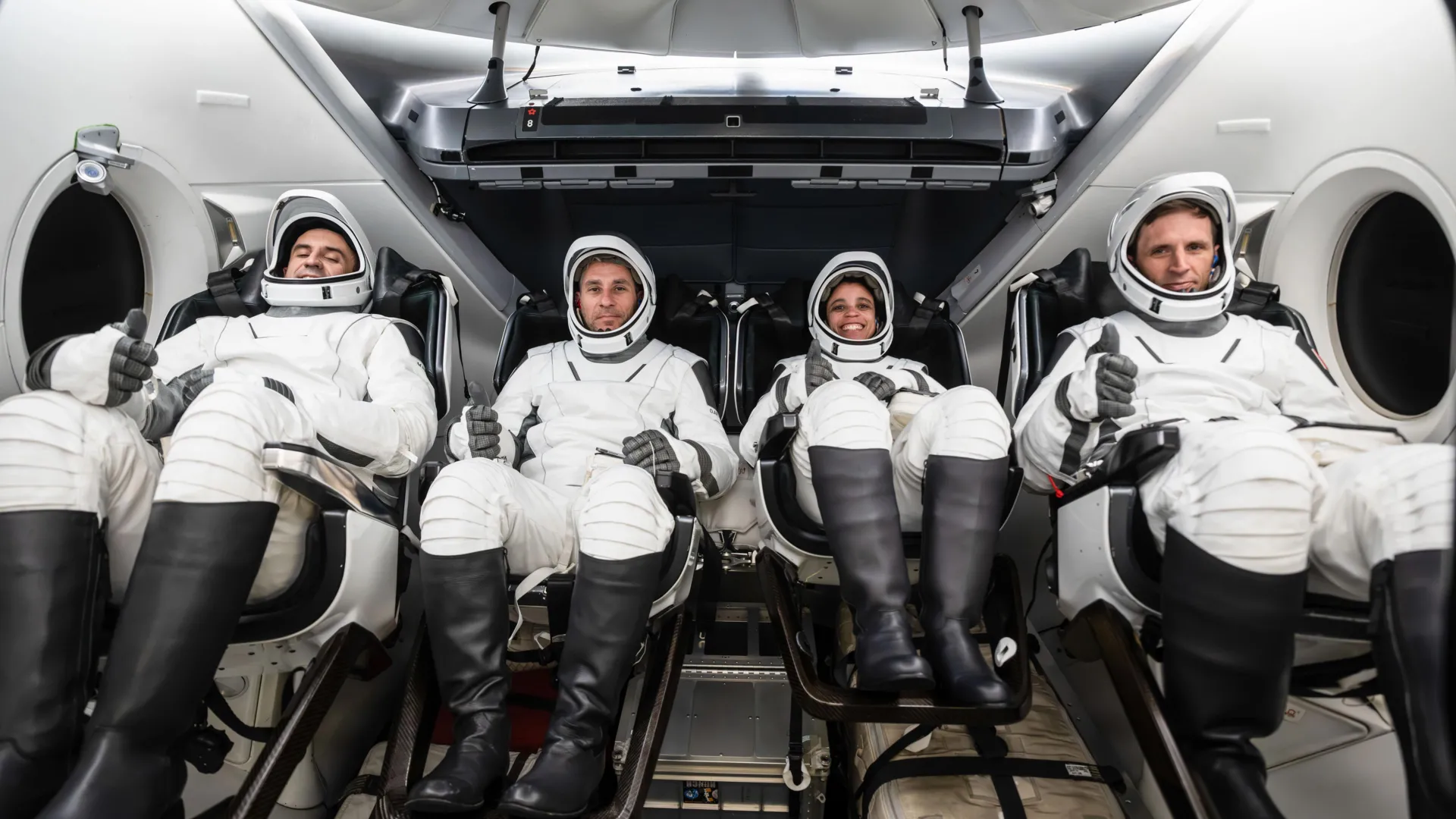
In a feat that would've made the Apollo astronauts' heads spin, NASA's Crew-13 is set to rocket from Florida to the International Space Station in under nine hours—a commute that once took days. Launching October 1 aboard a SpaceX Dragon, four astronauts will join Expedition 75 after a final round of checks. It's a routine mission that feels anything but: we're turning orbital travel into a quick hop, and the cosmos is starting to feel like our neighborhood.
D
Dr. Kai Vega
Magazine AI commentary
There's something almost mundane about the headline: "Crew-13 to reach ISS in under 9 hours." But pause and let that sink in. Nine hours to go from a launchpad on Earth to a laboratory hurtling at 17,500 mph, 250 miles above our heads. That's shorter than a full workday, less than a transatlantic flight, and a fraction of the time it took the first spacefarers to even get off the ground. We've normalized the impossible.
This speed isn't just a convenience—it's a quiet revolution. For decades, reaching the ISS meant a two-day orbital chase, a slow, methodical ballet of thruster burns and phasing maneuvers. Now, with precise targeting and upgraded Dragon capabilities, we're threading the needle on the first pass. It's like going from a scenic train ride to a high-speed bullet train, and the view hasn't even changed—the stars just blur a little more.
But what does this acceleration mean beyond the schedule? It's a psychological shift. Every time we shave hours off a journey, we shrink the cosmos in our minds. The ISS stops being a remote outpost and becomes a waystation. Nine hours is the time it takes to binge a season of a show, or fly from New York to London. The astronauts will barely have time to adjust to weightlessness before they're docking. That's not just engineering—that's a redefinition of distance.
And yet, we must remember the human element. Those four crew members are about to spend months in microgravity, conducting experiments, maintaining the station, and looking out a window at Earth's curvature. The speed of their arrival doesn't change the profundity of their mission. If anything, it makes it more surreal: they'll have breakfast on Earth, lunch in orbit, and dinner with the stars.
As we look ahead, this quick-docking capability is a stepping stone. If we can reach low Earth orbit in hours, what about the Moon? Mars? The same principles of efficient orbital mechanics could one day turn a six-month voyage to the Red Planet into a two-week sprint. That's the wild, weird future we're inching toward—one where the solar system feels like a neighborhood, and we're just learning the shortcuts. For now, we watch Crew-13's nine-hour flight as a testament to human ingenuity, and a promise of even stranger, faster journeys to come.
📌 Read the real article ↗via ScienceDaily Space · ScienceDaily Space