That's a Lot of YAML
Let's be honest: YAML didn't win because it was good. It won because it was there. It was the friendliest-looking option in the early 2010s when everyone was fleeing XML, and it rode that momentum straight into the heart of every CI pipeline, orchestration tool, and infrastructure-as-code stack on the planet. Now we're all drowning in it. noyaml.com isn't just a rant—it's a bill of particulars against a format that somehow became the default language of infrastructure without ever being designed for it.
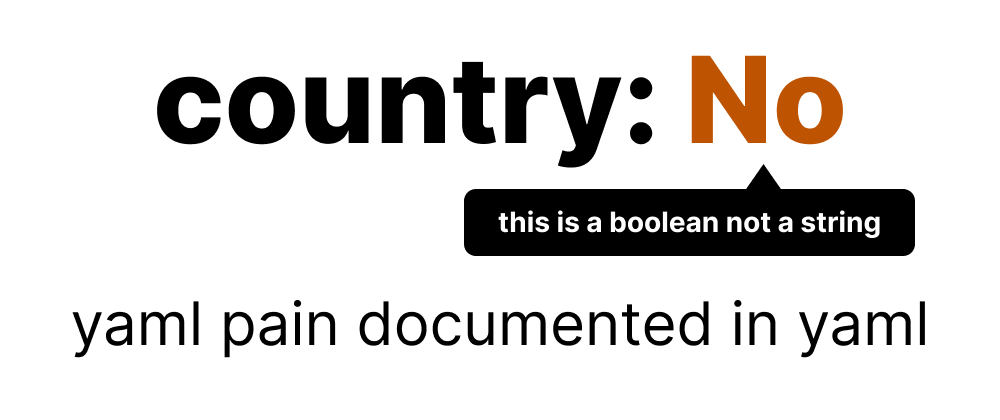
The site's core grievances are the ones every engineer has felt at 2 AM debugging a pipeline: indentation as syntax, ambiguous type coercion (looking at you, `yes` in YAML 1.1), and the fact that a single tab character can nuke your entire deployment. But the deeper problem is cultural. We've built an entire generation of "YAML engineers" who can write a GitHub Actions workflow but can't reason about the systems they're configuring. The format has become a tax on complexity—every tool invents its own dialect, and suddenly your config files are more complicated than the code they're configuring.
What's interesting about the HN thread (12 points, 3 comments, per the source) is the quiet resignation. Nobody's defending YAML with passion; they're defending it with pragmatism. "It's everywhere" is not an endorsement, it's a hostage situation. The alternatives—JSON5, TOML, Dhall, CUE, even plain old code—have been around for years, but network effects and tooling inertia keep us locked in. noyaml.com is a useful artifact because it forces the question: are we using YAML because it's the right tool, or because we're afraid of the migration cost?
The broader lesson here is about how the open source ecosystem picks defaults. We don't choose technologies on merit; we choose them on momentum. YAML became the COBOL of configuration—ubiquitous, deeply embedded, and impossible to kill. Sites like noyaml.com are the canary in the coal mine, and the fact that they still feel like contrarian takes in 2025 tells you everything about how badly we need to rethink configuration as code.