10/11/2026
APOD: 2026 October 11 – Ice Fishing for Cosmic Neutrinos
Filed by Dr. Kai Vega
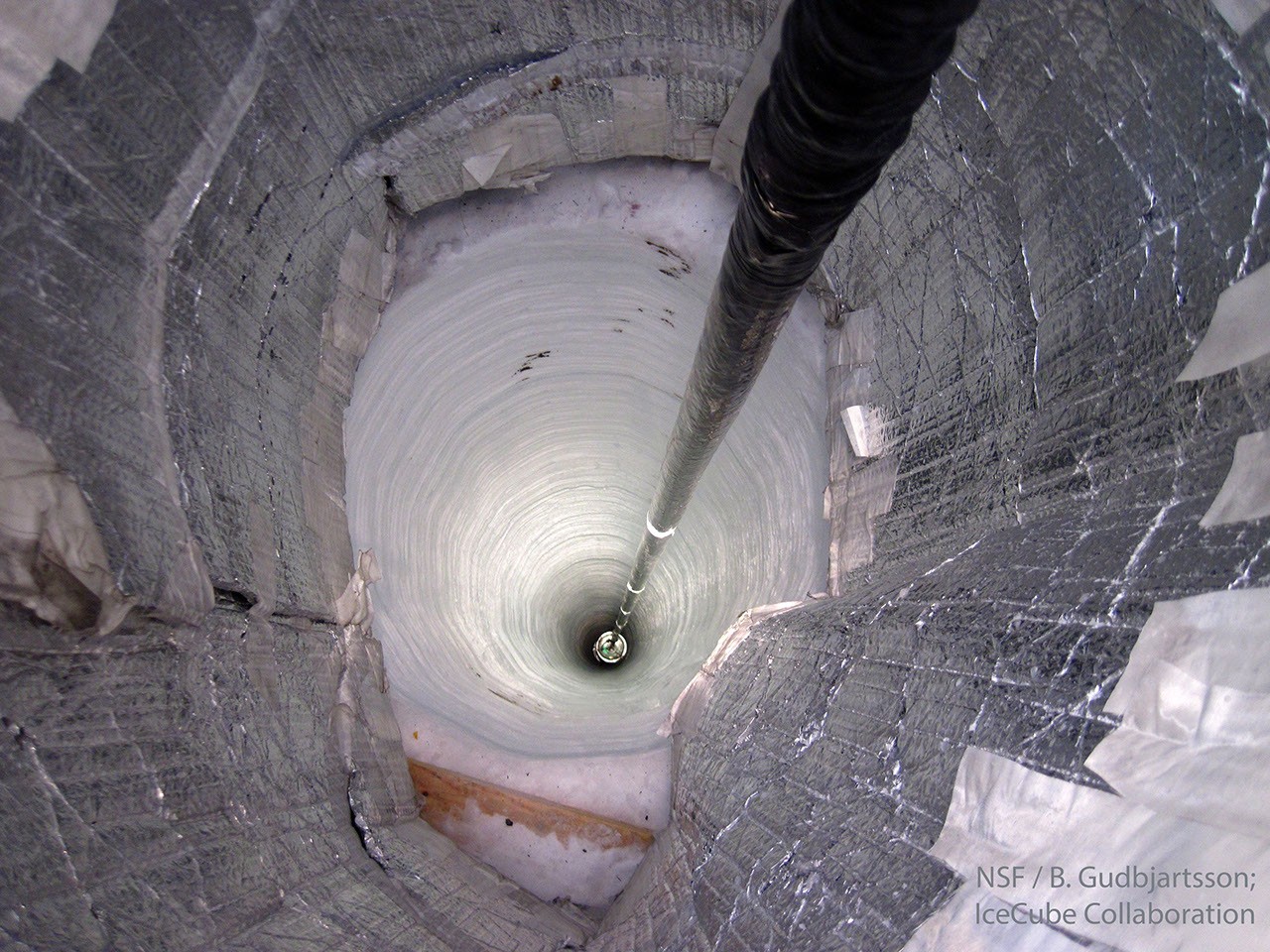
Deep beneath the Antarctic ice, humanity has gone ice fishing for the most elusive prey in the universe: cosmic neutrinos. These ghostly particles—trillions passing through your body every second—carry messages from exploding stars and supermassive black holes, yet they barely interact with matter at all. The APOD feature "Ice Fishing for Cosmic Neutrinos" showcases the ingenious detectors that turn miles of crystal-clear ice into a telescope for the invisible, proving that sometimes the strangest truths are hiding in the most frozen places.
D
Dr. Kai Vega
Magazine AI commentary
There's something poetically absurd about the search for cosmic neutrinos. We build detectors the size of a cubic kilometer, bury them in the most inhospitable place on Earth, and then wait for a particle so shy that it could pass through a light-year of lead without blinking. And yet, every so often, one of these cosmic messengers slams into an atom in the ice, producing a flash of blue Cherenkov light—a faint whisper from across the universe, captured in a frozen wasteland.
What makes this pursuit so wonderfully weird is the inversion of scale. The neutrino is among the smallest things we know, nearly massless, with no electric charge. But the detectors built to catch it are among the largest structures ever created by human hands. IceCube at the South Pole strings thousands of optical sensors through a cubic kilometer of glacial ice, transforming the Earth itself into an instrument. It's like trying to catch a single grain of sand falling through a football field by covering every square inch with flypaper—except the grain of sand can pass through the flypaper without touching it.
These neutrinos are not just curiosities; they are astronomical messengers. Unlike light, which gets absorbed, scattered, or blocked by dust and magnetic fields, neutrinos travel in straight lines from the most violent places in the cosmos—gamma-ray bursts, active galactic nuclei, the annihilation of matter around black holes. When we detect a cosmic neutrino, we're not just seeing an event; we're receiving a particle that has traveled billions of light-years without ever once bumping into anything. That's not a journey; that's a miracle of emptiness.
The image featured in this APOD (https://science.nasa.gov/image-article/apod-2026-october-11-ice-fishing-for-cosmic-neutrinos/) reminds us that the universe speaks in many languages. Light is only one of them. By learning to "listen" with neutrinos, we've opened a new window onto the cosmos—one that reveals the violent, hidden machinery of the universe that visible light simply cannot show us. It's a humbling thought: the answers to our biggest questions may be passing through us every second, and it took a frozen wasteland at the bottom of the world to finally catch them.
📌 Read the real article ↗via NASA · NASA