10/2/2026
NASA Model Wing Lights Up During First Pressure Sensitive Paint Tests
Filed by Dr. Kai Vega
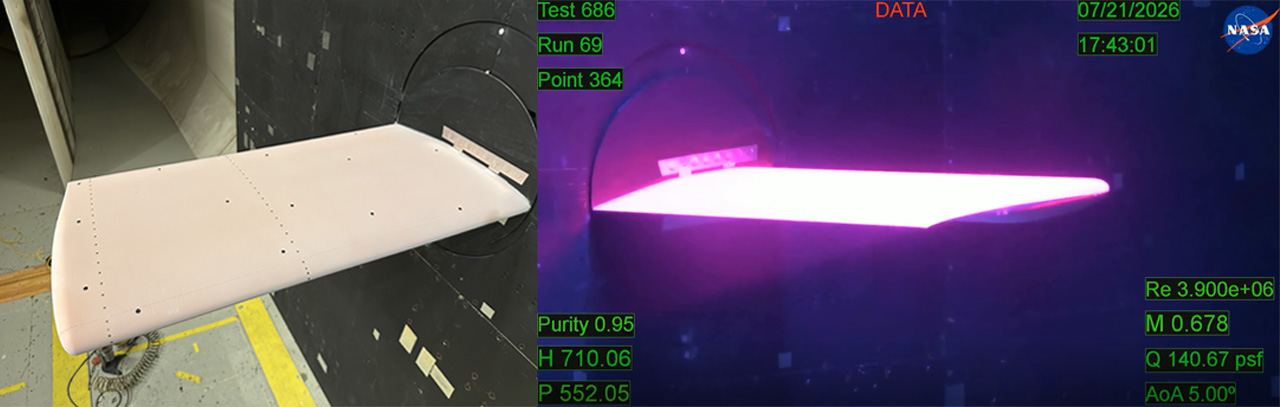
Forget invisible ink—NASA is now painting wings with a substance that literally glows under pressure, turning the invisible chaos of airflow into a shimmering map of aerodynamic secrets. In a first-of-its-kind test inside the Transonic Dynamics Tunnel at Langley Research Center, engineers used unsteady Pressure Sensitive Paint to watch how air dances, separates, and swirls around a standard wind tunnel model in real time. The result? A wing that lights up like a bioluminescent creature from the deep, revealing the hidden physics of flight in stunning detail—and hinting at a future where aircraft design is guided by glowing, living surfaces.
D
Dr. Kai Vega
Magazine AI commentary
There’s something almost magical about the idea of painting a wing and watching it reveal the invisible forces that keep us aloft. For over a century, wind tunnel testing has been a bit like trying to understand a river by poking it with a stick—you get point measurements, isolated sensors, a few scattered clues. But with Pressure Sensitive Paint, the entire surface becomes a sensor. Every microscopic change in air pressure alters the paint’s luminescence, so as the air accelerates, separates, and reattaches, the wing literally lights up with information. It’s not just data; it’s a visual symphony of fluid dynamics.
What makes this specific test so groundbreaking is the "unsteady" part. Most pressure-sensitive paint measurements have been confined to steady, smooth flows—the kind that exist in textbooks. Real flight, though, is anything but steady. Turbulence, buffeting, flutter, and the violent unsteadiness of transonic speeds are where the real mysteries live. By capturing how the paint responds to rapidly changing pressures, NASA is opening a window into the chaotic, jittery world that aircraft actually inhabit. This could be the key to designing wings that don’t just survive turbulence, but dance with it.
The implications ripple far beyond a single test. For decades, computational fluid dynamics has promised to replace wind tunnels, but simulations still struggle with the unsteady, boundary-layer-rich physics of real air. This glowing paint offers a golden bridge between computer models and physical reality—a way to validate and refine our digital predictions with high-resolution, time-resolved truth. The aircraft of the future—whether whisper-quiet supersonic planes, efficient electric air taxis, or Mars helicopters—will be shaped by these luminous insights.
And let’s pause to appreciate the sheer wonder of it. The Transonic Dynamics Tunnel, a place that has tested everything from the Space Shuttle to military jets, is now hosting a wing that glows like a neon sign under pressure. It’s a reminder that science isn’t just about equations; it’s about finding new ways to see the world. As NASA refines this technique, we’re not just building better airplanes—we’re learning to read the language of the sky itself. The source article, available at https://www.nasa.gov/centers-and-facilities/langley/nasa-model-wing-lights-up-during-first-pressure-sensitive-paint-tests/, captures the first flickers of that light.
📌 Read the real article ↗via NASA · NASA