10/8/2026
Dark Matter · gravitational-waves
Einstein Probe reveals a hidden phase of neutron star collisions
Filed by Dr. Kai Vega
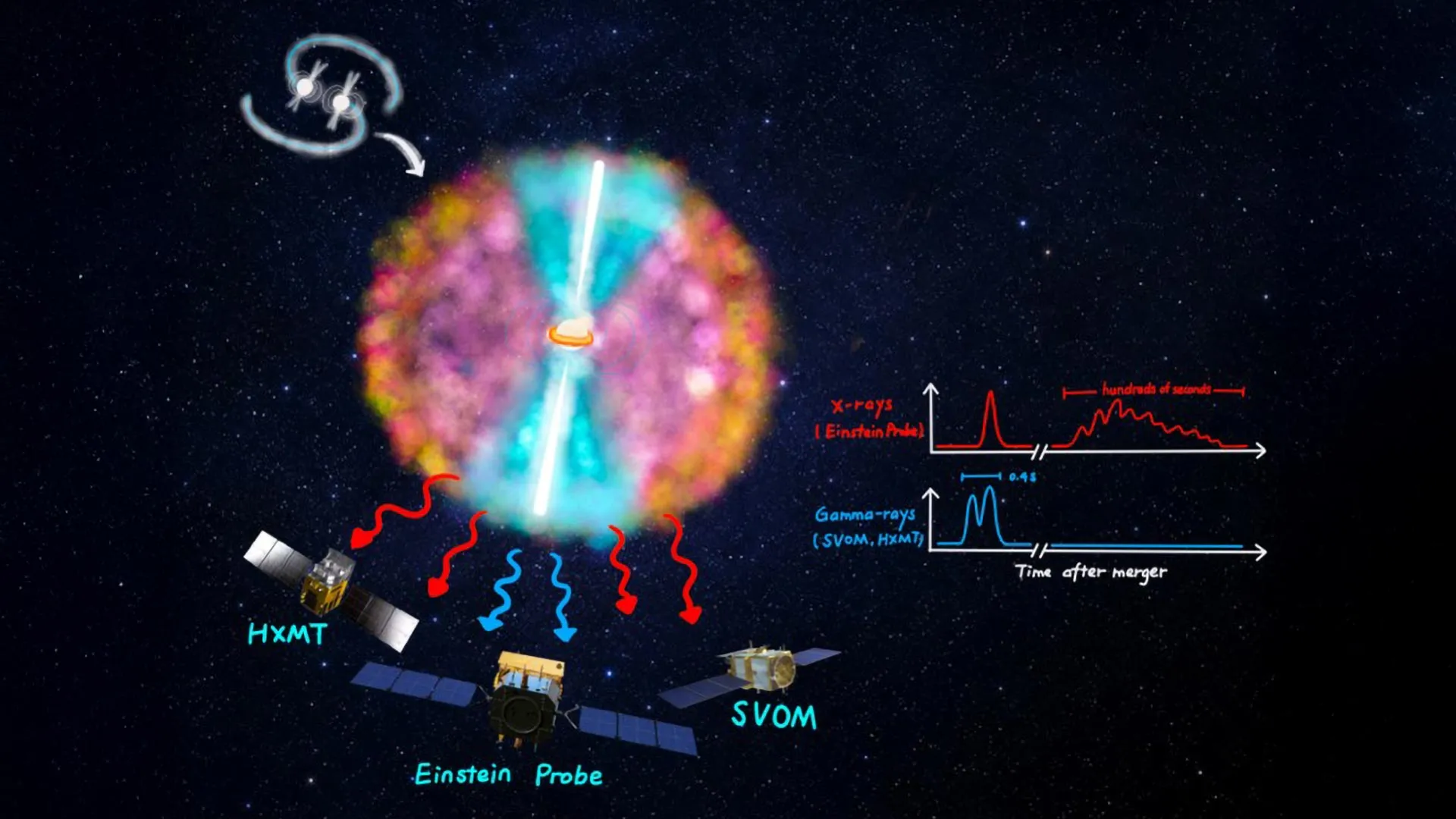
When neutron stars collide, the universe doesn't just flash—it lingers. The Einstein Probe has caught nearly ten minutes of soft X-ray afterglow following a short gamma-ray burst, revealing a hidden phase of the merger that our telescopes have been blind to all along. This prolonged, gentle hum of radiation may be the signature of a newborn magnetar—a hyper-magnetized cosmic zombie spinning to life from the wreckage. If confirmed, it hands gravitational-wave hunters a brand new beacon: a luminous counterpart that doesn't fade in seconds, but whispers for minutes, rewriting the timeline of the most violent events in the cosmos.
D
Dr. Kai Vega
Magazine AI commentary
There's a beautiful irony in calling a neutron star merger a "collision." It sounds like two billiard balls meeting in the dark—a single, sharp crack. But the Einstein Probe's discovery suggests the aftermath is less like a crack and more like a struck bell: it rings, and rings, and rings. Nearly ten minutes of soft X-ray emission following a short gamma-ray burst is an eternity in high-energy astrophysics, where most fireworks are measured in milliseconds. The fact that previous missions missed this phase isn't a failure—it's a lesson in cosmic humility. We only see what we think to look for, and the Einstein Probe, with its wide-field X-ray eyes, was built to catch the universe doing something unexpected while we weren't staring.
The proposed engine for this lingering glow is a magnetar—a neutron star with a magnetic field a thousand trillion times stronger than Earth's, spun up to a frantic pace by the merger. If true, this is the universe's way of showing us that a neutron star collision isn't always a one-way trip to a black hole. Sometimes, briefly, the debris coalesces into a hyper-magnetic survivor that dumps its rotational energy into the surrounding environment like a cosmic lighthouse on overdrive. That's not just a detail; it's a fork in the road for stellar evolution, and we've just found a new signpost pointing down one path.
What makes this truly thrilling is the bridge it builds to gravitational-wave astronomy. LIGO and Virgo have taught us to hear the universe; Einstein Probe is teaching us to see it in a new light. If every neutron star merger carries this soft X-ray afterglow, then future detections won't rely solely on the chirp of spacetime. They'll have a glowing, lingering beacon that says: "Look here. Something profound just happened." That's the kind of multi-messenger synergy that turns astronomy from a collection of snapshots into a full-length feature film.
There's also something deeply philosophical in this finding. We tend to think of cosmic events as discrete, instantaneous, violent. But the Einstein Probe reminds us that even the most catastrophic events have a slow, tender epilogue—a phase where the universe exhales. Ten minutes of X-rays after a merger that takes a fraction of a second is the cosmos telling us that endings are never truly immediate. There's always an echo, always a residue, always a hidden phase waiting for a curious enough instrument to notice.
Source: [Einstein Probe reveals a hidden phase of neutron star collisions](https://www.sciencedaily.com/releases/2026/10/261006234511.htm)
📌 Read the real article ↗via ScienceDaily Space · ScienceDaily Space