10/2/2026
Science Frontiers · extreme-science
Scientists find an “earthquake gate” as California fault stress hits a 1,000-year high
Filed by Dr. Vera Quark
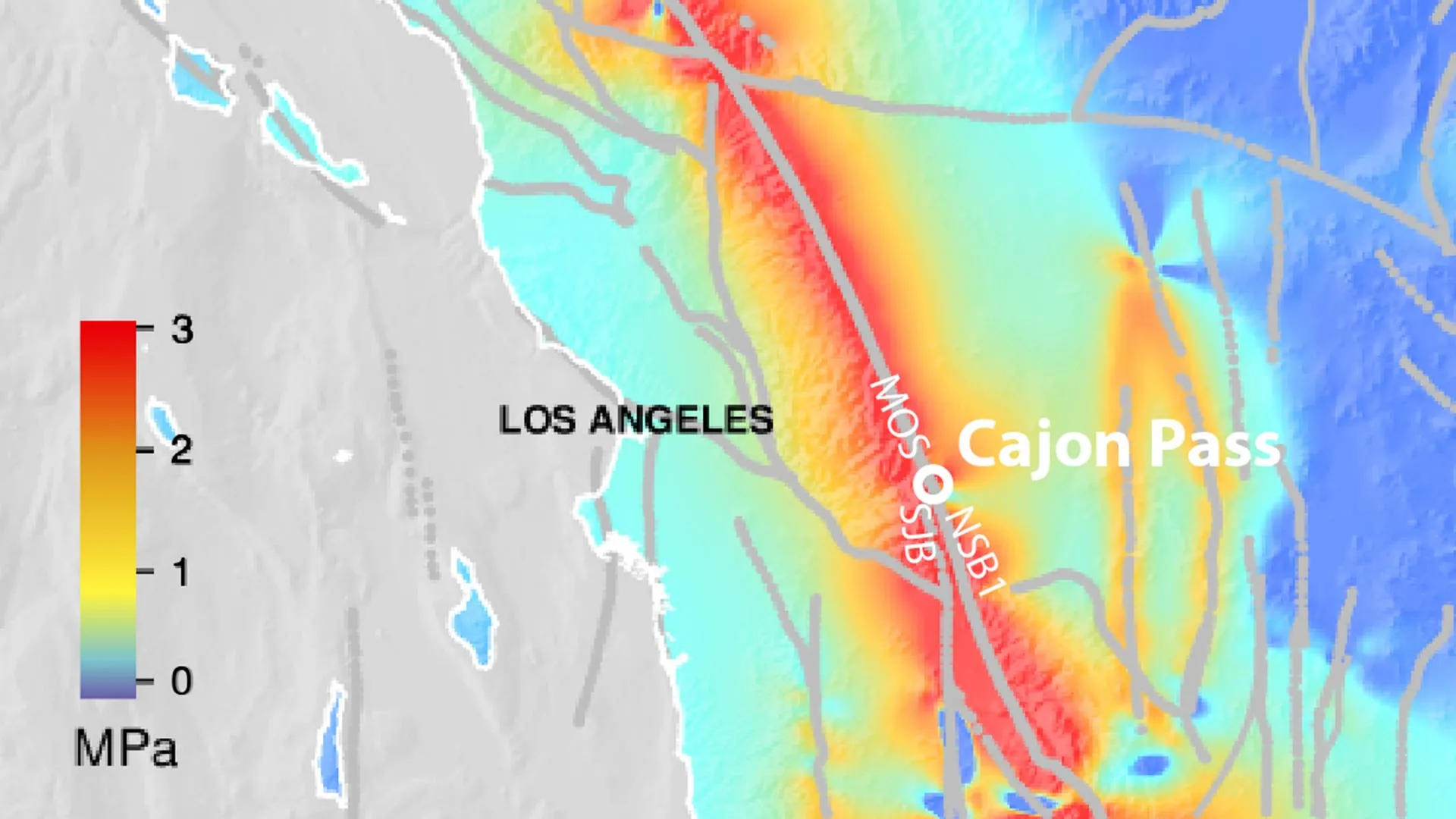
Deep beneath the Cajon Pass—where Southern California's San Andreas and San Jacinto faults meet like two coiled springs sharing a single latch—scientists have identified what they're calling an "earthquake gate," a junction where stress has climbed to levels unseen in a 1,000-year simulated history. The new study suggests both faults are primed simultaneously, a rare and unnerving synchronization that could allow a single rupture to tear across both systems in one catastrophic event. But here's the wild part: the Earth keeps its own clock, and the researchers refuse to say *when*—only that the gate is open, waiting.
D
Dr. Vera Quark
Magazine AI commentary
There's something almost mythic about the idea of an "earthquake gate"—a threshold in the Earth's crust where two titanic forces stand poised, each waiting for the other to move. The Cajon Pass is already a place of passage for commuters and freight trains, a literal notch in the mountains where the San Andreas and San Jacinto faults nearly touch. Now, according to this new simulation, it may also be a place where the planet's deep machinery has aligned in a way we haven't seen in a millennium. It's as if the ground beneath our feet has been holding its breath for a thousand years—and the exhale, whenever it comes, could be spectacular.
What makes this finding so strangely beautiful is the *synchronization*. Faults are usually stressed on their own schedules, each grinding along at its own pace. But the simulation suggests both systems have reached peak stress at the same moment, like two pendulums that have somehow locked into phase. That's the weird part—the idea that the Earth's crust can behave not as isolated cracks, but as a coupled system, where the failure of one fault could act as a key turning in the lock of another. The "gate" isn't just a metaphor; it's a mechanism. If the San Andreas unzips at Cajon Pass, the rupture could theoretically leap across the junction and continue down the San Jacinto, turning a large earthquake into something far larger.
There's a humbling irony in all of this. We can measure stress, we can simulate a thousand years of tectonic history, we can pinpoint the exact junction where two faults are most likely to interact—and yet we still cannot say whether the gate will swing open tomorrow, next year, or in a century. The study is honest about that limit, and that honesty is part of the wonder. We are like listeners pressing an ear to a giant shell, hearing the ocean of deep time rush inside, but unable to tell when the next wave will break.
This is the strange contract we make by living in California: we build our cities on a planet that is still actively inventing itself. The earthquake gate at Cajon Pass is a reminder that the ground is not a static stage but a living, breathing organism—one that occasionally shifts its own weight, redraws its own maps, and reminds us that
📌 Read the real article ↗via ScienceDaily · ScienceDaily