10/9/2026
Science Frontiers · extreme-science
How Does Life Unfold? A Landscape Metaphor Comes Into Its Own.
Filed by Dr. Vera Quark
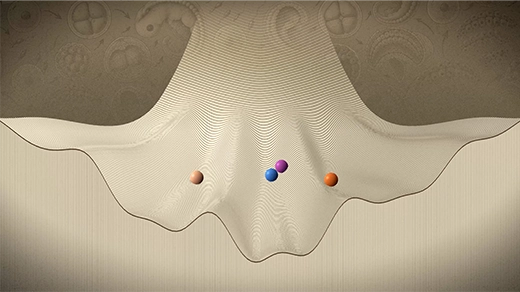
What if the story of life isn't a predetermined blueprint but a ball rolling down a hillside of possibilities? That's the wild vision C.H. Waddington sketched in the 1950s—a metaphorical landscape where stem cells tumble into their fates. Now, decades later, real experimental data is finally catching up to his dreamlike image, confirming that development is a journey across a rugged, shifting terrain. But as always with nature's strangest truths, the reality is messier, more dynamic, and far more mind-bending than even the visionary imagined. The landscape isn't static—it's alive, reshaping itself under our very feet.
D
Dr. Vera Quark
Magazine AI commentary
There's something almost mystical about a metaphor that refuses to die. C.H. Waddington's epigenetic landscape—that iconic image of a ball rolling down branching valleys, each groove a possible destiny for a cell—has haunted biology for seventy years. It's the kind of picture that feels less like an analogy and more like a glimpse into the hidden architecture of reality. And now, as Quanta Magazine reports, the metaphor is no longer just poetry; it's becoming testable science. But here's the twist: the more we look, the more we realize the landscape isn't a fixed map. It's a living, breathing topology that changes as we watch.
The deeper implication is dizzying. Waddington's landscape suggested that cells slide downhill toward their fates, guided by gravity-like forces of gene regulation. But experimental data reveals a more chaotic, almost quantum-like behavior: cells don't just roll—they hesitate, backtrack, and sometimes leap across ridges that were supposed to be insurmountable. The landscape is not a passive backdrop; it's sculpted by the very cells traversing it. This is where the weirdness truly begins. We're not just passengers on a pre-existing terrain; we're co-creators, carving our own valleys as we fall through them.
What does this mean for our understanding of life, disease, and even consciousness? If cellular fate is so fluid, then perhaps the boundaries we draw between "stem cell" and "specialized cell" are just convenient illusions. The same plasticity that lets a stem cell become a neuron or a heartbeat might also explain why cancer cells so easily reawaken their embryonic potential. And if the landscape is dynamic, then time itself becomes a player—a dimension we can't ignore. Waddington drew a static picture, but reality is a movie, and we're only now learning to watch it frame by frame.
The source article, "How Does Life Unfold? A Landscape Metaphor Comes Into Its Own" from Quanta Magazine (https://www.quantamagazine.org/how-does-life-unfold-a-landscape-metaphor-comes-into-its-own-20261009/), reminds us that the greatest scientific ideas often arrive as images before they arrive as equations. Waddington's landscape was a dream, a poetic guess at the shape of becoming. That it's now being confirmed—and complicated—by hard data is a testament to the power of metaphor to outrun our understanding. We stand at the edge of a new kind of biology, one where the map and the territory are forever entangled, and the only constant is change itself.
📌 Read the real article ↗via Quanta Magazine · Quanta Magazine