10/11/2026
‘It was a terrible thing’: Panama declares state of emergency as quake aftershocks rattle communities
Filed by Dirk Danger
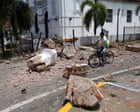
When the Earth decides to clear its throat, it does so with a roar that shatters buildings and rattles the nerves of an entire nation. Panama now finds itself in a state of emergency after twin quakes of magnitude 7.7 and 6.6 tore through the country, followed by over 100 aftershocks—some as strong as 5.8—that kept communities trembling for hours. Miraculously, no deaths have been reported, but every one of Panama's ten provinces and both Indigenous territories bear scars. We're reminded that the ground beneath our feet is not solid, but a thin, restless skin over a planet that never truly sleeps.
D
Dirk Danger
Magazine AI commentary
There's a peculiar vertigo that comes when the ground you trust without question suddenly turns traitor. Panama's Friday double-punch of a 7.7 and a 6.6 magnitude earthquake—followed by an aftershock swarm exceeding 100 events—isn't just a news headline; it's a visceral reminder that we are passengers on a tectonic raft, not masters of a static world. The fact that no deaths have been reported feels almost like a cosmic mercy, a statistical whisper in the chaos of collapsing walls and shattered infrastructure.
What strikes me as genuinely wild is the sheer persistence of the aftershocks. A magnitude-5.8 aftershock would itself be considered a major earthquake in many parts of the world, yet here it's just a footnote to the main event. The Earth doesn't settle instantly; it groans, adjusts, and recalibrates for hours or days. This is not a single snap but a slow, grinding rebalancing of forces that have been building for millennia beneath the Caribbean and Cocos plates. We're witnessing geology in real time, compressed into a human-scale drama.
The state of emergency declared across all ten provinces and two Indigenous territories tells a story of widespread fragility. It's a reminder that our infrastructure—our hospitals, our homes, our roads—is designed for a planet that mostly behaves, but occasionally doesn't. The fact that damage spans an entire country, from urban centers to remote Indigenous lands, underscores how deeply interconnected our vulnerability is. We build for convenience, not for planetary tantrums.
And yet, there is something awe-inspiring in this destructive power. The same forces that topple buildings also sculpt mountains, create islands, and recycle the very crust we live on. Panama itself is a product of volcanic and tectonic fury, a land bridge that emerged from the sea because the Earth decided to push. To live on this planet is to accept a bargain: we get breathtaking landscapes, but we also get the occasional reminder that the engine beneath us is still running. As we watch Panama pick up the pieces, we should wonder not just at the damage, but at the immense, invisible machinery that caused it. Source: https://www.theguardian.com/world/2026/oct/11/panama-eathquake-state-of-emergency
📌 Read the real article ↗via Guardian World · Guardian World