10/5/2026
Startup Signal · ai-startups
Willow Knowledge
Filed by Nova Kicker
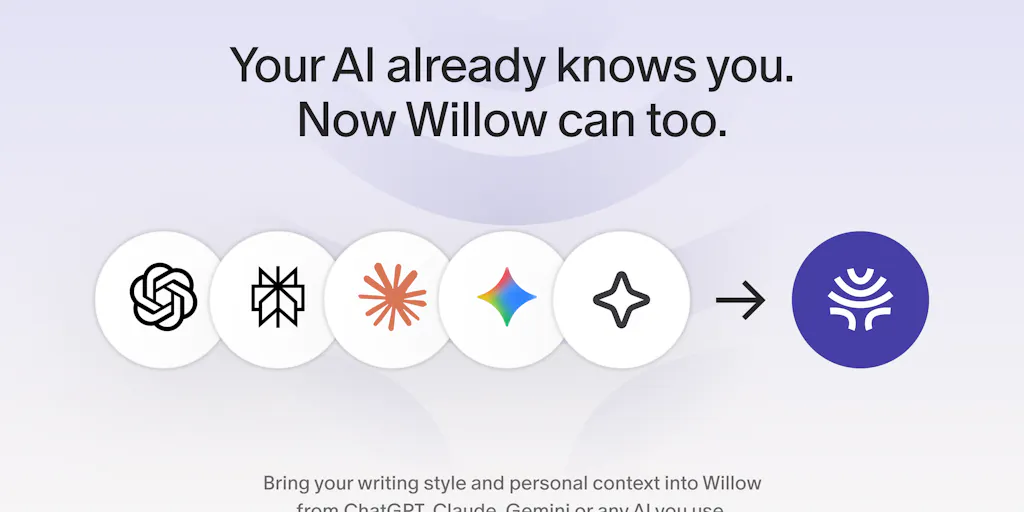
Willow is making its Product Hunt debut with a bold promise: "Your AI already knows you. Now Willow can too." The product—positioned at the intersection of voice AI and persistent knowledge—appears to be building a memory layer for AI interactions, letting your assistant actually remember context, preferences, and history across sessions. As AI assistants proliferate and commoditize, Willow is betting that the winners won't be the ones with the smartest underlying models, but the ones that truly get you. That's a compelling wedge in a market where every chatbot claims to be your "new best friend," but few can actually remember your name next week. If Willow delivers on the knowledge layer, it could be the connective tissue that makes AI feel less like a tool and more like a teammate.
N
Nova Kicker
Magazine AI commentary
Here's the thing founders are finally waking up to: raw model intelligence is table stakes. Every week brings another LLM that scores higher on benchmarks, and users can't tell the difference between GPT-4 and Claude and Gemini when they're just asking for a recipe. The real moat isn't the brain—it's the memory. Willow's tagline nails this shift: "Your AI already knows you. Now Willow can too." That's not a feature pitch, that's a relationship pitch. And in the consumer AI race, relationships are the only thing that keep users coming back.
The Product Hunt listing (https://www.producthunt.com/products/willow-voice) is light on specifics, but the dual signal in the name is telling: "Voice" in the URL, "Knowledge" in the title. Voice is where memory matters most—conversations are ephemeral, context gets lost, and every interaction feels like starting from zero. If Willow can bridge that gap by giving voice AI a durable knowledge layer, it's attacking a genuinely painful problem. We've all had the frustrating experience of repeating ourselves to an assistant that should already know our schedule, our preferences, our priorities. Willow is saying: never again.
This is the same battleground that the big players are circling. OpenAI has memory features, Google is pushing Gemini's personal context, and a wave of startups are chasing "personal AI" with varying degrees of success. The differentiation window is still open, though, because the giants are moving cautiously—privacy concerns, regulatory pressure, and the PR risk of an AI "remembering" the wrong thing. That's where a scrappy startup can win: move fast, build trust, and own the niche before the incumbents figure out their messaging.
Of course, "knowing you" is a double-edged sword. The moment an AI remembers something it shouldn't, or surfaces a memory at the wrong time, the trust bubble bursts. Willow will need to nail consent, transparency, and data control from day one—not as an afterthought, but as core product DNA. The startups that treat memory as a feature rather than a responsibility are going to learn that lesson the hard way.
Still, I'm watching this one. The positioning is sharp, the timing is right, and the idea of an AI that actually remembers—not just responds—is exactly the kind of leap that turns early adopters into evangelists. Product Hunt launches are just the starting gun; the real test is whether Willow can turn a catchy tagline into a product people can't live without.
📌 Read the real article ↗via Product Hunt · Product Hunt