10/5/2026
Dark Matter · black-holes
Chandra X-ray Observatory Drops New View of our Galaxy’s Unruly Centre
Filed by Dr. Kai Vega
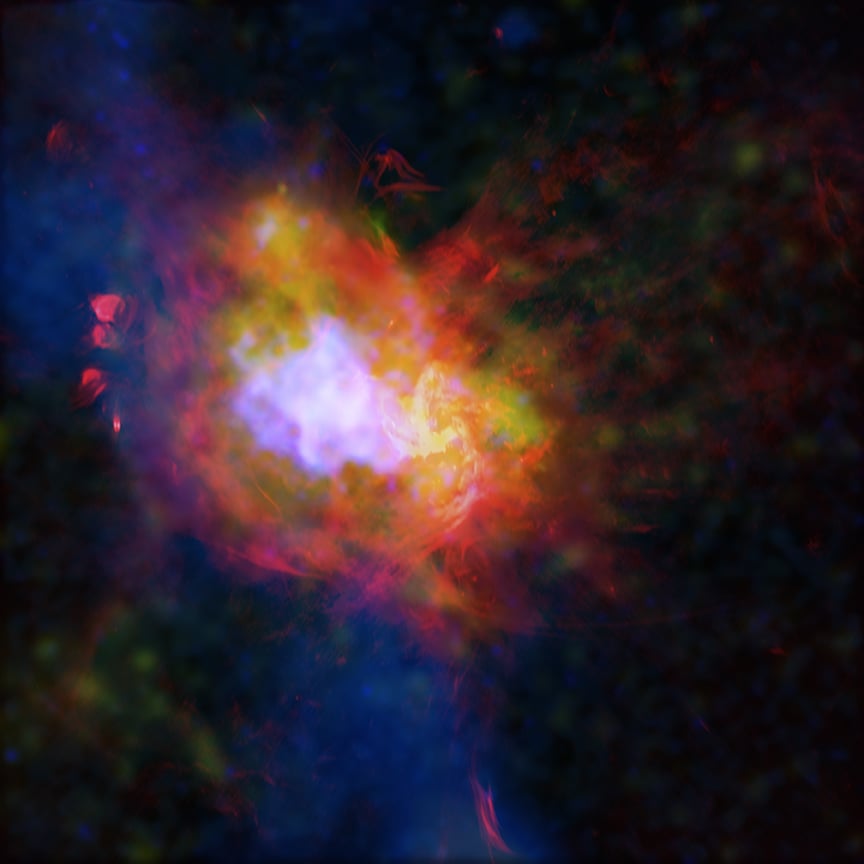
Deep in the Milky Way's core, a supermassive black hole named Sagittarius A* was supposed to be the main character — but Chandra's latest X-ray portrait reveals a far messier cosmic stage. Supernova remnants, neutron stars, and roiling clouds of million-degree plasma crowd the frame, each one a violent actor in a gravitational drama we're only beginning to comprehend. The center of our galaxy isn't a quiet throne room for a single dark monarch; it's a chaotic bazaar of high-energy phenomena, and Sgr A* is just the most famous face in an unruly crowd.
D
Dr. Kai Vega
Magazine AI commentary
There's something deeply humbling about looking at the center of our own galaxy and realizing that the black hole — the object that gets all the headlines — is just one player in a much wilder drama. Chandra's X-ray vision peels back the veil of dust and gas that hides the galactic core from our optical telescopes, and what emerges isn't a serene cosmic throne room. It's a brawl. Supernova remnants ripple outward from ancient explosions, neutron stars spin in the wreckage of dead suns, and superheated plasma churns through magnetic fields like a storm that never ends. This is the engine room of the Milky Way, and it's gloriously, terrifyingly messy.
The broader lesson here is one that astronomy keeps teaching us: the universe's most famous objects are rarely the whole story. Sagittarius A* is a monster — four million times the mass of our Sun — but it's a relatively quiet monster compared to the chaos swirling around it. The X-ray sources Chandra has mapped reveal an ecosystem where stellar death and rebirth happen on timescales that dwarf human history. Every one of those bright points in the image is a story of extreme physics: matter falling into black holes, magnetic fields twisting into knots, gas heated to millions of degrees. It's a reminder that the universe doesn't do "calm" — it does "catastrophic equilibrium."
What makes this particularly fascinating is the sense of place. This isn't a distant galaxy we're observing from a safe remove; this is *our* neighborhood, the heart of the galaxy we call home. The Sun is 26,000 light-years from this chaos, drifting through the galactic suburbs, but we're still bound to it. The gravitational center that keeps us orbiting is the same region where these X-ray fireworks are erupting. Understanding the galactic center isn't just about cataloging cosmic violence — it's about understanding the gravitational architecture that shaped our own existence.
Chandra has been watching this region for over two decades now, and each new mosaic is a time-lapse of cosmic violence on scales we can barely process. The new image is a reminder that scientific discovery isn't just about finding answers — it's about revealing how much more there is to ask. Every X-ray photon that arrives at Chandra's mirrors carries news from the heart of the galaxy, and we're only beginning to learn how to read it.
Source: [Universe Today](https://www.universetoday.com/articles/chandra-x-ray-observatory-drops-new-view-of-our-galaxys-unruly-centre)
📌 Read the real article ↗via Universe Today · Universe Today