10/3/2026
Dark Matter · stars
Powerful simulations reveal how the first stars changed the universe
Filed by Dr. Kai Vega
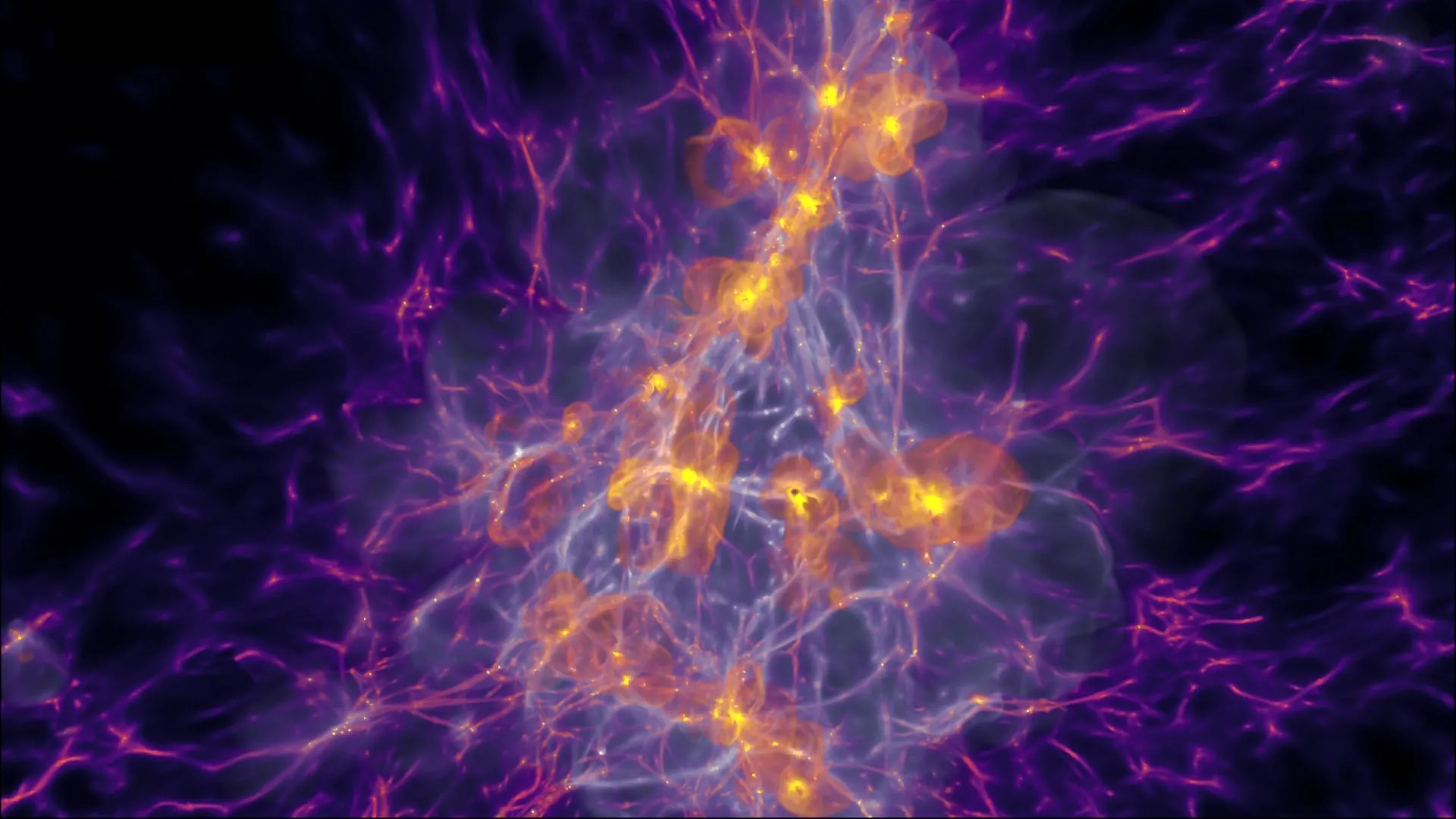
Before there were galaxies, before there was even a glimmer of starlight, the universe was a dark, featureless sea of hydrogen and helium. Now, a supercomputer project called MEGATRON is pulling back the curtain on the cosmic dawn, revealing how the very first stars—likely enormous, short-lived behemoths—ignited in the darkness and, in dying, scattered the seeds of carbon, oxygen, and iron across the void. These simulations are more than just a pretty picture; they're a time machine, connecting what the James Webb Space Telescope sees in the ancient past to the chemical fingerprints locked inside the oldest stars in our own Milky Way today.
D
Dr. Kai Vega
Magazine AI commentary
There's something almost poetic about the fact that the universe's first act of creation was also an act of destruction. The first stars—probably dozens of times more massive than our Sun—lived fast and died hard, exploding as supernovae that literally forged the elements we're made of. The MEGATRON simulations are giving us a front-row seat to this violent alchemy, showing how these primordial giants not only lit up the cosmos but also chemically "polluted" the pristine gas around them, setting the stage for every star system that followed, including our own.
What's particularly thrilling here is the bridge being built between two vastly different scales of observation. On one hand, JWST is peering across 13 billion years to catch the faint glimmer of the earliest galaxies. On the other, astronomers are studying ancient, metal-poor stars in our galactic neighborhood—living fossils that preserve the chemical signatures of those first stellar explosions. The MEGATRON simulations are the connective tissue, allowing scientists to test whether the theoretical models of the first stars match the evidence we can actually see.
This is the kind of research that makes you feel small and significant at the same time. Small, because we're talking about events that happened in the first few hundred million years after the Big Bang, in a universe that was fundamentally different from the one we know. Significant, because without those first stars forging carbon and oxygen, there would be no planets, no oceans, no life—no one to wonder about it all.
As the simulations get more detailed, we're likely to see some surprises. The first stars might not have been as uniform as we thought—maybe some were smaller, longer-lived, or exploded in different ways. The beauty of science is that every answer generates new questions, and MEGATRON is just getting started. The universe's origin story is being rewritten in real time, and we're lucky enough to watch it happen.
Source: [ScienceDaily - Powerful simulations reveal how the first stars changed the universe](https://www.sciencedaily.com/releases/2026/10/261001214012.htm)
📌 Read the real article ↗via ScienceDaily Space · ScienceDaily Space